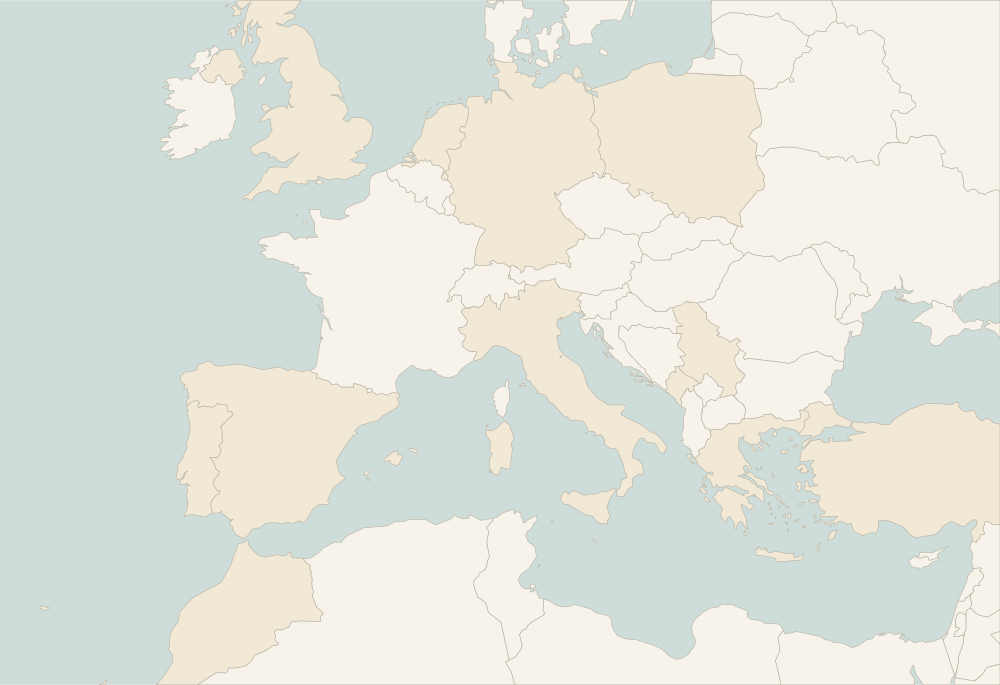
Italy is planned around one railway. Milan, Bologna, Florence, Rome and Naples sit on a single high-speed line: Milan to Rome takes about 2 h 55, Rome to Florence about 1 h 32, to Naples 1 h 10, and Venice, on a branch, is 3 h 45 from Rome. Everything off that line — Positano, Matera, Siena, the Tuscan hills — means changing to a bus, a local train or a car.
A week holds two cities on the line and one trip off it. Rome and Florence are the classic pair, and Siena works as a day from Florence: the 131R bus takes 1 h 15 and stops at the edge of the old town. The north combines differently — Milan, Bologna and Venice, with the lakes as a trip out of Milan.
Where next
Cities and places in Italy
Each place has its own page — what makes it worth the detour, and how long you need.
The south takes longer than the map suggests. There is no train to Positano: Curreri bus to Sorrento, then SITA bus to Positano, about 2 h one way. Matera is further still: from Bari SITA Sud/Cotrap bus, line 900, about 1 h 15 one way, so it needs at least one night.
Italy is in the eurozone: prices are in euro (EUR), cards everywhere, cash at markets. Tip not required; round up. A restaurant bill often also carries coperto (cover charge), €1–4 per person, a fixed charge for cutlery, tablecloth and bread that must be listed on the menu and sits apart from the tip. For entry, Schengen, EES active, ETIAS delayed.
Anyone renting a car needs to know about ZTL zones in city centres, cameras, fines by post: the historic centres of Rome, Florence, Milan and other cities are closed to vehicles without a permit, cameras read every plate, and the fine arrives by post weeks later. On the motorway, per section, no vignette. Accommodation often adds tourist tax set by each municipality, €1–10/night on top of the room rate, paid at check-out.
Blog
Stories from Italy
How it actually was when we were there, and what was worth it.
The most in the world, one more than China. The list holds not just buildings but whole historic centres — Rome, Florence, Naples and Siena — and the cave districts of Matera.
The food is regional, not national
Carbonara is Roman, ragù is from Bologna, pesto from Genoa, and the art of the Neapolitan pizzaiuolo has been on UNESCO's intangible heritage list since 2017.
Two companies on one line
The high-speed line is run by the state's Trenitalia (Frecciarossa) and the private Italo, so a ticket for the same route and hour can be priced in two places.
Two countries inside Italy
The Vatican in Rome, the smallest state in the world, and San Marino on its hill above Rimini.
The largest masonry dome
Brunelleschi's dome on Florence cathedral, built from 1420 to 1436, is still the largest vault of stone and brick in the world — 55 metres across on the outside.
Vesuvius is a live volcano
It last erupted in 1944. Pompeii, which it buried in AD 79, is reached from Naples on the Circumvesuviana suburban railway.
What to see
Five places for a first visit
This isn't a ranking — it's a route. Any one of these could carry a whole trip.
01
Rome
For a first visit to Italy and for antiquity: the Colosseum, the Forum, the Pantheon and the Vatican in one city, with three or four days needed for them. It sits in the middle of the high-speed line, which makes it the best base when a trip splits between north and south.
02
Florence and Tuscany
For the Renaissance and the vineyards in one trip. The city takes two days, four with Siena and the hills. Without a car, pair Florence with Siena; Val d'Orcia and the hill villages need a car or an organised tour.
03
Venice
The end of the railway and the end of the road for cars: from Santa Lucia station you go on foot or by vaporetto. Two or three days for the city and one for the lagoon islands. Not for anyone dragging big suitcases — almost every bridge has steps.
04
The Amalfi Coast
For the sea and the paths above the coast, in May–June or September. Positano is the base for the western stretch, Amalfi for Ravello above it. If hairpin bends are not for you, take the boat in season rather than the bus — the road is cut into the cliff and full in summer.
05
Milan and the northern lakes
The practical way into the north. The city needs a day or two, and the lakes are a regional train away: Como in 37 minutes from Centrale, Varenna in just over an hour. For the lake without the rush, sleep on the shore and do Milan as the day trip.
Did you know
Two things you probably did not know
History
Italy as a state is younger than the United States: it was unified in 1861, and Rome was only annexed in 1870. Until then the peninsula was a dozen kingdoms, duchies and papal lands.
Geography
Italy has more UNESCO World Heritage sites than any other country. It also contains two foreign states, San Marino and the Vatican, and one Italian municipality, Campione, lies inside Switzerland.
Short answers to what people ask most before setting out.
Should you buy train tickets in advance?
For high-speed trains, yes: the Frecce use variable pricing, so a Rome–Florence ticket bought months ahead costs several times less than on the morning of travel. Regional trains have fixed fares; a paper ticket must be validated in the machine on the platform before boarding, while one bought online is tied to the chosen train and needs no validation.
Do you need a car for Tuscany?
Not for Florence and Siena — a bus runs between them. For Val d'Orcia and the hill villages, yes, because public transport there doesn't serve sightseeing. Pick the car up when you leave Florence, not when you arrive, because you can't drive into the centre.
Which airport should you fly into?
By region rather than by fare: Rome for Rome and Florence; Milan, Bologna or Venice for the north; Naples for Amalfi; Bari for Matera.
Do you need cash in Italy, and what's the coperto?
Cards work almost everywhere: cards everywhere, cash at markets. Tip not required; round up, and coperto (cover charge), €1–4 per person is a separate line for the table and bread that must appear on the menu. For cars, ZTL zones in city centres, cameras, fines by post applies in historic centres and per section, no vignette on the motorway.
Canal Grande from Rialto bridge SW —
This Photo was taken by Wolfgang Moroder.
Feel free to use my photos, but please mention me as the author and se, CC BY-SA 3.0
Amalfi vista dal mare 2 Campania —
This Photo was taken by Wolfgang Moroder.
Feel free to use my photos, but please mention me as the author and se, CC BY-SA 3.0
Manarola NW Cinque Terre Sep23 A7C 07233 —
This Photo was taken by Timothy A. Gonsalves. Feel free to use my photos, but please mention me as the author. I wo, CC BY-SA 4.0
All photographs come from Wikimedia Commons and are used under the licence stated beside each one.
We're not spying on you. We only count which pages get read (Google Analytics), so we know what's worth writing next. No names, no ads that follow you around the web, and we never sell data. One click helps us a lot. Privacy policy