



01
Tarangire
Tarangire is baobab country, and in the dry season from June to October the elephants come to the river in herds of more than 300. It is the easiest first stop from Arusha and the one where the landscape looks most like the postcard.
The Serengeti, Kilimanjaro and Zanzibar in one country — and three different bills: the safari by the day, the mountain by the night, the island by the ferry
Tanzania is the country where you pay before you pack. The e-visa comes first, then the compulsory insurance, then park fees by the person and the day. The Ngorongoro crater is charged by the vehicle, so most of the safari bill is settled while you are still at home. Add Kilimanjaro and a Zanzibar ferry, and one holiday becomes three budgets that share an airport.
Visa rules depend on your passport, and for most travellers the answer is the e-visa through the official immigration portal, €43 for a single entry. Apply early rather than on the plane. Since 1 October 2026 the compulsory travel insurance covers the whole country, at €38 per adult. One policy works on both sides of the water, because the mainland scheme is run by NIC and Zanzibar's by ZIC, and residents of EAC and SADC states are exempt. Buy it online beforehand. A yellow fever card matters only if you arrive from a country with the risk, so read the transit rules of your connecting airport before you book.
Each place has its own page — what makes it worth the detour, and how long you need.
All 298 places we write about sit on one page — narrow them down by continent, country, price or what you are travelling for.
The northern circuit starts in Arusha, 55 km and about 1 h 20 by road from Kilimanjaro airport, and operators sell it in a slightly different order every time. A sensible loop runs to Tarangire (109 km, 2 h), then Lake Manyara (120 km, 2 h 15), then a night in Karatu. The Ngorongoro gate opens at 6, and you want to be on the crater floor before the traffic from Karatu arrives. From the crater it is 135 km and about 3 h 30 to the central Serengeti. Serengeti entry is €61 per person per day before 18 % VAT. Ngorongoro is €61 with VAT already inside it, and the descent adds €255 per vehicle. A group camping safari runs €217–347 a day and a mid-range lodge €390–693, with park fees in the package, so the lodge costs roughly twice the camp. Driving yourself is possible in the Serengeti, and drivers who go into the crater take a ranger aboard.
Two weeks fit if you stop trying to see everything: six days on safari, then Zanzibar for the rest. Do the bush first and the beach second, because after a week of 6 a.m. starts and red dust the ferry feels like a prize. Kilimanjaro does not squeeze into the same fortnight. It is a separate trip with its own bill. Seven days on the mountain mean park fees of €839 with VAT, and a summit success rate of 80 to 90 per cent against 40 to 60 on five or six days. Dar es Salaam works best as a connection. The Azam ferry to Zanzibar costs €30 and takes 1 h to 1 h 20, and the flight takes about 25 minutes.
Both sites fill in your nearest airport for you; change it in one click.
Buy the plan before you go and switch it on when you land.
Check the same room on both sites: price and cancellation terms can differ.
How it actually was when we were there, and what was worth it.

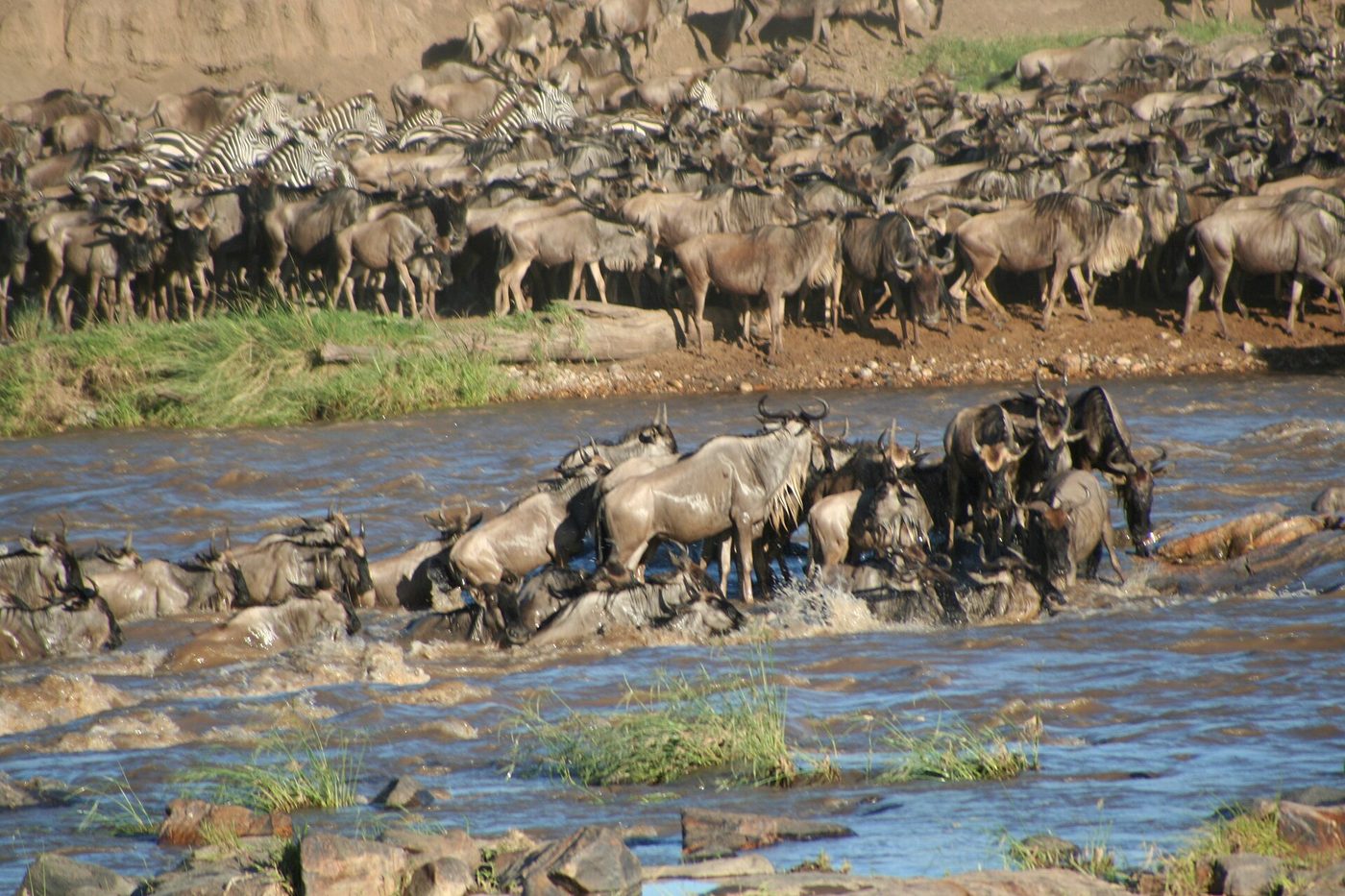
Where the herds are each month is known, the day of a river crossing is not, and the number in the brochures dates from the 1970s, while satellites found under six hundred thousand in August.

On Zanzibar two beaches ten kilometres apart do not have the same sea. The reason is not the hotel but the tide, and no photograph shows it.

Kilimanjaro is not decided by who is fit but by who may go to altitude and how fast their sleeping height rises. Both are known before you pay for the climb.

For Tanzania, a travel eSIM is installed at home, while a local SIM means a passport and a fingerprint at a counter.
Ngorongoro is often described as the largest intact, unflooded caldera in the world. The crater is about 19 km across, the walls rise to roughly 600 m, and the floor covers some 260 km². Estimates put around 25,000 large animals down there, which explains why the road in at dawn is busier than the road out at noon.
Kilimanjaro stands 5,895 m, alone on the plain, with no range to hide behind. Its glaciers covered 11.4 km² in 1912 and 1.76 km² in 2011, a loss of about 85 per cent. A 2013 study expects what remains on the plateau and southern slopes to be gone by around 2040, and nothing at all after 2060.
Sultan Said moved his capital to Zanzibar in 1840, and Stone Town grew rich on cloves and on people. The slave market closed in 1873, and Christ Church cathedral went up on its site. Guides say the high altar stands where the whipping post used to be, which is a hard thing to hear and a harder one to forget.
Tanganyika and Zanzibar joined in 1964, and the name is a blend of the two. It is the tidiest bit of diplomacy in the region: two names, one word, and a map that still treats the islands as a country within a country.
Freddie Mercury was born in Stone Town in 1946 as Farrokh Bulsara, into a Parsi family. The house on Kenyatta Road is now a small museum with photographs and a black piano in one room. Sources disagree on how much of his childhood was spent here, so keep the claim modest.
The Anglo-Zanzibar War began on 27 August 1896 and lasted 38 minutes by most counts, though some accounts say 40 or 45. The British fleet shelled the palace, and the sultan took refuge in the German consulate. The whole affair is shorter than most ferry queues in Dar es Salaam.
This isn't a ranking — it's a route. Any one of these could carry a whole trip.
Tarangire is baobab country, and in the dry season from June to October the elephants come to the river in herds of more than 300. It is the easiest first stop from Arusha and the one where the landscape looks most like the postcard.

Lake Manyara is a shallow soda lake that covers about two thirds of the park, and the flamingos depend on the water level. More than 400 bird species are on the list, and the lions are said to climb trees, though nothing guarantees you will see one up there. The village of Mto wa Mbu by the gate has a market.

Nyerere National Park was carved out of the northern part of the Selous in 2019. The best way in is by boat on the Rufiji river, among hippos, crocodiles and birds, and the dry season is the better time. It gives you a safari without a single minibus queue.

Pemba is half an hour by plane from Stone Town and gets fewer visitors than Unguja. Divers rate it above its neighbour, with Misali island in the Pemba Channel Marine Conservation Area as the main site, best from June to September and January to March. The clove harvest runs from July to December.

Mafia is the quiet island: a few lodges, no market, and whale sharks that stay all season from October to March. A survey in 2012 and 2013 counted 5.1 per outing on average and 8.2 in December, so December is the month to book.
The name Tanzania is a portmanteau: it was formed in 1964 when Tanganyika and Zanzibar merged into one state. The first three letters come from one name and the next three from the other.
Tanzania holds both Africa's highest point, Kilimanjaro, and part of the continent's deepest lake, Tanganyika, at 1,470 metres. The bed of that lake is over six hundred metres below sea level.
Short answers to what people ask most before setting out.
It depends on your passport. Where a visa is required, the e-visa from the official immigration portal costs €43 for a single entry. On top of that comes the compulsory insurance of €38 per adult since 1 October 2026, one policy for the mainland and Zanzibar. A yellow fever card is needed only when you arrive from a risk country.
Count it by the day. Park entry is charged per person, the crater per vehicle, and operators price the rest as a package that comes to €217–347 a day in a camp and €390–693 in a lodge. Climbing Kilimanjaro is a separate line, with park fees of €839 for seven days.
Yes, if Kilimanjaro stays out of it. Spend six days on the northern circuit, then fly or take the ferry to Zanzibar for the rest, with the sea last and the dust first. Stone Town deserves a day: Darajani market in the morning, the Old Fort and the cathedral in the heat, sunset at Forodhani.
Keep going — these destinations and stories pair well with this one.

A safari charged by the day, not by the trip, and a reserve whose gate fee doubles in July

An island where you do not choose a hotel but a coast: west for sunsets and calm sea, north for restaurants and nightlife, east for long beaches, south for the wind kitesurfers come for

A country of long distances and reversed seasons, driven on the left throughout
The whole of Tanzania fits into one query — six questions and you know which of them suits you.
Leave your email and we'll let you know when a new destination or story goes up.
All photographs come from Wikimedia Commons and are used under the licence stated beside each one.