Skip to content
Nomadinho
SR EN
Destination

Tunisia

Ten towns in a line, from the capital to the sand at Tozeur — in the order they're actually travelled, not listed

Arabic and French
Currency
Tunisian dinar (TND)
Language
Arabic (official), French widely used
Entry
EU/UK/US: 90 days visa-free
Tunisia
Tunisia · Mstyslav Chernov, CC BY-SA 3.0

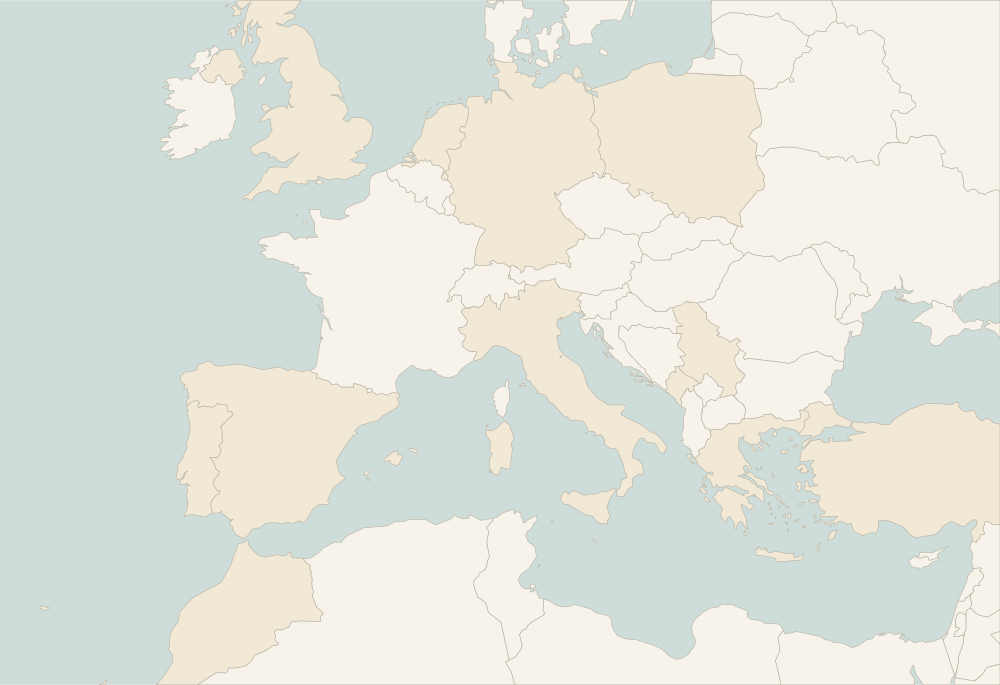
Tunisia here splits into ten towns strung out from the northern coast to the sand in the south: Tunis and Sidi Bou Said at the entry point, Hammamet, Sousse, Monastir and Mahdia in the Sahel, Kairouan and El Jem inland, then Djerba and Tozeur at the end, on the edge of the Sahara. The text follows that order, north to south, without doubling back.

Entry is simple for most passports: EU/UK/US: 90 days visa-free, with nothing to fill in beforehand. The country is best crossed in one direction, from the northern coast to the sand in the south: the capital and its surroundings, then the Sahel along the middle of the coast, then the south where the Sahara starts to take over.

Where next

Cities and places in Tunisia

Each place has its own page — what makes it worth the detour, and how long you need.

The full list

All 277 places we write about sit on one page — narrow them down by continent, country, price or what you are travelling for.

That line runs through ten towns, in the order most people actually travel it. Tunis is the point of entry and the largest city; the TGM train reaches Sidi Bou Said from there, a blue-and-white hill town over the bay. Hammamet comes next heading south-east, the first of the Sahel's resort towns; Sousse is the largest of them, with a UNESCO-listed medina and a transport hub with trains and louages running further south. From Sousse, Kairouan and its Great Mosque lie an hour and a half west, inland; further down the coast come Monastir and Mahdia, linked by the Sahel Metro. El Jem stands alone on the inland plain, an hour from Sousse, visited in passing on the way south or back to the coast. From there the route continues: Djerba is an island joined to the mainland by a causeway and a ferry, the last stop before the desert, and Tozeur is the gateway to the Sahara — an oasis town from which the desert settlements of Matmata or Douz are reached. The Sahara is worth at least one night away from any town — a quick pass through Tozeur isn't enough.

The Tunisian dinar cannot be taken out of the country and is not bought in advance: it is changed only on arrival, at the airport or a bank, at a rate that is €1 = 3.3699 TND and the same everywhere, and the surplus is changed back at the end with the exchange receipt. Cards work in hotels and larger shops; markets, taxis and tickets at smaller sites want cash. The major sites stay cheap: Carthage €6, El Jem €6 — a few euros each, while in neighbouring Egypt tickets do eat into the budget.

Blog

Stories from Tunisia

How it actually was when we were there, and what was worth it.

What it's known for

Six things Tunisia means

Carthage was a bigger city than Rome

Before the Third Punic War Carthage had around half a million people and a harbour for two hundred warships. Rome levelled it in 146 BC, then rebuilt it a century later as a Roman city — what you see today is Roman Carthage, not Hannibal's.

The amphitheatre at El Jem held 35,000

The third largest in the Roman world, built in the 3rd century in a town that may have had as many residents as the arena had seats. It stands in the middle of a plain with nothing around it, which is why it feels bigger than the Colosseum although it is not.

The Arab Spring started here

A fruit seller's self-immolation in Sidi Bouzid in December 2010 set off protests that removed the president within a month, then a wave through the whole Arab world. Tunisia is the only country of that wave that came out of it with free elections.

The Bardo holds the largest collection of Roman mosaics anywhere

The museum in the former bey's palace keeps floors from Roman villas across the country, including the only known portrait of Virgil. It closed after the 2015 attack and reopened in 2023.

Star Wars was filmed in the Sahara near Tozeur

Tatooine took its name from the Tunisian town of Tataouine, and the Mos Espa sets still stand in the sand at Ong Jemel. The houses at Matmata, dug into the ground to stay cool, are Luke's home — and people still live in them.

A country without oil in a region full of it

Tunisia has neither Libya's oil nor Algeria's gas, so tourism has been its main source of hard currency since the sixties. That explains both the quality of the coastal hotels and how hard the country works for every charter.

What to see

Five places for a first visit

This isn't a ranking — it's a route. Any one of these could carry a whole trip.

Matmata
01

Matmata

Houses dug into the ground around a round courtyard, to stay cool in summer and warm in winter; some are still lived in, one is the hotel where Star Wars was filmed. On the road to the Sahara, an hour from Gabès. Done in passing, not as a destination.

Dougga
02

Dougga

The best preserved Roman town in North Africa, on a hill two hours from Tunis: capitol, theatre, houses with mosaics and streets you walk as if paved yesterday. There is almost nobody. Go with a driver or a hire car.

Kelibia and Cap Bon
03

Kelibia and Cap Bon

The peninsula east of Hammamet: a fortress over the harbour, El Mansoura beach with the clearest water on the coast, and a shore road driven in one day. The vineyards are here too — Tunisia has made wine since Carthage.

Bizerte
04

Bizerte

Africa's northernmost town, with an old harbour lined with coloured houses and a medina facing the canal. An hour from Tunis by train. There are no all-inclusive hotels here, so the coast is different — the beaches are town beaches, full of local people.

Did you know

Two things you probably did not know

History

The Arab Spring began in Tunisia in December 2010, after the street vendor Mohamed Bouazizi set himself on fire in protest. Within a month the president who had ruled for twenty-three years had left the country.

Geography

Tunisia is the northernmost part of Africa: Cape Angela is the continent's northernmost point. A hundred and fifty kilometres of sea separate it from Sicily.

All the facts →

Frequently asked

Before you go

Short answers to what people ask most before setting out.

Does the same time of year suit a whole trip through Tunisia?

Not quite: the Sahel around Sousse and Hammamet is best June and September, while the south and the Sahara at Tozeur are best October–April — summer temperatures there make sightseeing exhausting. Anyone combining the coast and the Sahara in one trip picks a compromise date, usually spring or early autumn.

How do you travel between the ten towns?

By train and louage along the main line: Tunis–Sidi Bou Said on the TGM train, Tunis–Hammamet–Sousse by train or louage, Sousse–Monastir–Mahdia on the Sahel Metro, Sousse–El Jem by train or louage. South of El Jem, towards Djerba and Tozeur, louages still run, but a car or an organised tour becomes the more practical choice for the leg into the Sahara.

Can you buy dinars before you travel?

No. The dinar cannot leave Tunisia and is changed only on arrival, at the airport or a bank, at a rate that is €1 = 3.3699 TND and the same everywhere. Keep the exchange receipt — without it the surplus is not changed back at the end.

Plan the trip

Ready for Tunisia?

Checked at the source9 facts on this page carry a source and a check date.All sources →
Where next

If you liked this

Keep going — these destinations and stories pair well with this one.

On the map

Tunis, Sidi Bou Said, Hammamet and Sousse, and so on

The whole of Tunisia fits into one query — six questions and you know which of them suits you.

Not sure where to next? Six questions and you get places that actually suit you. Find me a destination

Front row for the next trip

Leave your email and we'll let you know when a new destination or story goes up.

Photo credits and licences (25)

All photographs come from Wikimedia Commons and are used under the licence stated beside each one.