

Djerba
An island joined to the mainland by a Roman causeway, with the oldest synagogue in Africa, a potters' village, and hotels on one shore while the island behind them lives its own life
- When to go
- October 24° · 2 rainy days
- Per day
- €€€price 3 of 5
- How many days
- 7days
- For you
- 6 questions →
- Nearest airport
- 7 km Djerba · 95 km Sfax
- Right now

Djerba is southern Tunisia: warmer and flatter than the coast around Sousse, with hotels strung along the east shore and the rest of the island given over to villages, olives and palms. The sea stays swimmable longer here than anywhere else in the country, and Matmata and Tataouine, troglodyte villages two hours across the causeway, are a day trip no other resort on the coast has.
The hotel zone is one strip on the east shore, from Sidi Mahrez to Aghir, with a beach some twenty kilometres long and a sea that stays shallow a hundred metres out — good for children, harder work for swimmers. The rest of the island is a different town: Houmt Souk in the north has a fish-auction market, a fishing harbour and the Borj el Kebir fort; the villages between it and the hotels have white houses and minaret-less mosques that look like small fortresses; and the olive groves hold menzels, the traditional courtyard houses. The island is flat, so a bicycle or a hired scooter crosses it in a single day.

The El Ghriba synagogue in the village of Erriadh is the oldest in Africa: tradition holds that a stone from Solomon's temple is built into it, and the Jewish community on Djerba is one of the few in the Arab world to have existed without interruption. You enter with your head covered and a small voluntary donation, and opening hours shift around holidays — it is worth checking before you go whether it is open. Guellala in the south is the potters' village, with workshops that still work as they did a century ago and a museum of tradition on the hill above them.
This trip is not the true Sahara of dunes — that is Douz, the two-day version from here — but troglodyte villages and ksour: across the seven-kilometre Roman causeway to Matmata with its underground houses, then on to Tataouine and Chenini, a cliff village with granaries that were a film set before they were a landmark. It is done in a day with a driver, ten hours, and that is the reason to pick Djerba over Sousse for this trip. The two-day version continues to the real dunes and a night in the desert near Douz.
Guides for Djerba
Shorter, practical pages for one concrete question each — how many days, how much money, where to sleep, where to escape the city.

Djerba in 2 days
→The two days left once the beach is set aside: the island's north with its market and synagogue on day one, then across…

Day trips from Djerba
→All three variants cross the same Roman causeway and then branch further into the desert — the further you go, the…

Where to stay in Djerba
→The hotel zone in the east, Houmt Souk with its funduqs in the north, or Midoun and the villages between them — three…

What Djerba costs
→Djerba costs little on sights — the market, the synagogue, Djerbahood and the beach are close to free — and the bill…

Djerba behind the façades: a tower of skulls and a settlement with no centre
→A fortress that carried a pyramid of skulls after one battle, and an island that never had a real capital because every…

What to eat in Djerba
→Fish from the Houmt Souk market, a tajine baked in a clay dish and harissa that sits on every table for free — food on…

The best time to visit Djerba
→Djerba has a long season: sea from May to the end of October, the pilgrimage in May, charter crowds in July and August…

Getting around Djerba
→A short taxi ride from the airport, and around the flat island a taxi, a hired scooter or a bike — the town bus still…
What to see in Djerba
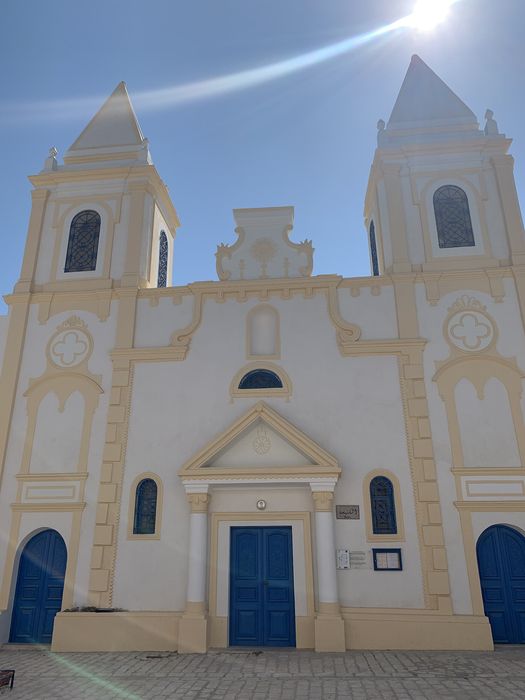
Houmt Souk
The main town with a fish-auction market, the Borj el Kebir fort by the sea and the funduqs — former caravanserais turned into courtyard hotels. Go in the morning for the market; a taxi from the hotel zone is about fifteen minutes.
free
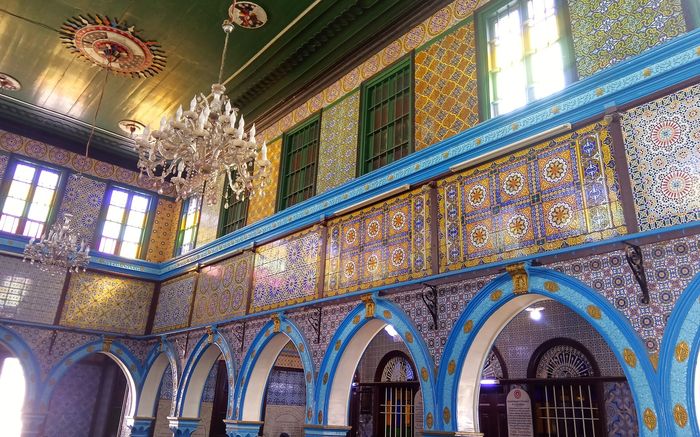
The El Ghriba synagogue
The oldest synagogue in Africa, in the village of Erriadh, with blue tiles and a 19th-century interior on foundations tradition holds are older. Head covered, a donation, and quiet — except in May, when the Lag BaOmer pilgrimage brings thousands of people and heavier security.
free (donation welcome) · 30–60 min · closed varies around holidays and the pilgrimage
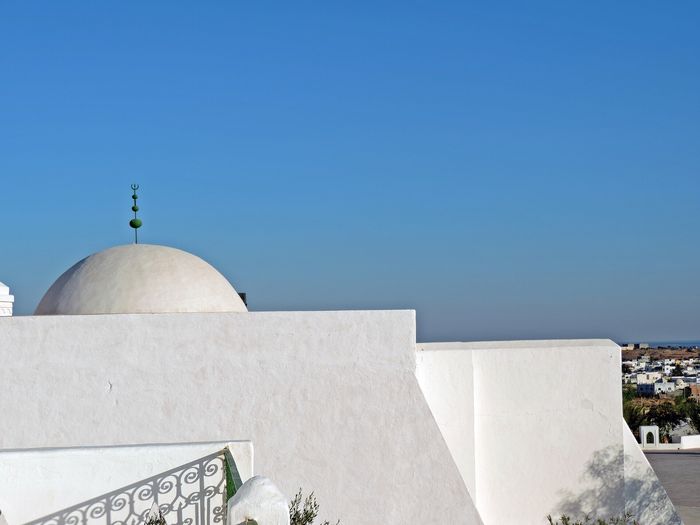
Guellala
The potters' village in the south, with workshops that still fire jars in kilns as they did a century ago, and a museum of tradition on the hill above them. Buy in the workshop, where you also see how a jar is made.
village and workshops free
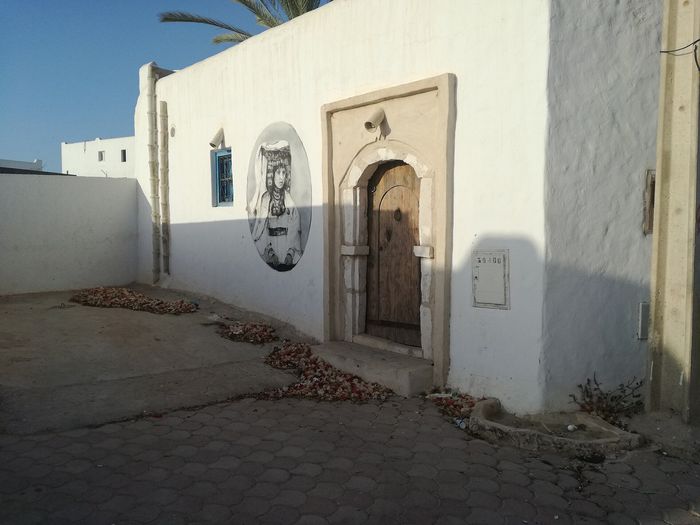
Djerbahood in Erriadh
The village where artists from around the world painted murals on the walls in 2014, and which has been an open-air museum since. An hour or two on foot between the synagogue and the murals, no ticket needed.
free · 1–2 h
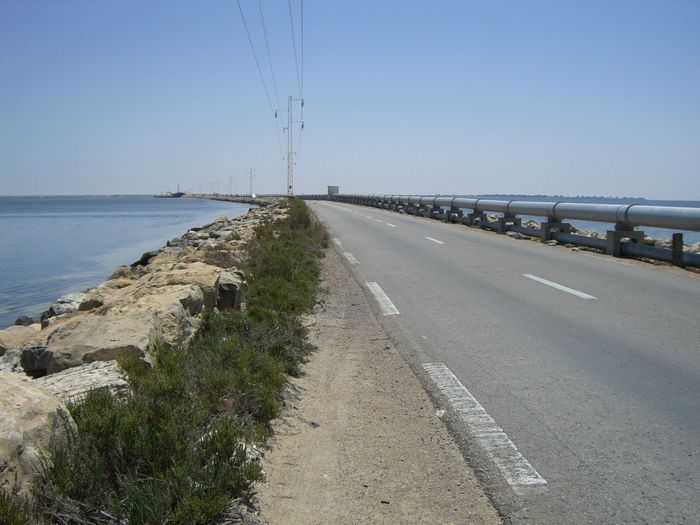
The Roman causeway, Matmata and Chenini
A seven-kilometre causeway joining the island to the mainland, and the road on to Matmata, Tataouine and Chenini — troglodyte houses and ksour, not dunes. A day tour to Tataouine and Chenini is €58 (children €38), booked in advance with an agency.
a full day, 9–10 h · closed not done in summer (heat, no shade) · booking: in advance with an agency
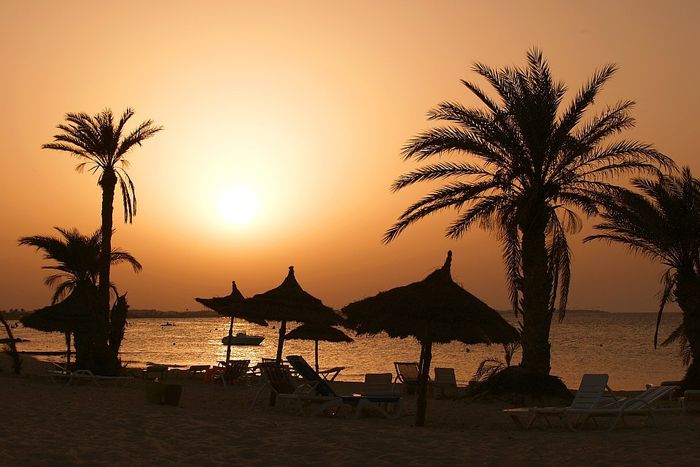
Sidi Mahrez beach
The main hotel beach in the east, with white sand and a shallow sea. Empty in the morning; the north-easterly wind raises waves in the afternoon that are too much for children.
free


Two things you probably did not know
The El Ghriba synagogue on Djerba is the oldest in Africa and by tradition was founded in the sixth century BC, after the destruction of the First Temple. A Jewish community has lived on the island without a break since.
Homer described Djerba as the island of the lotus-eaters, where Odysseus's men ate a fruit that made them forget where they came from. Locals still point out a tree they say is the one.
Ready for Djerba?
Within reach from here
Places sorted by straight-line distance from Djerba — day trips or weekends.

Tunisia
→Ten towns in a line, from the capital to the sand at Tozeur — in the order they're actually travelled, not listed

Egypt
→Two countries under one name: the Nile with its temples, which needs a plan, and the Red Sea, which needs only a charter — few people do both in one trip

Morocco
→The north by train, the south by road, and in July you leave Marrakech for the coast

Italy
→The cities on the high-speed line are an hour or two apart; the coast, Matera and the Tuscan hills lie off it
All 277 places we write about sit on one page — narrow them down by continent, country, price or what you are travelling for.
Front row for the next trip
Leave your email and we'll let you know when a new destination or story goes up.