

Antalya
The city most visitors only ever see through a transfer-bus window
- When to go
- October 22° · 4 rainy days
- Per day
- €€price 2 of 5
- How many days
- 3–4days
- For you
- 6 questions →
- Nearest airport
- 9 km Antalya
- Right now
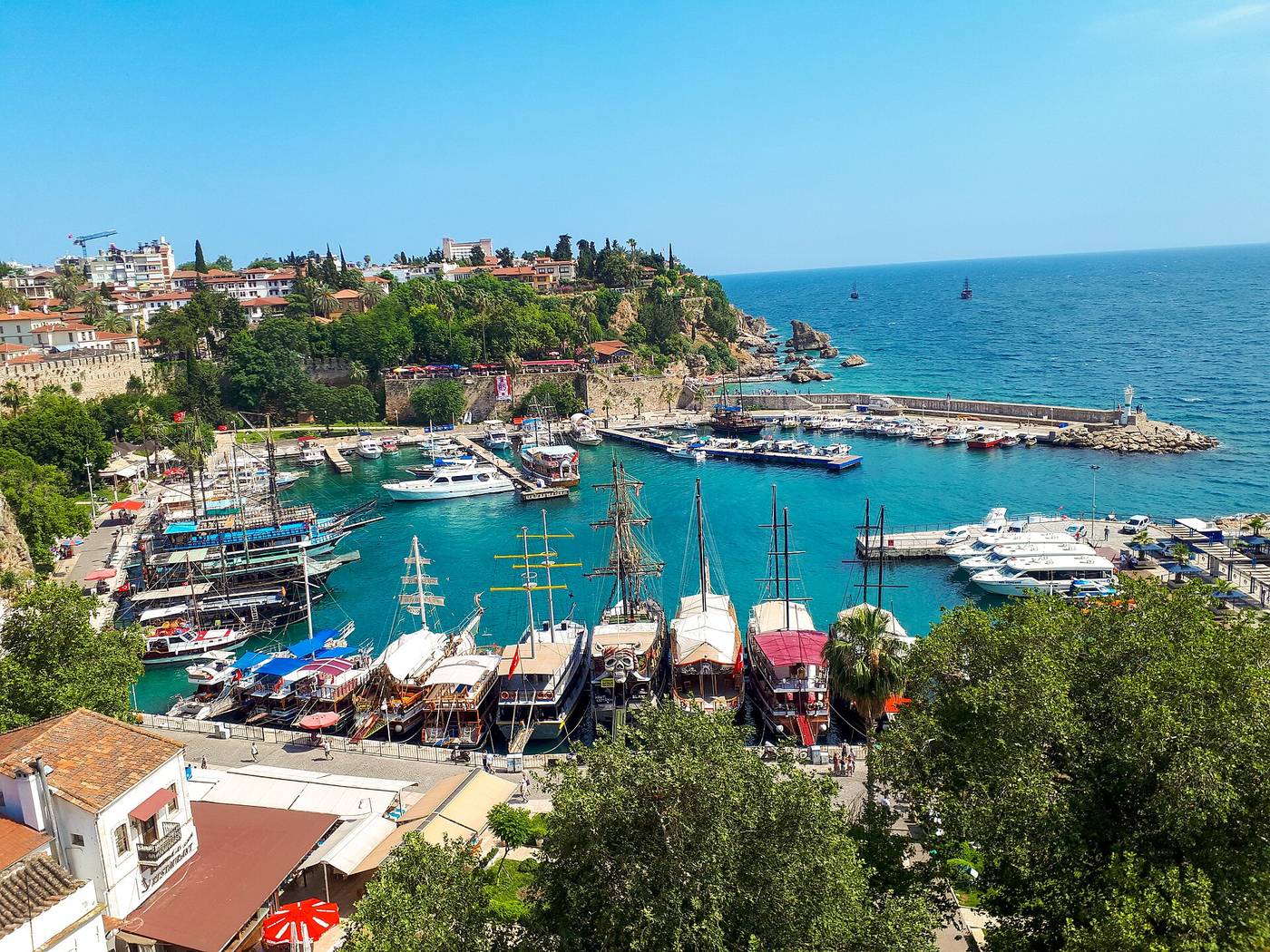
Thirty-nine million passengers went through Antalya airport in 2025, and most of them never saw the city — you come off the plane and straight onto a bus for Belek, Side or Kemer. Under that statistic sits an ordinary town with a Roman gate in its wall, an old harbour beneath a cliff, and a waterfall dropping straight into the sea.
The coast east and west of the city is one long all-inclusive belt, and that changes the arithmetic of a trip more than it looks. A week in Belek or Kemer, flight and all meals included, often costs less than five nights in the same kind of room anywhere else on the Mediterranean, because the hotel sells a package rather than a bed. The catch is that the package assumes you will never leave: transport into town is extra, and a restaurant outside suddenly feels expensive when it isn't.

If the city is what you want, stay in Kaleiçi — the old core inside the walls, with Ottoman houses, narrow cobbled lanes and a harbour you walk down into. Hadrian's Gate dates from the second century and was raised in honour of the emperor; it is still one of the three ways in. The Yivli Minare, the fluted Seljuk minaret, is visible from almost everywhere and works as a compass when you lose the thread. All of it fits into half a day on foot, with no ticket and no queue.
The season runs longer than people expect. The sea stays warm from May to mid-October, while July and August climb past thirty-five degrees with humidity, which is too much for anything but the beach. May, June and the first half of October give you swimming and ruins without the midday hit. Winter sits around ten degrees and rains, the resort belt shuts, but the city itself carries on and is at its cheapest.
What to see in Antalya
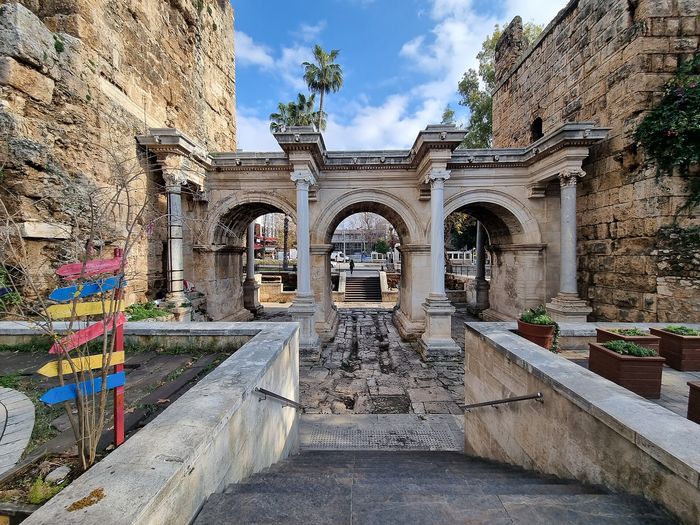
Kaleiçi and Hadrian's Gate
The old town inside the walls, Ottoman houses above and a harbour at the bottom. Hadrian's Gate is second-century, three arches on marble columns, and you walk through it for free like any other street. The lanes are narrow and mostly car-free, and the quarter is at its best in the evening.
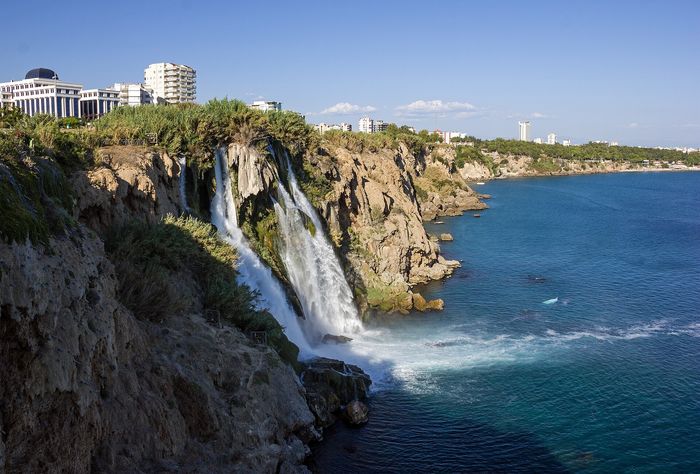
The Düden waterfalls
There are two, and they are not the same thing. The upper one is a karst spring where the river resurfaces after vanishing into a sinkhole eighteen kilometres upstream — the park charges an entrance fee. The lower one drops forty metres straight into the sea; its park is open around the clock and free, and the view is best from a boat or the headland opposite.
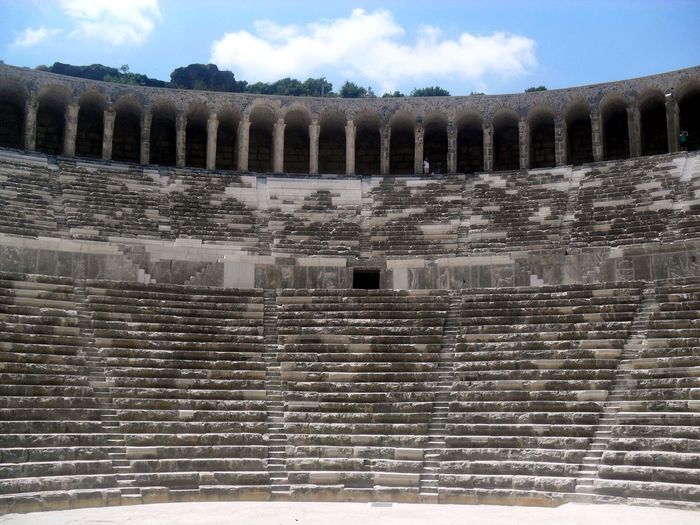
Aspendos
A Roman theatre from AD 155, forty kilometres east. Zenon, born in Aspendos itself, designed it, and it survives almost complete including the stage building — which is rare. It held around seven thousand, and since 1994 it has hosted an opera and ballet festival. A nineteen-kilometre aqueduct runs nearby.
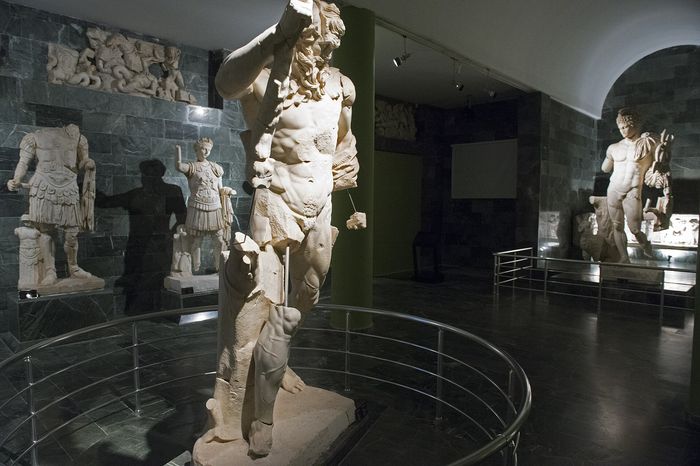
Perge
Fifteen kilometres east, and far bigger than people expect: a Hellenistic gate with towers, a stadium, first-century baths and a colonnaded street with a water channel down the middle. Apollonius of Perga, who described conic sections, came from here. There is almost no shade, so go early.
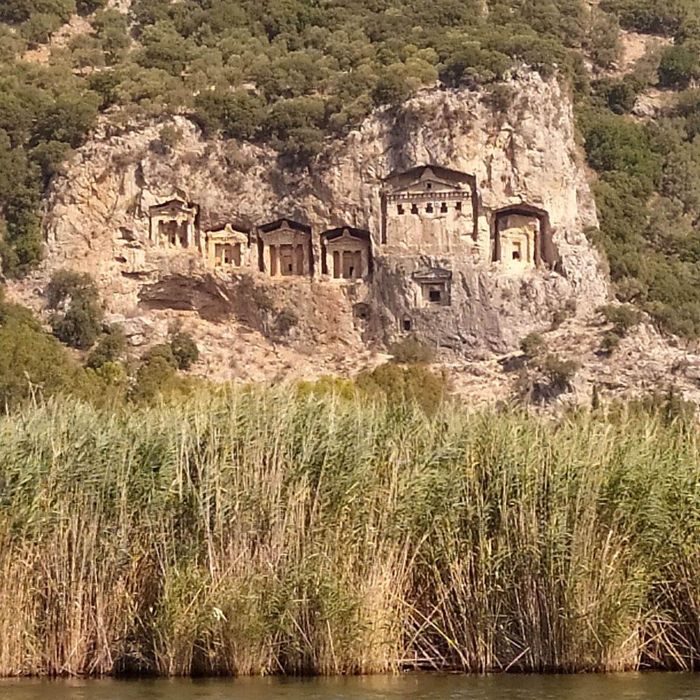
Konyaaltı or Lara
Konyaaltı lies west, under the mountains, mostly shingle, and the water is noticeably colder because an underground stream enters here. Lara is east, long and sandy, Blue Flag, lined with replica hotels (Topkapi, Venice, the Kremlin) running the all-inclusive model. The city sits between the two.
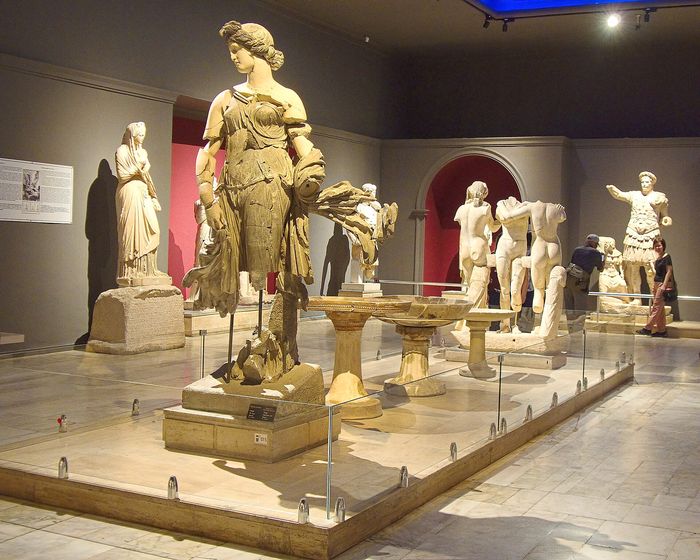
The archaeological museum — closed
The most important museum on this coast, with the Perge sculptures and the Heracles sarcophagus, has been shut to visitors since July 2025. After a seismic assessment the old building was closed and a new one is going up on the same site; the ministry promises completion in 2026, and the deadline has already slipped. Don't count on it — check the status before you go.


Two things you probably did not know
Hadrian's Gate in Antalya was raised in the year 130 for the emperor's visit. The ruts in the stone beneath it were worn by cart wheels over the centuries and are visible to the naked eye.
The Duden waterfall drops straight into the sea from a forty-metre cliff a few kilometres from the centre. The river disappears underground before that and runs through limestone, surfacing only just before the drop.
Ready for Antalya?
Within reach from here
Places sorted by straight-line distance from Antalya — day trips or weekends.

Turkey
→Istanbul, then one direction: Cappadocia by plane, Ephesus and Pamukkale by train, or the Lycian coast by bus

Greece
→The north by road, the Cyclades by ferry, Rhodes by air — pick the region first and the island second

Serbia
→The north an hour away by train, the mountains three or four by car — Serbia divides by the time you have
All 277 places we write about sit on one page — narrow them down by continent, country, price or what you are travelling for.
Front row for the next trip
Leave your email and we'll let you know when a new destination or story goes up.