

01
Bratislava
A capital on the Danube, with a castle on the hill above the Old Town. The only national capital bordering both Austria and Hungary, and the country's main way in.
A capital on the Danube, a castle town on the road to Vienna, a UNESCO mining town, the highest peaks in the Carpathians and a medieval east — all in euros, no conversion needed

Slovakia here means seven places strung out along one line, west to east: Bratislava is the capital and the main way in, right on the Danube and within reach of both Vienna and Budapest; Trenčín is a castle above a town on the road further north; Banská Štiavnica is a former mining town hidden in the hills, with no train reaching it; the High Tatras are the highest stretch of the Carpathians, with mountain villages as a base; Spiš Castle is one of the largest medieval castle complexes in the region; Košice is the country's second city and the gateway to eastern Slovakia; and Bardejov is the smallest and easternmost of all, a UNESCO-listed square. The west is reached from Bratislava, the east from Košice — the middle, around Poprad, links both directions.
Slovakia is in the eurozone: prices are in euro (EUR), cards everywhere, cash for small. For a visitor that means no conversion the way there is in neighbouring Czechia or Hungary — the same currency from Bratislava to Bardejov. Tip 10%, round up the bill.
Each place has its own page — what makes it worth the detour, and how long you need.
All 277 places we write about sit on one page — narrow them down by continent, country, price or what you are travelling for.
The motorway still asks for one formality in advance: electronic vignette required on motorways, for example €10.80 for ten days. It's bought online before setting off; motorway cameras read the plate and the fine arrives without a warning. Off the motorway, on town and regional roads, no vignette is needed.
Bratislava and Košice are two separate entry points into the country: Bratislava through M. R. Štefánik Airport, and Košice through its own, about 20 min from the city centre. Trenčín is reached from Bratislava direct train (ZSSK / RegioJet), €6.06 (2nd class, standard fare) one way. Bardejov has no rail line or airport of its own: from Košice it's bus (FlixBus), 1 h 15 one way.
The middle of the country runs differently: Banská Štiavnica has no railway reaching it, only regional bus (IDS BBSK, line 115, SAD Zvolen) from Zvolen. The High Tatras and Spiš Castle share the same hub, Poprad, but split from there — a narrow-gauge line, TEŽ train (Tatra Electric Railway), runs up to the mountain villages, while the castle is reached bus (SAD Poprad, line 071208: Poprad–Levoča–Spišské Podhradie).
What ties all seven places together is that none of them is only a stop along the way: Spiš Castle is one of the largest medieval castle complexes in Central Europe, Banská Štiavnica and Bardejov carry UNESCO-listed historic centres, and the High Tatras are the only stretch of the Carpathians with a peak over 2,600 metres. Slovakia is rarely covered in one west-to-east trip; most visitors pick either the west around Bratislava and Trenčín, or the east around Košice, Spiš Castle, the Tatras and Bardejov.
Bratislava is the only national capital in the world that borders two other countries, Austria and Hungary — the city centre sits some ten kilometres from each.
Gerlachovský štít in the High Tatras, at 2,655 metres, is the only peak in the entire Carpathian range above 2,600 metres.
Spiš Castle is one of the largest medieval castle complexes in Central Europe; its historic site has been UNESCO-listed since 1993.
Banská Štiavnica grew up around silver and gold mines and was one of the most important mining centres in the Kingdom of Hungary; its historic centre has been UNESCO-listed since 1993.
This isn't a ranking — it's a route. Any one of these could carry a whole trip.
A capital on the Danube, with a castle on the hill above the Old Town. The only national capital bordering both Austria and Hungary, and the country's main way in.

A town with a castle looking down over the Váh valley, on the road north from Bratislava. Doable in a day, with a side trip to nearby Beckov Castle.

A former mining town in the hills of central Slovakia, with no railway of its own and a UNESCO-listed historic centre. Reached by bus from Zvolen.

The highest stretch of the Carpathians, with mountain villages as a base and a narrow-gauge line linking them. The hub is Poprad, the same one used for Spiš Castle.

One of the largest medieval castle complexes in Central Europe, on a hill above the plain. A day trip from Poprad, by bus via Levoča.

The country's second city and the gateway to eastern Slovakia, with a Gothic cathedral at the heart of its old centre. Has its own airport, closer to the east than to Bratislava.

The easternmost and smallest of the seven, with a UNESCO-listed square and a spa-town open-air museum nearby. No railway of its own, a day trip from Košice.
Short answers to what people ask most before setting out.
Not quite: the west, Bratislava and Trenčín, and the east, Košice and Bardejov, follow a close but not identical seasonal pattern — check April–June and September–October and May–June and September. The mountain villages in the High Tatras keep their own, shorter season because of snow.
On the motorway, yes: electronic vignette required on motorways, for example €10.80. Bratislava and Košice are walkable or reached by city transport; a car helps most for Banská Štiavnica, which has no railway, and for smaller trips off the main lines.
In the cities, almost everywhere: cards everywhere, cash for small. Cash is still useful for small markets and pubs outside them, and for the tip — 10%, round up the bill.
Keep going — these destinations and stories pair well with this one.

A capital on the Vltava, Moravia's second city, a spa town with a film festival and a small town bent around a river — one country still paying in koruna

A country crossed by train in five hours, from a Vienna coffee house to a Tyrolean cable car — so you choose the order, not the country

A capital on the Danube, a hill-country wine town, a southern city near Croatia and Central Europe's biggest lake — one country, no euro

A country where half of what looks old isn't, and that is precisely the point
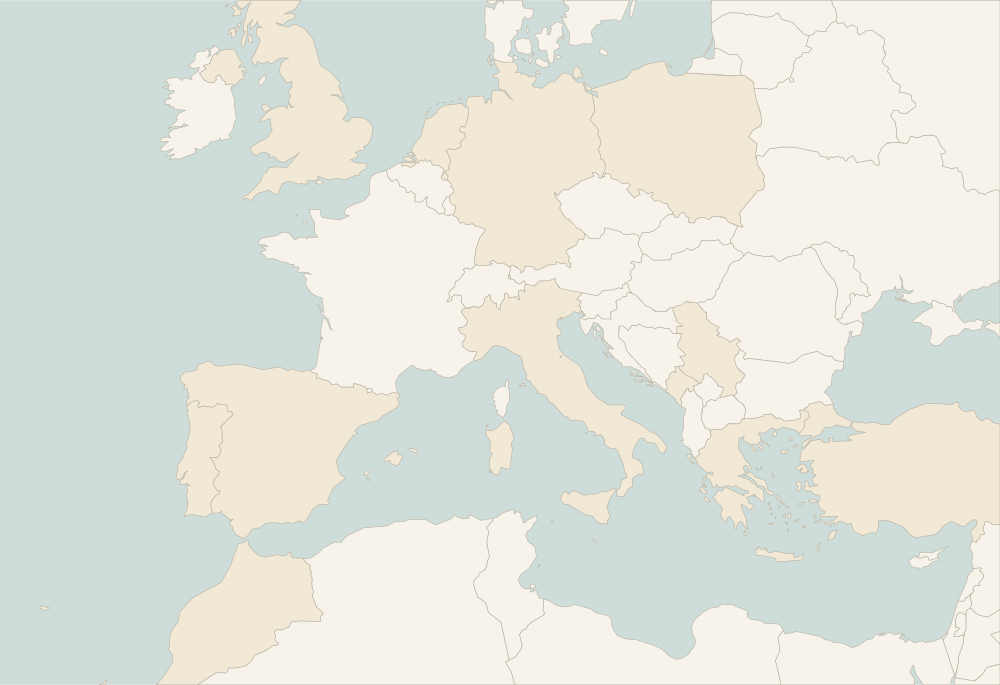
The whole of Slovakia fits into one query — six questions and you know which of them suits you.
Leave your email and we'll let you know when a new destination or story goes up.
All photographs come from Wikimedia Commons and are used under the licence stated beside each one.