

01
Budapest
A capital split by the Danube: hilly Buda with its castle on one bank, flat Pest with the parliament on the other. The only one of the four with its own airport, and the only one with a metro.
A capital on the Danube, a hill-country wine town, a southern city near Croatia and Central Europe's biggest lake — one country, no euro

Hungary here means four places that barely touch: Budapest is the capital and the country's only international entry point, Eger is a wine town in the hills of the north-east, Pécs is a southern city closer to the Croatian border than to Budapest, and Balaton is Central Europe's largest lake. All three inland points are reached by train from Budapest, and this guide keeps that order — from the capital outward.
The difference between these four places is bigger than most single countries offer. Budapest is both the largest and the busiest: Buda and Pest were separate towns until they merged in 1873, and the split still shows — hilly Buda with its castle on one bank of the Danube, flat Pest with the parliament on the other. Eger is small and steep, with a castle above the town and vineyards starting right behind the last street — the whole old town is walkable in a day. Pécs is the southernmost, with Roman and Ottoman layers in its centre and a climate that already feels Mediterranean. Balaton is a lake almost 200 km long, with Balatonfüred as the place with its own railway station and the most accommodation on the northern shore.
Each place has its own page — what makes it worth the detour, and how long you need.
All 277 places we write about sit on one page — narrow them down by continent, country, price or what you are travelling for.
Budapest is the hub for everything else. Trains to Eger and to Pécs leave from Keleti station; from BUD airport to Eger it's a bus then a train, about 2 h 45 min total, to Pécs a bus and a MÁV InterCity train, 3 h 10–4 h 05. A direct train also runs to Balaton, from Budapest-Kelenföld or Déli station to Balatonfüred. Hungary is not in the eurozone: prices are in forint (HUF) (1 EUR = 362.40 HUF), mostly cards; cash for markets. Also: e-vignette required on motorways.
Hungarian is a Uralic (Finno-Ugric) language, related to Finnish and Estonian — the only one of its kind in the region, while every neighbouring country speaks a Slavic, Germanic or Romance language.
Buda, Pest and Óbuda were three separate towns on opposite banks of the Danube until they merged into a single city on 17 November 1873.
Line 1 of the Budapest metro (Földalatti), opened in 1896, is the oldest electrified underground railway on mainland Europe. It has been a UNESCO World Heritage Site since 1996, alongside the Danube banks and Andrássy Avenue.
Lake Balaton runs almost 200 km around its shore and is the largest lake in Central Europe, yet it's rarely more than a few metres deep.
The Tokaj wine region was demarcated by royal decree in 1737, making it the oldest officially delimited wine region in the world. It has been under UNESCO protection since 2002.
Ernő Rubik invented the cube that bears his name in Budapest in 1974, originally as a teaching aid for spatial thinking at the Academy of Applied Arts.
This isn't a ranking — it's a route. Any one of these could carry a whole trip.
A capital split by the Danube: hilly Buda with its castle on one bank, flat Pest with the parliament on the other. The only one of the four with its own airport, and the only one with a metro.

A small hill-country town in the north-east, with a castle above the centre and vineyards starting right behind the last street. The whole old town is walkable in a day.

The southernmost of the four, closer to the Croatian border than to Budapest. Roman and Ottoman layers sit side by side in the centre, and the climate already feels noticeably milder.

Central Europe's largest lake. Balatonfüred on the northern shore has its own railway station and the most accommodation, and serves as the starting point for the rest of the lake.
Short answers to what people ask most before setting out.
No: the best time for Budapest, Eger and Pécs is Apr–Jun · Sep–Oct; for swimming on Balaton, it's Jun–Aug; May and Sep quieter. Outside that window the lake is still quiet, but seasonal beaches and facilities run on shorter hours or not at all.
On the motorway, yes: e-vignette required on motorways, for example €19.04 (D1, 10-day). Inside Budapest, no — the city has a metro and dense public transport. Trains run to Eger and Pécs from Budapest; a car helps most around Balaton, where the shoreline runs almost 200 km.
No. Prices are in forint (HUF), at 1 EUR = 362.40 HUF: cards; cash for markets. Tip ~10%, unless service is included.
Keep going — these destinations and stories pair well with this one.
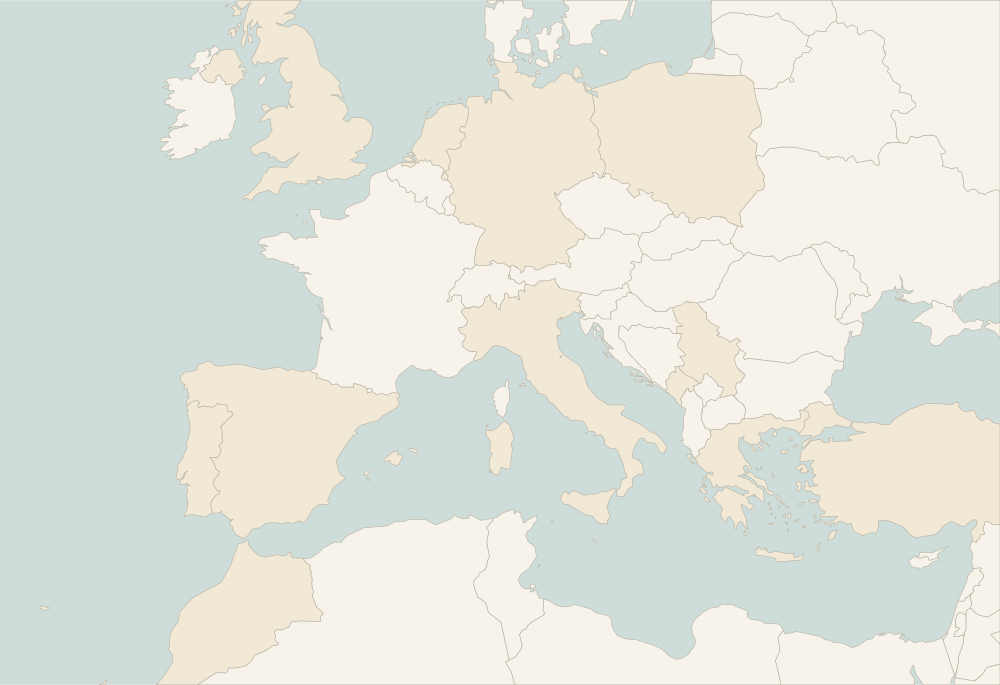
The whole of Hungary fits into one query — six questions and you know which of them suits you.
Leave your email and we'll let you know when a new destination or story goes up.
All photographs come from Wikimedia Commons and are used under the licence stated beside each one.

