
Skip to content
Nomadinho
SR EN
Destination

Germany

A country with no single centre but a dozen, each convinced it is the main one

Main airports: Frankfurt (FRA), Munich (MUC)
Currency
Euro (EUR)
Language
German
When to go
May–June and September
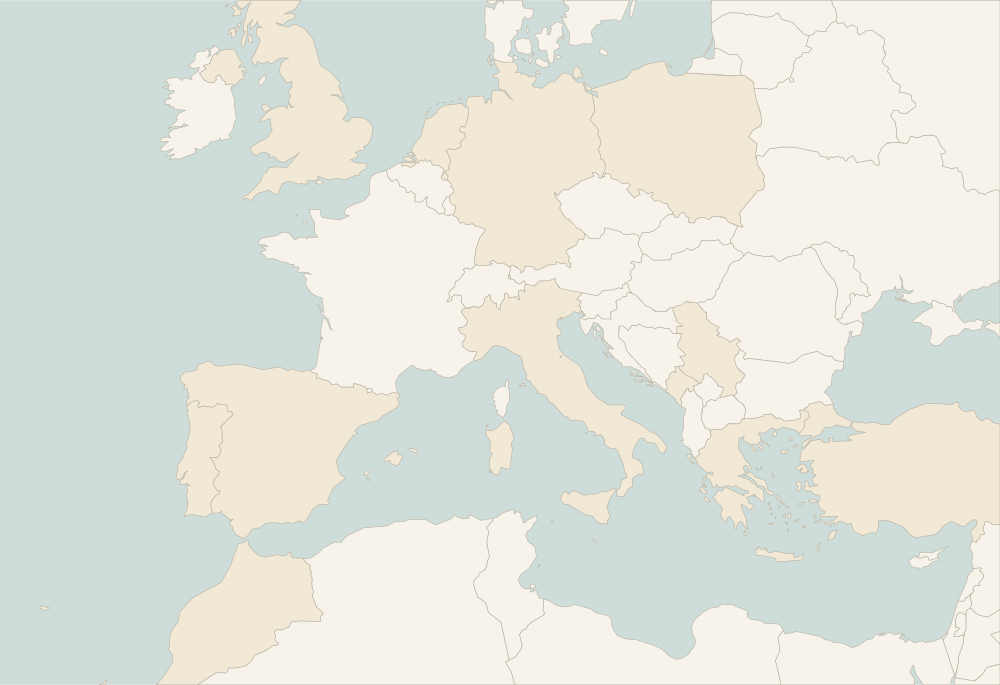
Germany
Germany · R, CC BY-SA 4.0

Until 1871 Germany was a collection of kingdoms and free cities, and you can still feel it: the money is in Frankfurt, the ships in Hamburg, the beer and the industry in Munich, and Berlin only became a working capital when parliament moved into the rebuilt Reichstag in 1999. So you don't do this country from one base. You do it by train, between cities that make no effort to resemble each other.

The train is the default way to move here, and it is also Germany's biggest weak spot. Deutsche Bahn's long-distance services ran on time 60.1 per cent of the time in 2025, where 'on time' means less than six minutes late; ten years earlier the figure was 74.4. The practical consequence is simple: don't plan a fifteen-minute connection, and don't book a flight for the same afternoon you arrive by train from another city. New management has set a target of at least sixty per cent for 2026, which tells you enough about expectations.

Where next

Cities and places in Germany

Each place has its own page — what makes it worth the detour, and how long you need.

The full list

All 277 places we write about sit on one page — narrow them down by continent, country, price or what you are travelling for.

What a ticket costs depends on when you buy it. Sparpreis fares on the ICE start at €21.99 and tie you to one specific train, while the full Flexpreis on the same route can be three times that. The €63 Deutschlandticket covers every regional and city service in the country for a month but no fast trains — excellent for someone staying a while and commuting daily, useless for three days in one city.

Sunday is its own shock. Shops and malls are closed by law rather than by habit, and only bakeries within limited hours, station kiosks, petrol stations and hospitality stay open. If you need toothpaste on a Sunday morning, you go to the main railway station, and the groceries get bought on Saturday. Museums, restaurants and cafes run normally, so Sunday isn't a lost day but a day without shopping.

Blog

Stories from Germany

How it actually was when we were there, and what was worth it.

What it's known for

Six things Germany means

A country that became one late

The German Empire was proclaimed in 1871; until then the same territory held dozens of states. The federalism that came out of that isn't decoration but a working system: sixteen federal states decide their own schools, policing and holidays, so even the public holidays differ from state to state.

A wall that stood for twenty-eight years

The Berlin Wall went up on 13 August 1961 and fell on 9 November 1989. It didn't divide Germany; it ringed West Berlin on every side. The Window of Remembrance on Bernauer Strasse shows the 130 people who died at it, each with a photograph and a date.

Beer to a rule from 1516

The Bavarian purity law of 1516 permitted barley, hops and water — nobody could name yeast yet. The number of breweries keeps falling: 1,415 in 2025, a hundred and thirty-seven fewer than in the record year of 2019.

A motorway with no limit, but a recommendation

About seventy per cent of the German motorway network has no general speed limit. The advisory speed of 130 km/h has existed since 1978 and is not a ban, but it has teeth: drive faster and end up in a crash, and you share liability even when the collision wasn't your fault.

A bottle deposit people actually reclaim

Cans and bottles carry a deposit, and every sizeable supermarket has a return machine. A full bag of bottles is worth real money here — which is why people leave them beside the bin rather than in it, for someone who needs the money to collect.

Cash slowly losing its lead

Germany was a cash country for decades: in 2008, 83 per cent of transactions were paid in notes and coins. According to Bundesbank figures for 2025, cashless finally took the lead — 55 per cent against 45. That remaining 45 per cent is still the reason a traveller carries banknotes here.

What to see

Five places for a first visit

This isn't a ranking — it's a route. Any one of these could carry a whole trip.

Berlin
01

Berlin

A capital that makes no attempt to look tidy. Five museums on Museum Island run on one €24 ticket, the Reichstag dome is free if you register ahead, and Tempelhofer Feld is a former airport turned into a park of over three hundred hectares where the only things landing are kites. Three to four days.

Munich
02

Munich

The Bavarian capital, where the Pinakotheken cost €1 per museum on Sundays. Oktoberfest (from 19 September to 4 October) more than doubles room rates, so unless it's why you're going, it is better avoided.

Hamburg
03

Hamburg

A port that has been UNESCO-listed since 2015 for the Speicherstadt and the office quarter beside it. The Elbphilharmonie sits on a 1963 warehouse, the fish market trades on Sundays from five in the morning (seven in winter) until half past nine, and the Reeperbahn is worth walking not for the sin story but for the nightlife.

Dresden
04

Dresden

A baroque city on the Elbe flattened on 13 February 1945 and then rebuilt piece by piece over decades. The Frauenkirche was reconsecrated in 2005 and the dark original stones are visible in its facade with the naked eye. It is also the way into Saxon Switzerland, by S-Bahn.

Heidelberg
05

Heidelberg

A university town founded in 1386, the oldest in present-day Germany, with a red sandstone castle ruin above the Neckar. The castle ticket is €11 and includes the funicular both ways, the Great Barrel and the Pharmacy Museum. One day covers it.

Did you know

Two things you probably did not know

History

Germany as a single state dates from 1871, and again from 1990. Before the first unification it was a collection of over thirty kingdoms, duchies and free cities, each with its own money and measures.

Science

On a large part of Germany's motorways there is no speed limit, only a recommendation of 130 an hour. It is the only country in Europe with no general motorway limit.

All the facts →

Frequently asked

Before you go

Short answers to what people ask most before setting out.

Why is everything closed on Sundays in Germany?

The shop-closing law keeps Sunday non-trading, and it isn't up to the individual retailer. Bakeries within limited hours, station kiosks, petrol stations, museums and hospitality stay open. A few times a year a city approves a 'verkaufsoffener Sonntag', but it is announced well in advance and isn't something to count on.

Is the Deutschlandticket worth it for a tourist?

It costs €63 a month and is valid nationwide, but only on regional and city services — ICE, IC and EC are not included. For one city and three days it doesn't pay off, because a day ticket is cheaper, and for a longer stay in one city the comparison is with that city's weekly ticket. It pays when you spend several days in a row moving between cities on regional trains.

What is Pfand and how do you get it back?

It's a deposit on packaging: 25 cents on single-use cans and plastic bottles, 8 cents on a returnable beer bottle, 15 on larger returnables. You feed the bottle into a machine in the supermarket, it prints a voucher, and the voucher comes off your bill or is paid out at the till. Wine, sparkling wine, milk and juice in glass carry no deposit.

Plan the trip

Ready for Germany?

Checked at the source6 facts on this page carry a source and a check date.All sources →
Where next

If you liked this

Keep going — these destinations and stories pair well with this one.

On the map

Berlin, Munich, Hamburg and Dresden, and so on

The whole of Germany fits into one query — six questions and you know which of them suits you.

Not sure where to next? Six questions and you get places that actually suit you. Find me a destination

Front row for the next trip

Leave your email and we'll let you know when a new destination or story goes up.

Photo credits and licences (20)

All photographs come from Wikimedia Commons and are used under the licence stated beside each one.