

Dresden
A baroque centre that burned to the ground in 1945 and was put back stone by stone
- When to go
- September 16° · 10 rainy days
- Per day
- €€€price 3 of 5
- How many days
- 2days
- For you
- 6 questions →
- Nearest airport
- 9 km Dresden
- Right now

Dresden is filed everywhere as a baroque city, but most of what you see downtown did not survive the war — the raids of 13 to 15 February 1945 burned out the core, and putting it back took decades. The Frauenkirche was only reconsecrated on 30 October 2005. Which is why the square around it looks freshly finished. It is.
The rebuild is easiest to read on the Frauenkirche facade: the dark blocks are original, dug out of the rubble, the pale ones are new. Of more than eight and a half thousand salvaged pieces, around 3,800 went back in, each to the spot it came from. The cross on the dome was a gift from Britain, made by a British silversmith whose father flew in the raid on the city. The church itself is free to enter, and the dome, 67 metres above the square, needs no booked slot.

The Historic Green Vault in the Royal Palace is different: it admits you on a timed slot, and the palace is shut on Tuesdays. The Zwinger, with the Old Masters gallery, is shut on Mondays instead. Those two different closing days are the usual reason somebody loses half a weekend here — in most German cities the museums go quiet on Monday, in Dresden not all of them do. The Zwinger courtyard is open and free every day, so at least that always fits.
The city itself is crossed quickly, so the third day tends to go upstream. From the main station the S-Bahn runs to Rathen in about half an hour, and from there you walk up to the Bastei — a rock 194 metres above the Elbe with a sandstone bridge that has stood since 1851. Start in the morning; after eleven you queue on the bridge itself. You can come back by boat, on a nine-strong paddle-steamer fleet that bills itself as the oldest in the world.
Guides for Dresden
Shorter, practical pages for one concrete question each — how many days, how much money, where to sleep, where to escape the city.

Dresden in 2 days
→One day belongs to the Zwinger, the other to the palace — and each of them takes its own day off.

Day trips from Dresden
→The Bastei, Meissen, Moritzburg and the Czech side — what goes by the S1, what by bus, and what the day ticket leaves…

Dresden across the river: singing courtyards, a panorama in a gasometer
→Courtyards that play when it rains, a panorama twenty-seven metres high in an old gasometer, and a bridge two local men…
What to see in Dresden
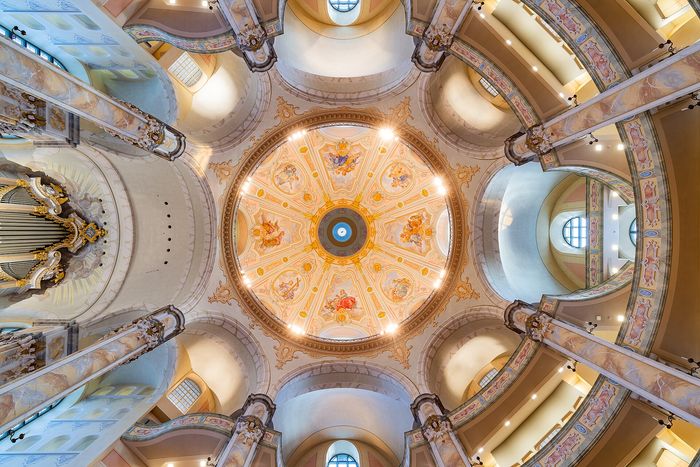
The Frauenkirche
Reconsecrated on 30 October 2005, sixty years after the bombing. Inside it is pale and light, with none of the heaviness you expect. Entry is free; the dome is €12: 174 steps first, then a spiral ramp at a 14 per cent gradient and steep stairs at the end, with no lift. From November to February it closes at four.
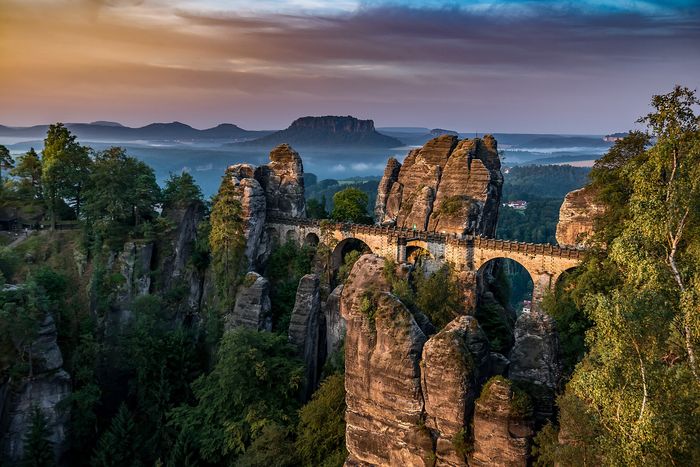
The Bastei and Saxon Switzerland
From Rathen station a ferry takes you across the river, then it's a forty-minute walk up. The Neurathen rock castle has been closed since September 2023, after measurements showed the rocks moving; the bridge is open, and its view is why you came.
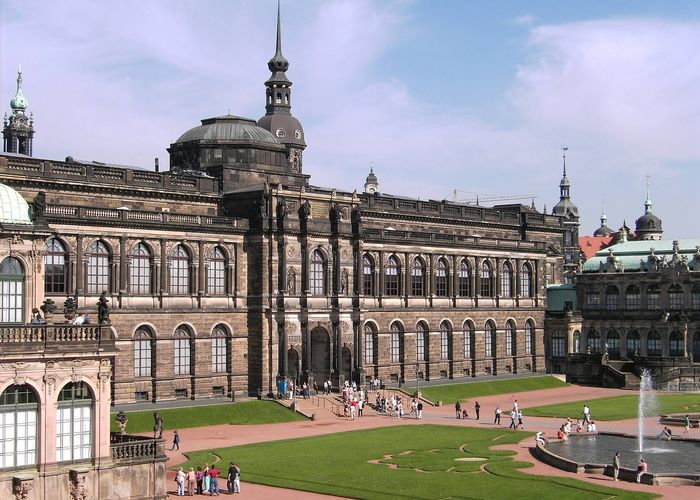
The Zwinger and the Old Masters
The gallery is paid through the combined Zwinger ticket, €18, which also covers the Porcelain Collection and the Mathematical-Physical Salon. It holds Raphael's Sistine Madonna, whose two angels along the bottom edge have ended up on half the souvenirs in town.
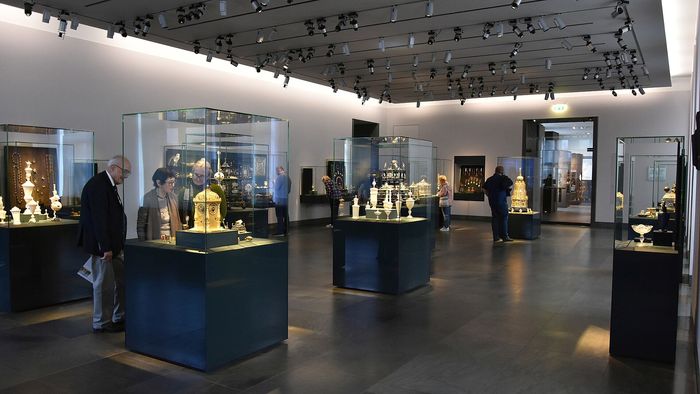
The Green Vault
The Saxon rulers' treasury in the Royal Palace, split in two. The historic half runs on timed entry and costs €18; on 25 November 2019 twenty-one pieces of jewellery with some 4,300 diamonds were taken from it. Most came back in 2022, several are still missing. The New Green Vault comes with the ticket for the rest of the palace, €18.
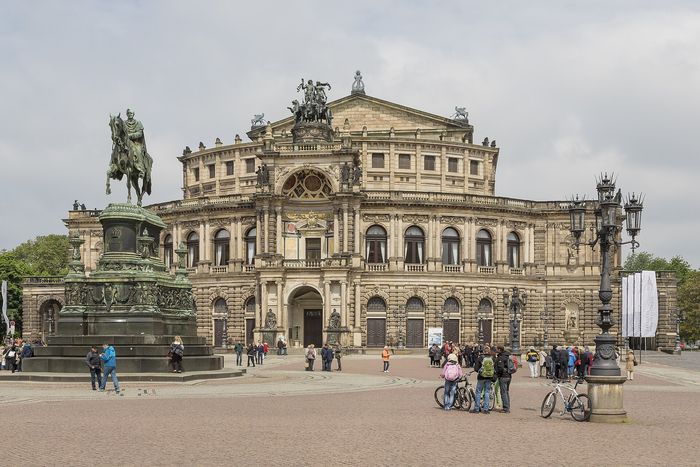
The Semperoper
The building burned on 13 February 1945 and reopened exactly forty years later, on 13 February 1985. The interior is seen on 45-minute tours, €16, run almost daily, but slots depend on rehearsals — check that morning, not a week ahead.
- N
Neustadt, across the river
The quarter where nothing was reconstructed after the war. Alaunstraße and the streets around it are where Dresden actually spends its evenings: cheaper, louder and younger than the baroque half. The Kunsthofpassage is a run of linked courtyards, and on one of them the drainpipes are arranged so the facade plays when it rains.


Two things you probably did not know
After the bombing of 1945 the Frauenkirche lay as a heap of stone for forty-five years, kept as a memorial. It was rebuilt only in 2005, with every block numbered and returned to its place. The dark stones on the facade are the original ones.
The Fürstenzug, the procession of princes, is a 102-metre wall covered with around twenty-three thousand Meissen tiles. It survived the bombing almost intact, because the porcelain withstood the heat.
Ready for Dresden?
Within reach from here
Places sorted by straight-line distance from Dresden — day trips or weekends.


All 277 places we write about sit on one page — narrow them down by continent, country, price or what you are travelling for.
Within reach from here: Leipzig, Karlovy Vary and Prague
See how much of that actually suits you — or pin Dresden if you have been.
Front row for the next trip
Leave your email and we'll let you know when a new destination or story goes up.