
Skip to content
Nomadinho
SR EN
Destination

Poland

A country where half of what looks old isn't, and that is precisely the point

Zloty (PLN)·Main airports: Warsaw (WAW), Kraków (KRK)
Currency
złoty (PLN)
Language
Polish
Entry
Schengen, EES active, ETIAS delayed
Poland
Poland · Andrzej Otrębski, CC BY-SA 4.0

Poland vanished from the map in 1795, came back in 1918, and was carved up again by Germany and the Soviet Union in 1939 — and you can see it at every step in its cities. Warsaw was raised from dust after 1944, partly from paintings, Gdańsk from photographs, and Kraków came through the war nearly untouched — which is still what separates the three.

The first thing to understand is the money. Poland joined the EU in 2004 but never adopted the euro, and euros are accepted almost nowhere — you pay in zloty, and a euro buys about 4.38 zloty. That is not a technicality: Eurostat put Polish household price levels for 2025 at 73 per cent of the EU average, against 136 in Ireland — only Bulgaria and Romania came in lower.

Where next

Cities and places in Poland

Each place has its own page — what makes it worth the detour, and how long you need.

The full list

All 277 places we write about sit on one page — narrow them down by continent, country, price or what you are travelling for.

The second is how well the trains work. The fastest train links Kraków and Warsaw in just under two and a half hours, and since 2026 the Czech operators Leo Express and RegioJet have run the route alongside PKP Intercity. Fares are dynamic on all of them: the cheapest seats go first — from €2 with Leo Express — so buy as soon as you know the day. Everything else hangs off that spine: Warsaw to Wrocław about three and a half hours, Kraków to Gdańsk about five.

The third is food, and here there is an institution you will not find anywhere else. The bar mleczny is a canteen from another era — the first opened in Warsaw in 1896, and while they are privately run today the state still part-subsidises them. You order at a counter, wait for the dish to be called, and clear your own tray. No music, no waiter, and no tourist theatre: it is where people actually eat lunch.

Blog

Stories from Poland

How it actually was when we were there, and what was worth it.

What it's known for

Six things Poland means

A city rebuilt from paintings

German troops destroyed more than 85 per cent of Warsaw's historic core after the 1944 uprising. The reconstruction leaned partly on Bernardo Bellotto's cityscapes, and in 1980 UNESCO listed the Old Town precisely for that reconstruction, as an example of rebuilding a deliberately and totally destroyed city.

Kraków was among the first twelve in the world

When UNESCO drew up its first World Heritage list in 1978 it held twelve sites — and two of them were Polish: the historic centre of Kraków and the Wieliczka salt mine. The Kraków listing covers 149.65 hectares, from the medieval town through Wawel Hill to Kazimierz.

Solidarity started in a shipyard

The August 1980 strike at the Gdańsk shipyard produced the first independent trade union in the Eastern Bloc. The museum built around it, the European Solidarity Centre, stands right beside Gate No. 2 the workers walked through — the permanent exhibition is €9.21, audio guide included.

The Second World War began at 4.45 in the morning

The German ship Schleswig-Holstein opened fire on the Polish depot at Westerplatte on 1 September 1939 at 4.45. A garrison of a little over two hundred held out for seven days instead of the twelve hours expected. It is a park of ruins today, with a 25-metre monument, and entry is free.

Salt was mined here for seven centuries

The Wieliczka mine worked from the thirteenth century to the end of the twentieth and holds hundreds of kilometres of galleries underground. The tourist route covers only a sliver of that, and of its eight hundred-plus steps, 380 come right at the start, on the way down.

The milk bar outlived both communism and the transition

Milk bars began as cheap canteens, survived the nineties, and are privately run today but still part-subsidised. Which is why they still sit in the middle of the city, not only on its edge.

What to see

Five places for a first visit

This isn't a ranking — it's a route. Any one of these could carry a whole trip.

Kraków
01

Kraków

What you are looking at here is genuinely old. The Main Market is 200 by 200 metres and the largest medieval square in Europe, while on Wawel every exhibition is ticketed separately unless you take the combined ticket. Auschwitz and the salt mine both go out from here, so count on three days minimum.

Warsaw
02

Warsaw

A city that looks younger than it is, because almost all of it is post-1944. The Old Town is a reconstruction and that is exactly why it is UNESCO-listed; the Palace of Culture and Science is a gift from Moscow, and the terrace on its thirtieth floor costs €6.91. The Warsaw Rising Museum and POLIN each want two hours at least.

Gdańsk
03

Gdańsk

A Baltic port with facades that look Flemish and were in fact rebuilt from photographs after 1945. The Museum of the Second World War is free on Tuesdays, Westerplatte is always free, and Sopot and Gdynia are fifteen and thirty minutes away on the commuter train.

Wrocław
04

Wrocław

A city on twelve islands with over a thousand bronze dwarfs on its pavements, left over from an anti-communist happening in the eighties. Centennial Hall has been UNESCO-listed since 2006, and on Cathedral Island a lamplighter still lights around a hundred gas lamps by hand every evening.

The Wieliczka salt mine
05

The Wieliczka salt mine

Twenty minutes by train from Kraków and UNESCO-listed since 1978. The tourist route runs 135 metres underground, three and a half kilometres through chambers cut into salt, with St Kinga's chapel as the payoff. A ticket with an English guide is €32.94, and it is 17 to 18 degrees down there all year.

Did you know

Two things you probably did not know

History

Poland was wiped off the map for 123 years. Russia, Prussia and Austria partitioned it in 1795 and the state returned only in 1918. Through that time the language and its literature were kept alive in homes and churches.

Science

The Polish constitution of 3 May 1791 was the first modern written constitution in Europe and the second in the world after the American one. It lasted fourteen months before neighbouring powers abolished it by force.

All the facts →

Frequently asked

Before you go

Short answers to what people ask most before setting out.

Can you pay in euros in Poland?

No. Poland is in the EU but not the eurozone, and euros are accepted almost nowhere. You pay in zloty — a euro buys about 4.38 zloty — and you change money at an exchange office called a kantor.

What does the Kraków to Warsaw train cost?

It depends on when you buy: PKP Intercity, Leo Express and RegioJet all sell at dynamic fares, and Leo Express's cheapest seats start at €2. The fastest train takes just under two and a half hours.

What is a bar mleczny and why is it so cheap?

It's a milk bar, a canteen format dating back to the late nineteenth century. They are privately run now but part-subsidised by the state, so a full meal in Warsaw costs €5–10.

Plan the trip

Ready for Poland?

Checked at the source6 facts on this page carry a source and a check date.All sources →
Where next

If you liked this

Keep going — these destinations and stories pair well with this one.

On the map

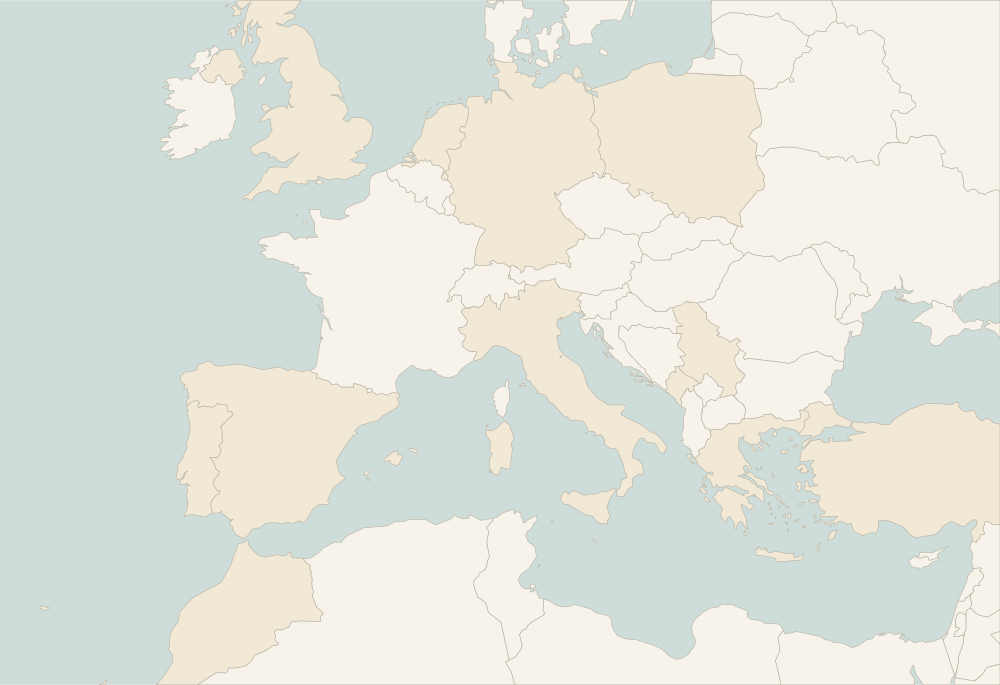
Kraków, Warsaw, Gdańsk and Wrocław, and so on

The whole of Poland fits into one query — six questions and you know which of them suits you.

Not sure where to next? Six questions and you get places that actually suit you. Find me a destination

Front row for the next trip

Leave your email and we'll let you know when a new destination or story goes up.

Photo credits and licences (23)

All photographs come from Wikimedia Commons and are used under the licence stated beside each one.