

- Published
- 28 January 2026
- Reading
- 5 min read
- Where
- Gdansk, Poland
- Prices checked
- 21. Oct 2026.
A week in the Tricity sounds long only while you count cities. Count neighbourhoods on one commuter line and the days fill themselves.
Gdansk, Sopot and Gdynia are three cities on paper and one town in practice, strung along about 30 km of coast. A week sounds like too much if you look at Gdansk alone, and about right once you stop drawing borders between them. The glue is a commuter train that runs every seven to ten minutes at rush hour, and it turns the three places into districts with very different moods: a museum quarter, a seaside promenade and a port laid out on an empty shore.
The SKM is the spine of the whole week
The SKM is the suburban line that ties all three together, and it is the only timetable you need to learn. Sopot is 15 minutes from Gdansk and Gdynia 30, at €2.07 and €2.53 from Gdansk Śródmieście. On weekdays trains come every 7 to 10 minutes between 6 and 9 and between 15 and 18, then every 10 to 15 minutes, and on Sundays every 15 to 20. A 24-hour ticket for trains and city transport together costs €7.83, which pays off only on a day when trams and buses join the train. Read the platform signs at Gdansk Główny, because an SKM ticket does not work on the long-distance trains, and from Sopot to Gdynia sit on the right for the sea.
Two museums and one crane
Gdansk deserves three separate days, and the calendar decides their order. The Museum of the Second World War is free on Tuesdays, with a cap of 2,500 visitors, doors open from 10 to 16 and tickets sold at the box office until 14:30 with no booking, so go first thing. It is closed on Mondays, and the European Solidarity Centre by the old shipyard is closed on Tuesdays, which gives it a day of its own. The third day belongs to the Żuraw, the harbour crane dating from 1442, which is free on Wednesdays and sits on the Motława a short walk from Mariacka street.
Official ticket
- Tuesdays
- free, daily cap
- Mondays
- closed
Through a partner
- options with a guide or audio guide
- usually costs more than the official ticket

The pier, the beach and the spa levy
Sopot is the evening town, and the pier is its front door. At about 511 metres it is a long wooden walkway into the sea, and it began in 1827 as a stub only 31 metres long. In 2026 the full fare was €2.30 from 10 April to 30 September, with non-stop opening from 27 June to 31 August and a 20 per cent discount for holders of the Tourist Card (Karta Turysty) that comes with the spa levy. Residents walk on free, and so does everyone outside the paid period. Go in the morning. Then follow Monciak, the pedestrian street from the pier to the station, to lunch and to the Crooked House, a wavy-fronted building from 2004.
Official ticket
- Length
- 511 m
- Around the clock
- 27 Jun–31 Aug
Through a partner
- options with a guide or audio guide
- usually costs more than the official ticket
A city built from nothing
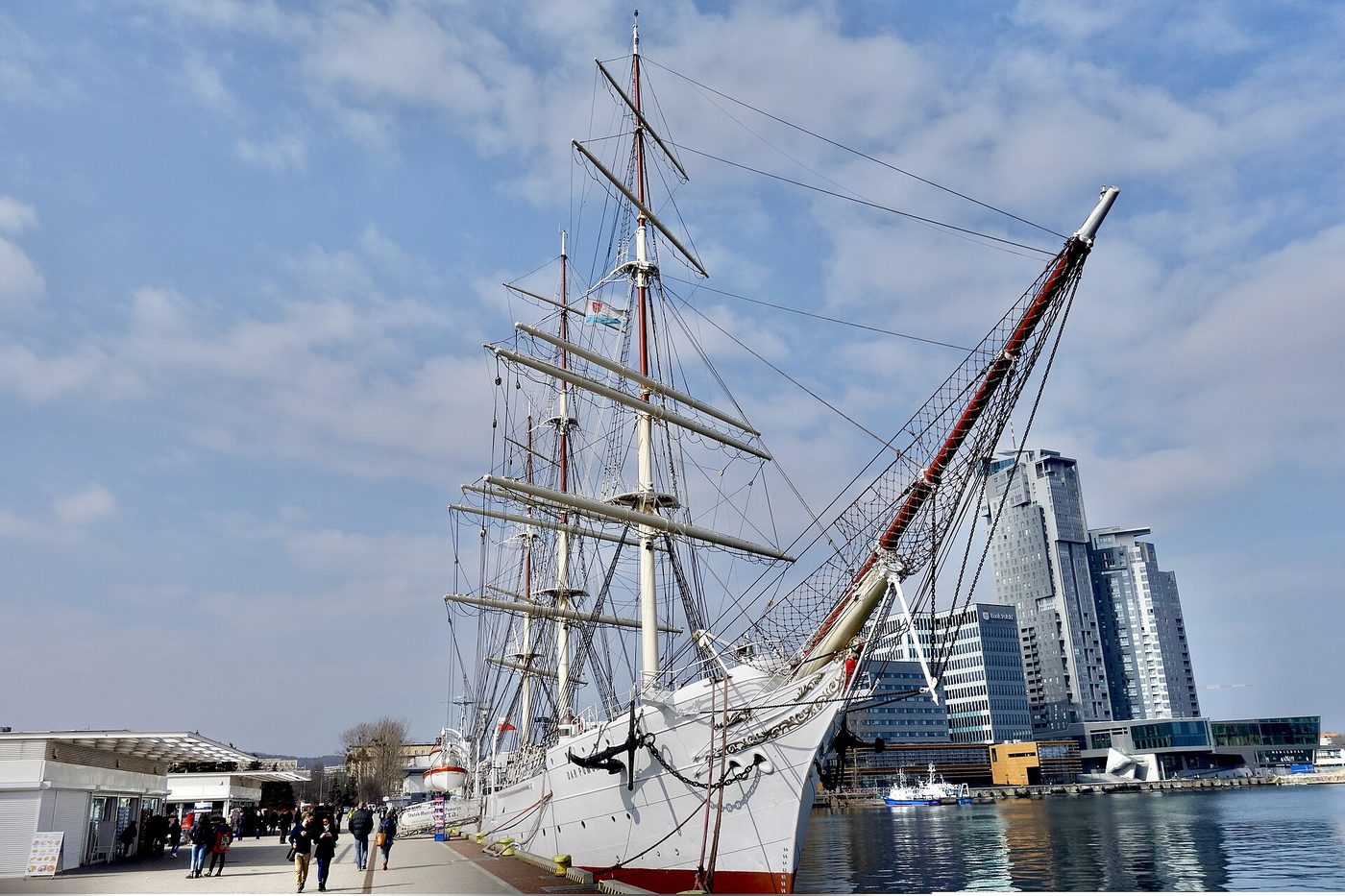
Gdynia has no old centre, and that is the whole point. It was laid out between the wars as a port on a bare shore, and its modernist blocks read like a city drawn in one sitting. From the station walk down 10 Lutego to Skwer Kościuszki, where the sailing ship Dar Pomorza, built in 1909 by Blohm & Voss in Hamburg and a museum ship since 1983, lies beside the Błyskawica. The Emigration Museum sits in the old sea station, closed on Mondays and, according to 2026 guides, free on Wednesdays. For the view, ride the free funicular up Kamienna Góra, then take the train to Orłowo and walk the cliff.

What the sea is actually like
The Baltic plays by different rules from the Adriatic, and it rewards a visitor who arrives knowing them. The water sits between 16 and 18 °C in August and around 16 to 17 in September, so a swim here is a short, brisk event rather than an afternoon. Salinity is low and does not sting the eyes, though swimming feels harder than in the south. The beaches are wide and sandy, backed by pine forest, with a steady wind that keeps them airy. Treat them as places to walk, and keep the swimming for a warm day.
When not to come
Skip St Dominic's Fair, which runs from late July to mid-August, unless crowds are the point. Three summer weeks of stalls fill the centre of Gdansk and slow every street in the Main Town. June and September both fall outside the fair and leave the town easy to cross. A week divides easily: three days for Gdansk and its museums, one for Westerplatte, one for Sopot, one for Gdynia and one with no plan, which is often the one you remember. Take bus 106 from the war museum to Westerplatte, where works since February 2026 have closed one access road.

In the Tricity nobody has to choose between the sea and the city. One train carries you from a museum to a beach to a ship, and the week lasts exactly as long as it takes the three towns to stop being day trips for each other.
Check the same room on both sites: price and cancellation terms can differ.
Poland, in brief
What now
If this sounds like your trip, start here.
- Choose the station, not the city — the SKM links all three and runs every seven to ten minutes at peak.
- A 24-hour ticket (train plus city transport) pays only once you add trams or buses — for the train to Sopot and Gdynia alone, singles are cheaper.
- Read the platform carefully — SKM and intercity trains use the same stations.
Gdańsk
→The city where the Second World War started and where communism came apart

Gdańsk in 2 days
→Długi Targ, Westerplatte and the shipyard in two days — arranged around two museums that close on different days.

Day trips from Gdańsk
→Malbork for a full day, Hel for the beach, Sopot and Gdynia for half — all by train except Kashubia.

Where to stay in Gdańsk
→The Main Town puts everything within reach, Wrzeszcz keeps the same ride for less money, and Sopot trades the address for a beach on the doorstep.

What Gdańsk costs
→The biggest item is the bed, the biggest decision is Gdańsk or Sopot — everything else is a few euros a day.

Gdańsk behind the façades: the crane, the tower, the fortress and the district the guides skip
→A crane that once hauled masts, a tower that shows how small the Main Town really is, a fortress at the river mouth and a district tourists rarely reach.

What to eat in Gdańsk
→Gdańsk eats the Polish menu with a speciality of its own in a glass — a liqueur with real gold flakes in it, as old as the port itself.

The best time to visit Gdańsk
→In Gdańsk the date changes the sea temperature as much as the air — and three weeks in late summer turn the city into one long fair.

Getting around Gdańsk
→A train from the airport into town, the SKM to Sopot and Gdynia, trams to Brzeźno and Jelitkowo, and the Main Town on foot.

Mistakes everyone makes in Gdańsk
→Five mistakes that cost time or a ticket in Gdańsk, and what to do instead.

Beaches in Gdańsk
→Brzeźno is a tram and a pier, Jelitkowo is wide sand and a park, Stogi is pine and dunes, with no tram until mid-2027 — and Sopot and Gdynia are already a different stop.

Poland
→A country where half of what looks old isn't, and that is precisely the point

Auschwitz-Birkenau: how to book it and how the day runs
→Most visitors plan the train and forget the ticket, and the ticket is the part that cannot wait.

How cheap Poland actually is in 2026, item by item
→The reputation for a cheap country runs a few years behind the prices.

Warsaw: the old town that is seventy years old
→Most of what you see in central Warsaw is only about seventy years old, yet the city sits on the World Heritage list.
Front row for the next trip
Leave your email and we'll let you know when a new destination or story goes up.