Skip to content
Nomadinho
SR EN
Destination

Czechia

A capital on the Vltava, Moravia's second city, a spa town with a film festival and a small town bent around a river — one country still paying in koruna

Koruna (CZK), not the euro·A capital, Moravia and spa towns
Currency
Czech koruna (CZK)
Language
Czech
Entry
Schengen, EES active, ETIAS delayed
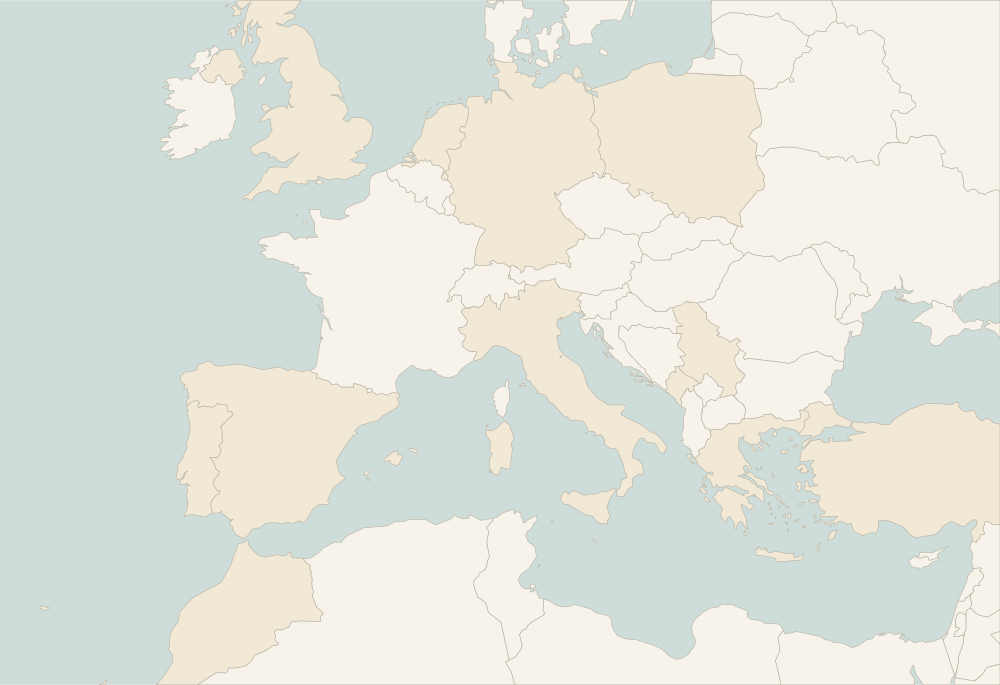
Czechia
Czechia · Tadeáš Bednarz, CC BY-SA 4.0

Czechia here means eight places that don't fit one kind of trip: Prague is the capital and the country's main international entry point, Brno and Olomouc are Moravian cities on the other side of the country, Český Krumlov is a small town wrapped around a river bend, Karlovy Vary is a spa town with its own film festival, Kutná Hora is a day trip built around one strong story, silver; Plzeň takes two days around another, beer; and Telč is the smallest of all, a UNESCO-listed square and not much else. Almost everything is reached by train from Prague; the exception is Telč, which sits closer to Brno.

Czechia is not in the eurozone: prices are in Czech koruna (CZK), at €1 = 24.399 CZK, cards everywhere, cash outside Prague. For a visitor coming from the eurozone that means one extra conversion on every price tag, and cash in the wallet before leaving Prague. Tip tip 10%, tell the server.

Where next

Cities and places in Czechia

Each place has its own page — what makes it worth the detour, and how long you need.

The full list

All 277 places we write about sit on one page — narrow them down by continent, country, price or what you are travelling for.

The same advance-payment logic covers the motorway: it's paid ahead of time, with a vignette, vignette, electronic via edalnice.cz, for example €12.30 (10 days). It's bought online or through an app before setting off; a car without one gets fined as soon as a camera reads the plate. Town and regional roads need no vignette; only motorways do.

Without a car, trains are the backbone of getting around the country, and the state operator doesn't run them alone: on the Prague–Brno–Olomouc line, alongside České dráhy, private operators RegioJet and Leo Express also run services, so departure and price get chosen the way a flight would be, not off a single timetable. Prague–Brno takes 2 h 30–37 min, Prague–Olomouc about 2 h 15, both direct.

The same line runs into another Czechia: Prague is not all of it — the country splits into Bohemia in the west and north and Moravia in the east, where Brno and Olomouc are. The difference shows in the accent, in wine as the local drink instead of beer — southern Moravia is wine country — and in visitor numbers, which in both Moravian cities stay well below Prague's.

Beer here is more industry than folklore: Pilsen produced the first golden pilsner-style lager in 1842, now sold as Pilsner Urquell, and the world copied that style from this one city. Czechia has held the world's highest per-capita beer consumption for decades, and its breweries remain one of the few products the country is recognised for abroad, a serious export line.
What it's known for

Six things Czechia means

The oldest astronomical clock still running

The Prague Orloj on the Old Town Square was installed in 1410 and is the third-oldest astronomical clock in the world, but the oldest one still working. It was built by clockmaker Mikuláš of Kadaň with astronomer Jan Šindel.

Central Europe's oldest university

Charles University in Prague was founded in 1348 by Emperor Charles IV, making it the oldest university north of the Alps and east of France at the time — the oldest in the whole of Central Europe.

The caron and the acute are a Czech invention

The háček and čárka diacritics were first proposed around 1406 in a work called Orthographia Bohemica, attributed to Jan Hus, then rector of Charles University — the first known spelling reform proposed for a Slavic language.

A town built by silver

In the Middle Ages, silver mines made Kutná Hora one of the most important towns in the Kingdom of Bohemia; that money paid for St Barbara's Cathedral. The town's historic centre has been a UNESCO World Heritage Site since 1995.

Franz Kafka wrote in German

Franz Kafka was born in Prague in 1883 and wrote in German his whole life, not in Czech — the city he lived in and the city his stories are set in didn't share a language.

A peaceful revolution without a shot fired

The Velvet Revolution ran from 17 November to 29 December 1989, when Václav Havel was elected president — a transfer of power without armed conflict, which is where the name comes from.

What to see

Five places for a first visit

This isn't a ranking — it's a route. Any one of these could carry a whole trip.

Prague
01

Prague

A capital on both banks of the Vltava: a castle and cathedral on the hill above one side, the Old Town and its astronomical clock on the other. The country's main airport, and the only one of the eight with a metro. Brno has its own airport, but only two year-round routes.

Brno
02

Brno

The country's second city and the capital of Moravia, with the Špilberk fortress on a hill above the centre. Less visited than Prague, even though it's under three hours away by train.

Český Krumlov
03

Český Krumlov

A small town wrapped around a bend of the Vltava, with a castle looking down over the whole historic centre. Walkable in a day, but a longer trip out than the Moravian cities.

Karlovy Vary
04

Karlovy Vary

A spa town in western Bohemia, with colonnades built over hot springs and a film festival every summer. Closer to the German border than to Moravia.

Olomouc
05

Olomouc

A Moravian university town with a Baroque Holy Trinity Column on its main square, under UNESCO protection. Smaller and quieter than Brno, with a similar train link from Prague.

Pilsen
06

Pilsen

The city where the first golden pilsner-style lager was brewed in 1842, and still home to the brewery that claims the original recipe. Close to Prague, usually a day trip.

Frequently asked

Before you go

Short answers to what people ask most before setting out.

Does the same time of year suit every place in Czechia?

Almost: Prague and the Moravian cities are best May–June and September, and the same goes for Karlovy Vary and Český Krumlov. The exception is Kutná Hora, which runs longer and quieter April–October, longer hours — the mine and the chateaux keep shorter hours outside that window.

Do I need a vignette or a car in Czechia?

On the motorway, yes: vignette, electronic via edalnice.cz, for example €12.30 (10 days). Inside Prague, no — the city has a metro and dense public transport. Between cities, the train is the main link (Prague–Brno–Olomouc); a car helps most for trips off those lines.

Can I pay by card everywhere in Czechia?

In the cities, almost everywhere: cards everywhere, cash outside Prague. Cash is still useful for small markets and pubs outside them, and for the tip — tip 10%, tell the server.

Plan the trip

Ready for Czechia?

Checked at the source12 facts on this page carry a source and a check date.All sources →
Where next

If you liked this

Keep going — these destinations and stories pair well with this one.

On the map

Prague, Brno, Český Krumlov and Karlovy Vary, and so on

The whole of Czechia fits into one query — six questions and you know which of them suits you.

Not sure where to next? Six questions and you get places that actually suit you. Find me a destination

Front row for the next trip

Leave your email and we'll let you know when a new destination or story goes up.

Photo credits and licences (18)

All photographs come from Wikimedia Commons and are used under the licence stated beside each one.