

- Published
- 7 October 2026
- Reading
- 7 min read
- Where
- Prague
- Prices checked
- 7. Oct 2026.
Czech castles chain well into one route: Prague and two trips from it, then South Bohemia, then Telč. From November several open only some days.
Six castles make a route that runs from Prague to the Moravian border without repeating a style: the largest castle complex in the country, a Gothic treasury, an archduke's hunting lodge, a white neo-Gothic fantasy, a river town built around its castle, and a Renaissance one with an arcaded square. What decides the route is the calendar: from November several of them open only some days, and some close for winter. Look up the opening days before you fix the order.
The largest of them all
Prague Castle was started in 870 with a small church and grew into a complex that the Guinness Book of Records lists as the largest ancient castle in the world. It was home to Bohemian kings, Holy Roman emperors and, since 1918, to Czechoslovak and Czech presidents. The Gothic St Vitus Cathedral inside was finished only in 1929.
It received 2.59 million visitors in 2024, and a visitor ticket is €18.44. It sits above the Vltava in the centre of the city, so it needs no transport at all and works as the first morning of the route.
Official ticket
- Visitor ticket
- €18.44
- Location
- above the Vltava, in the centre
Through a partner
- options with a guide or audio guide
- usually costs more than the official ticket

A treasury on a hill
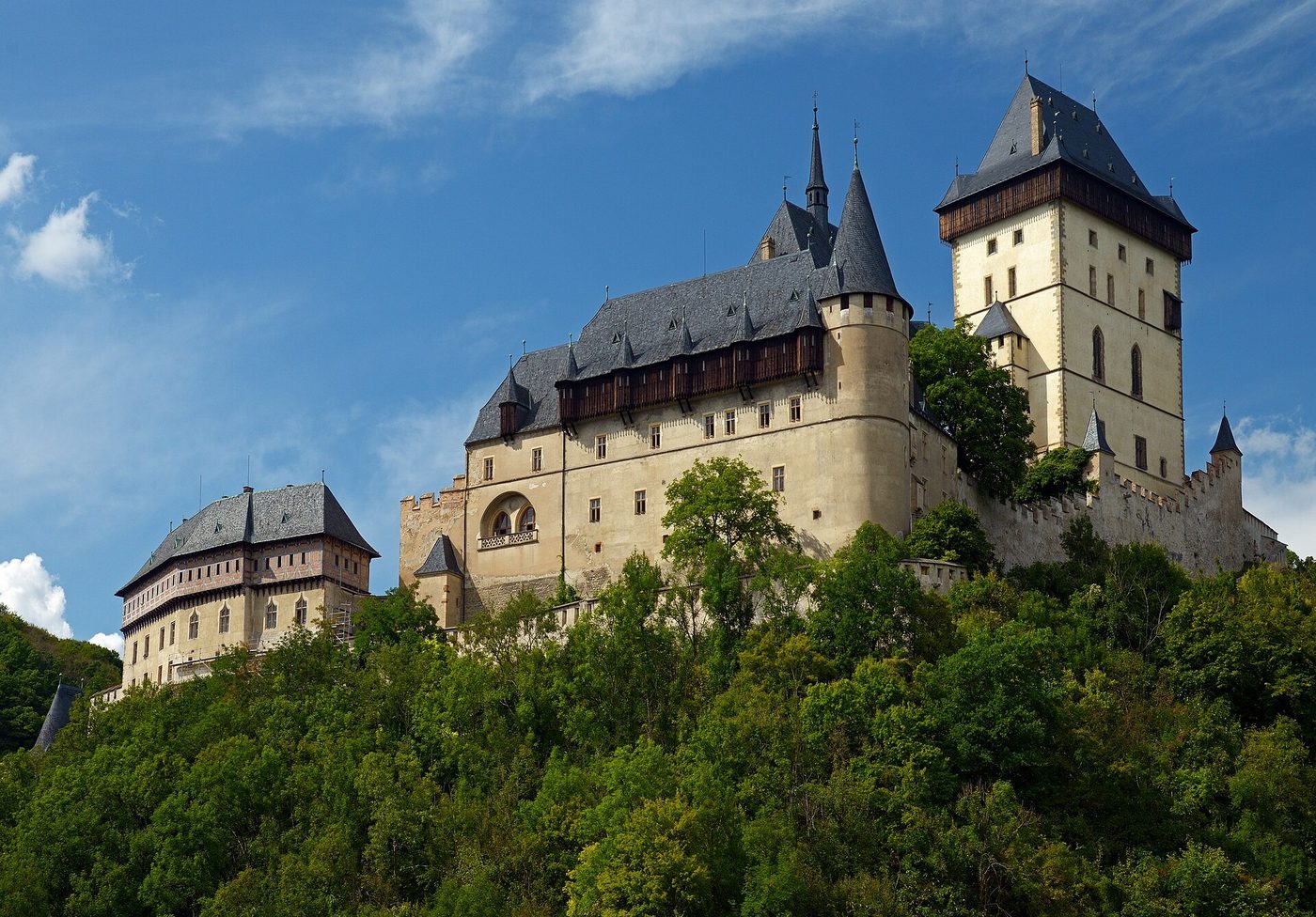
Karlštejn was founded in 1348 by Charles IV to keep the crown jewels and holy relics of his empire, and it looks the part: a Gothic fortress on a wooded hill above the Berounka, with the tall Great Tower at one end. About 40 kilometres from Prague, it is the easiest of the trips out of Prague. A train leaves Prague every 30 minutes and takes 40 min.
From the station it is a walk through the village and uphill. Only guided tours run, and the basic tour is €12.29, and it runs Tue–Sun 9:30–16:30 in October, Fri–Sun 10–15 in November; the castle is closed 21–25 December. The separate chapel tour, which includes the holiest rooms, costs more than double and runs only in season.
Official ticket
- Basic tour
- €12.29
- Train from Prague
- every 30 min, takes 40 min
- Oct
- Tue–Sun 9:30–16:30
- Closed
- 21–25 December
Through a partner
- options with a guide or audio guide
- usually costs more than the official ticket

The last home of Franz Ferdinand
Konopiště began about 1294 as a French-style Gothic fortress, was turned into a Baroque château, and was bought in 1887 by Archduke Franz Ferdinand of Austria, who had it rebuilt as a residence and laid out an English park of 225 hectares with a rose garden. His hunting trophies fill one of the tours, and the castle is famous as his last home before Sarajevo.
It lies on the line from Prague to České Budějovice. The train stops at Benešov u Prahy and the castle is about two kilometres on foot, or by a tourist train in season. The state rooms are €12.29 and open Tue–Sun 10–15 in October, Sat–Sun 10–15 in November; the archduke's private rooms cost more and, among the autumn months, open only in October.
Official ticket
- State rooms
- €12.29
- Oct
- Tue–Sun 10–15
- Nov
- Sat–Sun 10–15
- From the station
- Benešov u Prahy, about two km
Through a partner
- options with a guide or audio guide
- usually costs more than the official ticket
Windsor on the Vltava
Hluboká is a white castle of towers and battlements, rebuilt in 1841–1871 in a neo-Gothic style modelled on Windsor by the Schwarzenbergs, who had owned it since 1661. It stands 15 kilometres north of České Budějovice, about 150 kilometres south of Prague.
No train runs straight from Prague: by rail it means a change in České Budějovice and a station at least three kilometres from the castle, so the direct bus from Prague, or a car, is easier. The main tour is €12.29, and the castle is open Tue–Sun 9–16:30 until 1 November, winter tour Tue–Sun 9–16 from 3 November.
Compare rental prices before you go, then pick the car up at the airport or in town.
A castle that is a town
Český Krumlov dates from 1253 and is the second-largest castle complex in Czechia after Prague Castle, wrapped by a bend of the Vltava and a UNESCO site since 1992.
Its Baroque theatre from 1767 is among the best preserved in the world, and the five-storey Cloak Bridge, from 1764, carries visitors over the moat to the gardens.
Direct express trains run from Prague in about 3 h. Circuit I is €12.30 and runs Tue–Sun 9–16 (Sep–Oct 2026), with booking recommended, and the castle is closed Monday; out of season (Nov–Mar).
Official ticket
- Circuit I
- €12.30
- Open
- Tue–Sun 9–16 (Sep–Oct 2026)
- Closed
- Mondays
- From Prague
- express, about 3 h
Through a partner
- options with a guide or audio guide
- usually costs more than the official ticket

The Renaissance one
Telč closes the route: in the middle of the 16th century Zachariáš of Hradec had the Gothic castle rebuilt in the Renaissance style, and the arcaded houses of the square outside it followed. The castle and the historic centre are a UNESCO site, and the castle and the square stand side by side.
It sits on the Moravian side, so the way in is by bus: 1 h 45 from Brno, or 2 h from České Budějovice, which makes it a natural last stop after Hluboká and Krumlov. Entry is €10.66 (circuit A), and the closing days are Monday (confirmed Sep–Oct); closed Nov–Mar.

Check the same room on both sites: price and cancellation terms can differ.
Czechia, in brief
What now
If this sounds like your trip, start here.
Prague
→Charles Bridge, the clock on the Old Town Square and the castle on the hill are one half; the Jewish Quarter and Vyšehrad, on the opposite bank of the Vltava from the Castle, are the other.

Prague in 3 days
→Day one is the Castle and the bridge, day two is Josefov and Vyšehrad, day three is Kutná Hora by train.
Day trips from Prague
→An ossuary built from the bones of 40,000 people, a castle that once guarded the crown jewels, and a fortress with two faces of history.

Where to stay in Prague
→Staré Město puts everything within reach and charges the most for it. Malá Strana is quieter, right by the Castle.

What Prague costs
→The priciest item in Prague is the Castle, and the biggest free reward is its courtyards and gardens, which you can see without a ticket at all.

Prague beyond the Castle: the garden, the library, the lane and the island the walk skips
→A terraced Baroque garden without the crowds, a library seen from the doorway, a lane without a single souvenir shop and an island right under the bridge.

What to eat in Prague
→Svíčková in a tavern, chlebíčky on the go, a dark lager with either. Five dishes that cover what people in Prague actually eat.

The best time to visit Prague
→May, June and September keep Prague free of the summer crowds.

Getting around Prague
→From the plane to Old Town Square in two steps: a trolleybus, then the metro.

Mistakes everyone makes in Prague
→Five mistakes that cost time or money in Prague, and what to do instead.

Czechia
→A capital on the Vltava, the country's second city, a spa town with a film festival and a small town bent around a river — one country still paying in koruna

Fortresses of Serbia: six walls from Petrovaradin to Niš
→The Danube in Serbia carries a string of fortresses that are visited in the order the river flows, from a Habsburg one at Novi Sad to a medieval one in the gorge, with Niš kept for a separate day.

Castles of Slovakia: six fortresses from Bratislava to Spiš
→Six castles stand between the Danube and the Spiš plateau, so they are visited from west to east.

Castles of Austria: six strongholds from Vienna to Innsbruck
→Austria's castles can be visited from east to west, from the Vienna area through Styria and Salzburg to Tyrol, because each of the six is a trip from a larger city.

Castles of Bavaria: Ludwig's palaces and Nuremberg from Munich
→Ludwig's palaces lie in three directions from Munich, and Nuremberg in a fourth.
Prague, Kutná Hora and Pilsen from this story
See which of them suits you, then pin what you have already done.
Front row for the next trip
Leave your email and we'll let you know when a new destination or story goes up.