

Castles of Bavaria: Ludwig's palaces and Nuremberg from Munich
- Published
- 7 October 2026
- Reading
- 7 min read
- Where
- Herrenchiemsee
- Prices checked
- 7. Oct 2026.
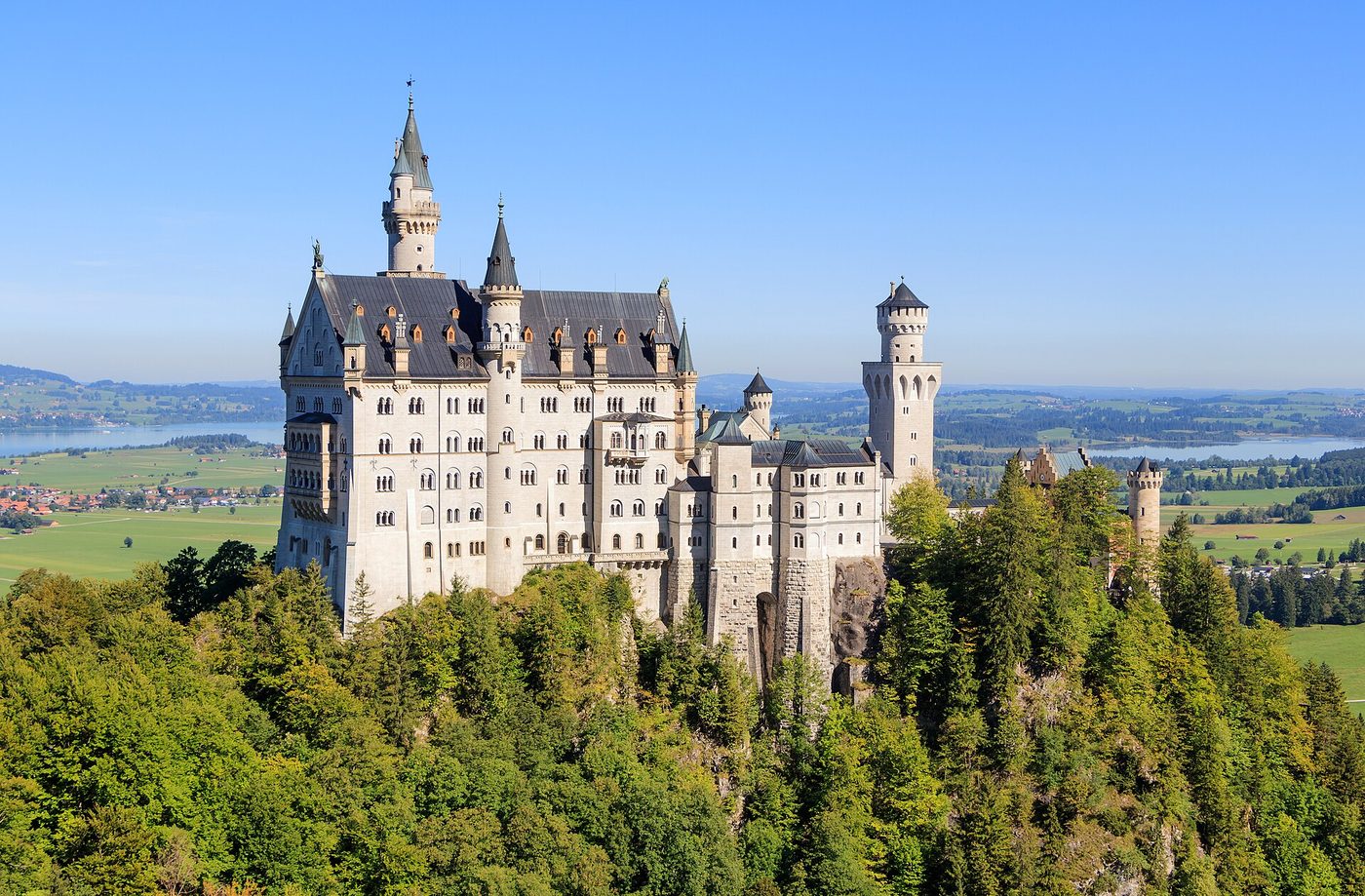
Ludwig's palaces lie in three directions from Munich, and Nuremberg in a fourth. Each needs a day of its own, and Neuschwanstein needs a ticket bought ahead.
Three palaces in Bavaria were built by one king, Ludwig II, and each lies in a different direction from Munich: Herrenchiemsee to the east, Neuschwanstein to the south, Linderhof to the south-west. Nuremberg's Imperial Castle, an older, imperial one, lies to the north. All four can be done as day trips, but not two on one day, and at Neuschwanstein the ticket has to be settled before the train is.
A Versailles on an island
Herrenchiemsee is the simplest of the three palaces to reach, one train and a boat, so if you have never done a castle day trip, start here. Ludwig II bought the island in the Chiemsee in 1873 and then began the New Palace, from plans by Georg Dollmann, as a copy of Versailles. When he died in 1886 it was still unfinished: 50 of its 70 rooms were left as bare shells. What was finished is the grand part, led by a Hall of Mirrors 98 metres long, longer than the one at Versailles.
From Munich the train to Prien am Chiemsee takes around an hour. From the station a small Chiemsee train runs in summer to the pier at Stock; otherwise it is about 30 minutes on foot, and from the pier a boat crosses to the island. The state rooms are visited only on a guided tour, in English it lasts about 40 minutes. The combination ticket is €14, and the palace is open 25 April to 24 October 9am–6pm, in winter 10am–4.45pm.
Official ticket
- Combination ticket
- €14
- Tour
- about 40 min in English
- 25 Apr–24 Oct
- 9am–6pm
- From Munich
- train to Prien, around an hour
Through a partner
- options with a guide or audio guide
- usually costs more than the official ticket

The one that needs a time slot
Neuschwanstein was begun in 1869 and never finished: only the gateway and the royal rooms in the Palas were ever habitable. Ludwig II died on 13 June 1886 and the castle was opened to visitors that August. It is on the UNESCO list together with Ludwig's other palaces.
Entry is only by guided tour of about 30 minutes, at a fixed time printed on the ticket, with groups of up to 35. Tickets are sold only through the official Ticket Center in Hohenschwangau. Entry is €21, and an online booking adds €2.50 per ticket. Same-day tickets at the centre go first come, first served and are often sold out very early, so the online booking is the safe path, because the castle itself is open 28 March to 15 October 9am–6pm, 16 October to 27 March 10am–4pm.
The train from Munich to Füssen takes about two hours; then bus 73 or 78 for about ten minutes to Hohenschwangau. The walk up to the castle is 1.5 kilometres and 30 to 40 minutes, or a shuttle bus or a horse carriage takes you up. A regional Bayern-Ticket, €34 for one person and €10 for each further traveller, covers the whole trip but is valid on weekdays only from 9 am and not on ICE or IC trains.
Hohenschwangau, the castle below, was renovated by Ludwig's father, and it has its own ticket, bought at the same centre, a tour of about 45 minutes and about 90 steps to climb, with tours running until 15 October 9am–4.30pm, then 10am–4pm. Seasonal palace passes do not cover it.
Official ticket
- Entry
- €21, online +€2.50
- Tour
- about 30 min, up to 35 people
- 28 Mar–15 Oct
- 9am–6pm
- From Munich
- train to Füssen, about two hours
Through a partner
- options with a guide or audio guide
- usually costs more than the official ticket
The only one he finished
Linderhof is the only one of the three that was completed in the king's lifetime. Built to Dollmann's plans and finished in 1880, it was Ludwig's home from 1876. The park is the point as much as the palace: an artificial Venus Grotto made for a scene from Wagner's Tannhäuser, lit by 24 dynamos, and the Moorish Kiosk, bought after its first owner went bankrupt.
Visits to the palace are by guided tour of about 25 minutes, in German or English, and the grotto, open in summer only, on its own tour. The palace ticket is €11, palace and grotto together €18. The palace is open 15 April to 15 October 9am–6pm, the rest of the year 10am–4.30pm.
This is the hardest of the four without a car: a train to Murnau, a train on to Oberammergau, then bus 9622 to the palace, in all about three hours and 45 minutes each way, so if one day is all you have, read the timetable before booking anything.
Official ticket
- Palace
- €11
- Palace and grotto
- €18
- Tour
- about 25 min
- Without a car
- about three hours and 45 minutes each way
Through a partner
- options with a guide or audio guide
- usually costs more than the official ticket
Compare rental prices before you go, then pick the car up at the airport or in town.

The Imperial Castle
Nuremberg is a different kind of castle, an old imperial seat rather than a king's palace. The Hohenstaufen built it above the town, and the Golden Bull of 1356 made Nuremberg the place where each newly elected ruler of the Holy Roman Empire had to hold his first diet. It was destroyed in 1945 and has been rebuilt. The Palas and the Imperial Castle Museum are visited on your own; only the Deep Well comes with a guide, included in the ticket.
A combined ticket for Palas, museum and well is €10, and the gardens are free, while the castle is open April to September 9am–6pm, October to March 10am–4pm. The ICE from Munich takes about an hour, and from the main station it is roughly 30 minutes on foot through the old town to the castle. That is the one trip of the four that needs neither a time slot nor a connecting bus.
Official ticket
- Palas, museum, well
- €10
- Gardens
- free
- Apr–Sep
- 9am–6pm
- From Munich
- ICE, about an hour
Through a partner
- options with a guide or audio guide
- usually costs more than the official ticket

Check the same room on both sites: price and cancellation terms can differ.
Germany, in brief
What now
If this sounds like your trip, start here.
Munich
→The Bavarian capital, behaving as if the rest of Germany were abroad

Munich in 2 days
→The market on Saturday, the galleries on Sunday, a Monday without the Pinakotheken: two days in Munich ordered by the calendar, not the map.

Day trips from Munich
→Five trips out of Munich all leave from the main station, and the length of the ride decides how much of the day is left when you arrive.

Where to stay in Munich
→Munich's quarters all lie in the inner fare zone, so you choose by what you want outside the door: museums, bars, a park or a train.
What to eat in Munich
→What gets ordered in Munich, what it costs in the best-known beer hall, and what you carry into a beer garden from the market.
The best time to visit Munich
→Munich's weather rarely spoils a plan; Oktoberfest and the big trade fairs spoil the price of a room.

Germany
→A country with no single centre but a dozen, each convinced it is the main one

Fortresses of Serbia: six walls from Petrovaradin to Niš
→The Danube in Serbia carries a string of fortresses that are visited in the order the river flows, from a Habsburg one at Novi Sad to a medieval one in the gorge, with Niš kept for a separate day.

Castles of Slovakia: six fortresses from Bratislava to Spiš
→Six castles stand between the Danube and the Spiš plateau, so they are visited from west to east.

Castles of Austria: six strongholds from Vienna to Innsbruck
→Austria's castles can be visited from east to west, from the Vienna area through Styria and Salzburg to Tyrol, because each of the six is a trip from a larger city.

Castles of Czechia: six castles from Prague to Telč
→Czech castles chain well into one route: Prague and two trips from it, then South Bohemia, then Telč. From November several open only some days.
Front row for the next trip
Leave your email and we'll let you know when a new destination or story goes up.