
Malta
Three islands, a capital smaller than a square kilometre and megalithic temples from the fourth millennium BC
- Currency
- euro (EUR)
- Language
- Maltese and English (both official)
- Entry
- Schengen
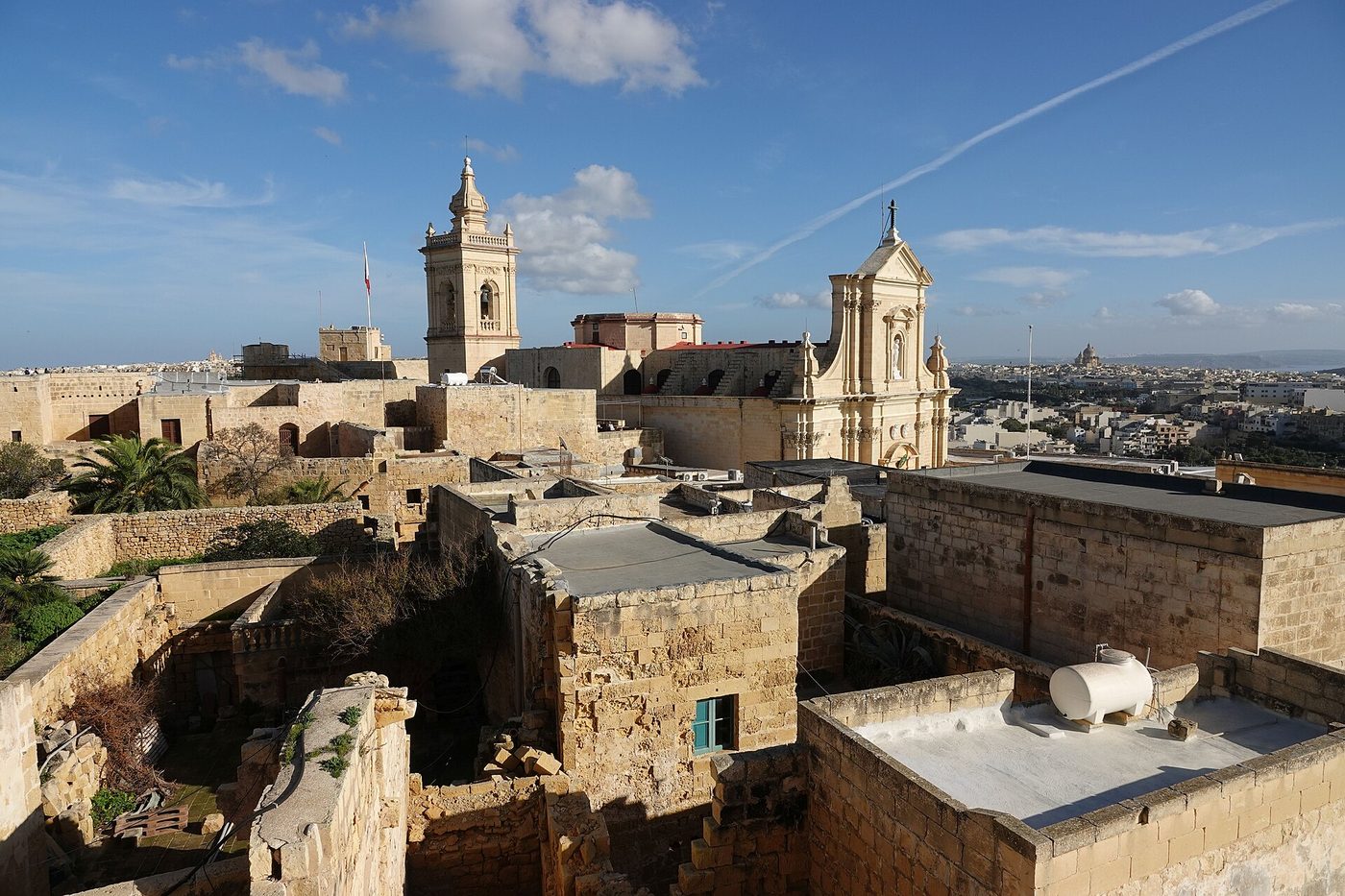
Malta is best seen from Valletta, with the rest of the archipelago as outings. The country covers 316 square kilometres across three inhabited islands, Malta, Gozo and Comino, and counted 588,254 residents in the 2025 census. Only the capital has its own page on this site, because Mdina, Gozo and Comino each work as a day out from there rather than as a base of their own.
Money is the easy part. Malta joined the EU on 1 May 2004 and has used the euro since 1 January 2008, so nothing needs changing at the airport if you arrive from the eurozone. Cards work almost everywhere, and a pocketful of coins covers the exceptions at kiosks and village bars. Tipping follows the usual custom: 5–10% if service is not included. Both English and Maltese are official, so signs, menus and timetables are readable from the first minute, which removes the one worry most first-time visitors have about a small island.
Cities and places in Malta
Each place has its own page — what makes it worth the detour, and how long you need.

All 282 places we write about sit on one page — narrow them down by continent, country, price or what you are travelling for.
Entry depends on the passport you carry, and the rules are changing at the moment: Schengen; EES active, ETIAS delayed. Read the current position a few weeks before departure, since the new border systems are the part that moves. Independence came on 21 September 1964 and the republic on 13 December 1974, so this is a young state with an old harbour.
Driving is on the left, which takes a few junctions to get used to. A car is rarely needed for the plan on this site, because Valletta is a walking city and the outings run on buses and ferries. Road tolls: none, except Valletta's zone. Plugs are the other surprise, so pack an adapter if your devices were built for something else: type G, 230V. In an emergency, call 112 (EU-wide number).
Think of the country as one base and three outings. Valletta carries the first days, with the harbour, the churches and the museums. Mdina was the capital until 1530, has 242 residents and keeps most cars out, which earns it the name of the Silent City, and it fits into half a day. Gozo covers 67 square kilometres, wants a full day, and sits a ferry ride away from Ċirkewwa to Mġarr of about 25 minutes. The fare is €4.65 return for foot passengers, collected only on the way back. Comino suits a morning or midday slot, because landing there has needed a free pass since 1 May 2025. The slots run from 8 to 13, 13.30 to 17.30 and 18 to 22, and anyone who stays on the boat needs no pass. Whoever sleeps in Valletta pays a tourist tax of €1.50 per person per night, which rose to this rate on 1 July 2026 and is capped at fifteen nights per visit, so it belongs in the budget from the first night.
Both sites fill in your nearest airport for you; change it in one click.
Check the same room on both sites: price and cancellation terms can differ.
Four things Malta means
Three islands on 316 square kilometres
Malta, Gozo and Comino make up the archipelago, with 588,254 people counted in the 2025 census. The highest point is Ta’ Dmejrek at 253 metres, which tells you the scale of the whole place.
Temples from the fourth millennium BC
The megalithic temples went up between roughly 3600 and 2500 BC. Ġgantija joined the UNESCO list in 1980 and the other five followed in 1992.
The EU’s smallest capital
Valletta covers 0.61 square kilometres and was founded in 1566. UNESCO listed it in 1980, and it was a European Capital of Culture in 2018.
Driving on the left
Malta became independent on 21 September 1964 and the traffic still keeps to the left, so look right first at every crossing.
Before you go
Short answers to what people ask most before setting out.
Do I need a visa for Malta?
It depends on the passport you carry. For most visitors Malta is a Schengen country, and the current rules read: Schengen; EES active, ETIAS delayed.
How many days does Malta need?
The answer in days: 2–3 for town; 4–5 with trips. Valletta alone fills the shorter figure, and each outing adds half a day or a whole one.
Do I need a car in Malta?
Not for Valletta, which you walk. Elsewhere the bus is enough for most plans, and a single ride costs €2 winter, €2.50 summer. Anyone who does hire a car drives on the left, and the only road charge is in Valletta’s own zone, which applies to Maltese-plated vehicles.
Which plug does Malta use?
Malta uses type G, 230V, so bring an adapter if your chargers have a different plug.
Ready for Malta?
If you liked this
Keep going — these destinations and stories pair well with this one.

Italy
→The cities on the high-speed line are an hour or two apart; the coast, Matera and the Tuscan hills lie off it

Greece
→The north by road, the Cyclades by ferry, Rhodes by air — pick the region first and the island second

Tunisia
→Ten towns in a line, from the capital to the sand at Tozeur — in the order they're actually travelled, not listed

Croatia
→A thousand islands and one road that looks down on all of them

Cyprus
→An island with the euro, left-hand traffic and two views of the same map, entered through Larnaca
Valletta
The whole of Malta fits into one query — six questions and you know which of them suits you.
Front row for the next trip
Leave your email and we'll let you know when a new destination or story goes up.