

Rhodes
A medieval city people still live in, on an island with two different coasts
- When to go
- November 19° · 7 rainy days
- Per day
- €€€price 3 of 5
- How many days
- 5–7days
- For you
- 6 questions →
- Nearest airport
- 13 km Rhodes
- Right now
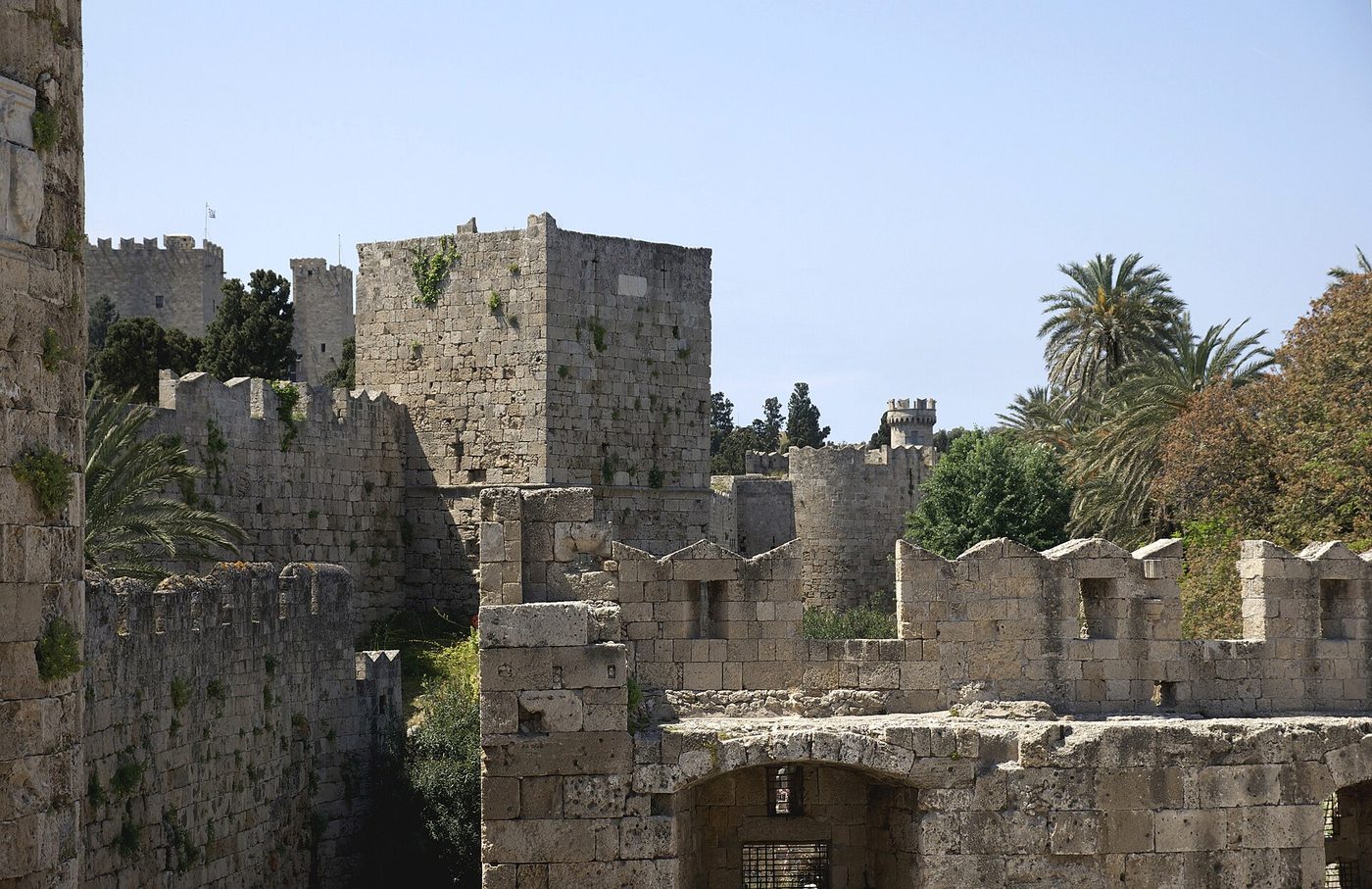
Rhodes is a fortified medieval town where people still keep flats, shops and a school, set on an island of eighty kilometres with warm sea all around it. The long walls run four kilometres and enclose sixty-five hectares of streets, while the rest of the island continues another seventy kilometres to the south.
The Knights of St John held the island from 1309 to 1523 and in that time turned a Byzantine citadel into a medieval town. The Street of the Knights is still a straight cobbled line of inns for the order's seven tongues, one for each nation, and the Great Hospital built between 1440 and 1489 is now the archaeological museum. After 1523 the Ottomans added mosques, hammams and minarets on top. UNESCO listed it in 1988. 'The largest inhabited medieval town in Europe' is the agencies' line, not UNESCO's; what stands without a caveat is 'inhabited', since people still keep house inside the walls.

The Palace of the Grand Master is not quite what it looks like. The original vanished in 1856, when lightning struck a powder magazine under a nearby church and the blast took out half the citadel. The Italians built today's palace between 1937 and 1940 as a summer residence for Victor Emmanuel III and Mussolini, and floored it with ancient mosaics from Kos. It is not a fake, but not the Middle Ages either, and the huge halls stay cold even in July.
The island has two coasts and they behave differently. The sunny west is exposed to the meltemi, which blows from the north most summer afternoons, so Ixia and Ialysos are where people windsurf and kite. The calm, sheltered east is where you go with children. The rule settles your accommodation faster than any review: want to swim, go east; want wind, go west. With over three thousand hours of sun a year, mid-October is still season.
3-star hotel, double room, per person per night
Timed-entry tickets and guided tours in one place.
Both sites fill in your nearest airport for you; change it in one click.
Guides for Rhodes
Shorter, practical pages for one concrete question each — how many days, how much money, where to sleep, where to escape the city.

Rhodes in 5 days
→The first two days stay in town, on foot; the other three go by bus, but not the same one: the east and west of the island run on two different companies, and that changes the order more than anything else.

Day trips from Rhodes
→Lindos and Kameiros are a half-day by bus; Prasonisi to the south and Symi across the water each need a full day and a different kind of plan.

Where to stay in Rhodes
→Rhodes town is the starting point for both RODA and KTEL Rodou, so it's the one base that doesn't force a choice between east and west: that decision waits for the coast, not the bed.

What Rhodes costs
→Greece is in the eurozone, so there's no currency conversion: the bed, food and all four sights have a price here, only the bus fare is missing.

Rhodes town beyond the Palace and the Street of the Knights
→A harbour with deer statues and windmills, the oldest synagogue in Greece and a hill with an ancient stadium, all off the main list and all without a bus.

What to eat in Rhodes
→Pitaroudia and melekouni aren't on every Greek menu: the two of them, alongside slow-cooked goat, keep Rhodian cooking different from islands running on Greek salad and gyros alone.

The best time to visit Rhodes
→The date in Rhodes doesn't just change the temperature: it also decides whether the Valley of the Butterflies is even open, and how full the ferry to Symi gets.

Getting around Rhodes
→Two companies split the island like two city lines that never cross: know which runs where, and you rarely wait at the wrong stop.

Mistakes everyone makes in Rhodes
→Anyone arriving on Rhodes assuming one bus and one ticket cover everything gets it wrong before setting off: RODA, KTEL Rodou and the 2025 reform change the plan more than anything else.
What to see in Rhodes
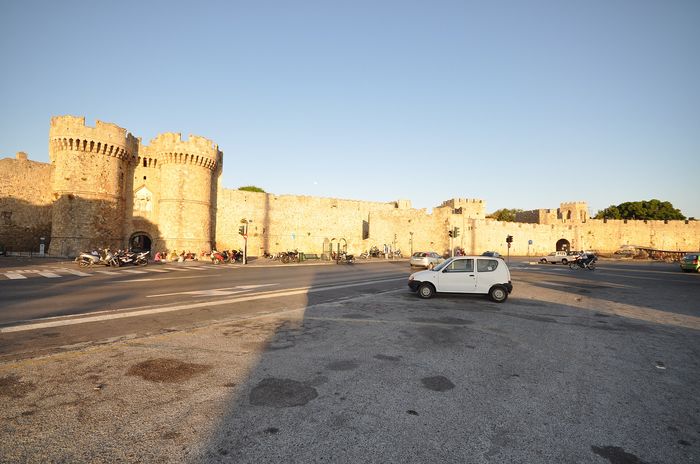
The old town and the Street of the Knights
Four kilometres of old wall around sixty-five hectares of streets, with a moat that is now a park you can walk for free. The Street of the Knights takes ten minutes to cross and looks best before eight in the morning, while the gates are empty and the ships haven't docked.
free · 10 min (street only)
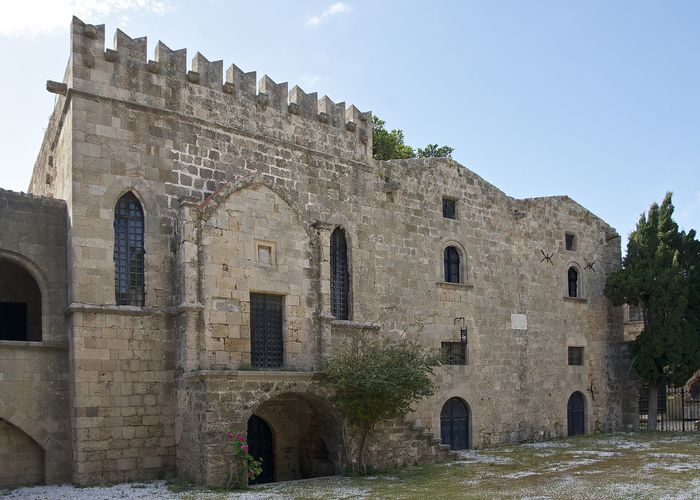
The Palace of the Grand Master
A courtyard, three hundred metres of corridor and huge halls floored with ancient mosaics from Kos. Go in the morning, because by afternoon everything off the cruise ships is inside.
€20 · closed Tuesday (Nov–Mar) · booking: recommended
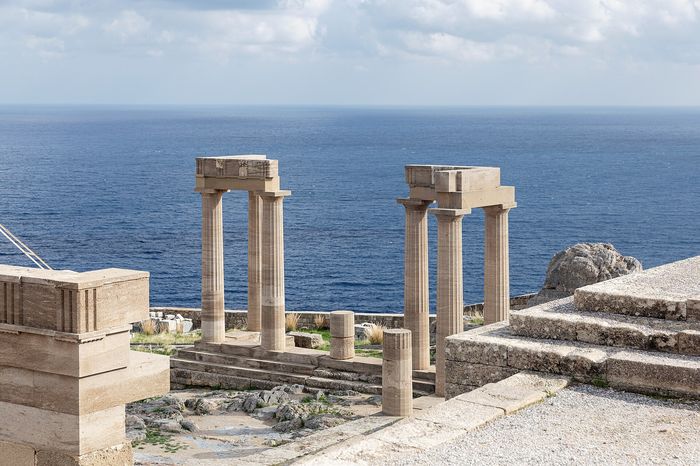
Lindos and its acropolis
Forty kilometres south, a white car-free village under a steep rock carrying a temple of Athena from around 300 BC. Cut into the stairway is a relief of a warship from about 180 BC. Below is St Paul's Bay, an almost closed ring of rock.
€20 · booking: timed slot
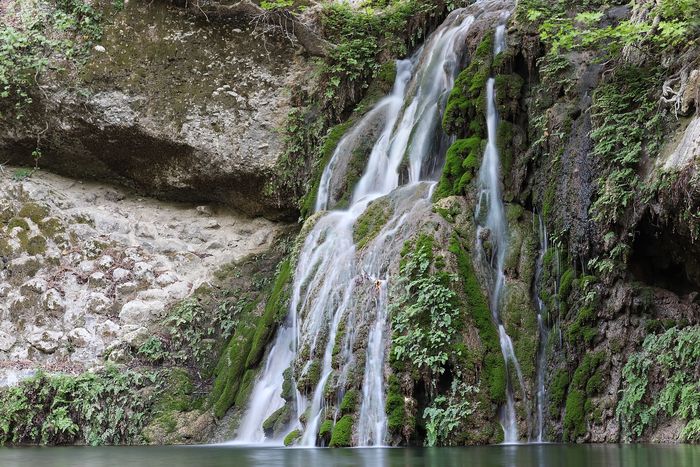
The Valley of the Butterflies
Petaloudes is a valley of moths rather than butterflies: Euplagia quadripunctaria rhodosensis flies by day and gathers on the trunks in thousands from July to September to sit out the heat. It doesn't feed at that stage, so every clap and shout literally spends its lifespan, hence the silence rule.
€6 (22 Jun–24 Sep)
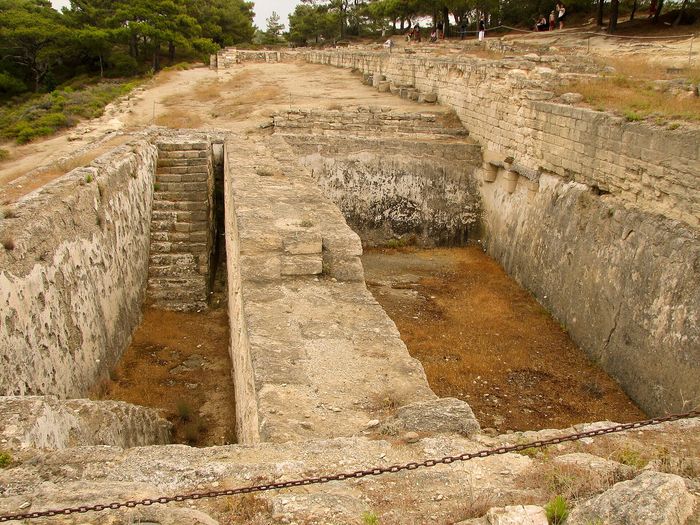
Kameiros
One of the island's three ancient Dorian cities, flattened by earthquakes in 226 BC and AD 142, then forgotten until 1859. What survives is a whole street grid on a sloping hillside, houses, an agora and a covered cistern of six hundred cubic metres from the sixth century BC. There is no shade anywhere, so come early.
€10 · closed Tuesday (Nov–Mar)
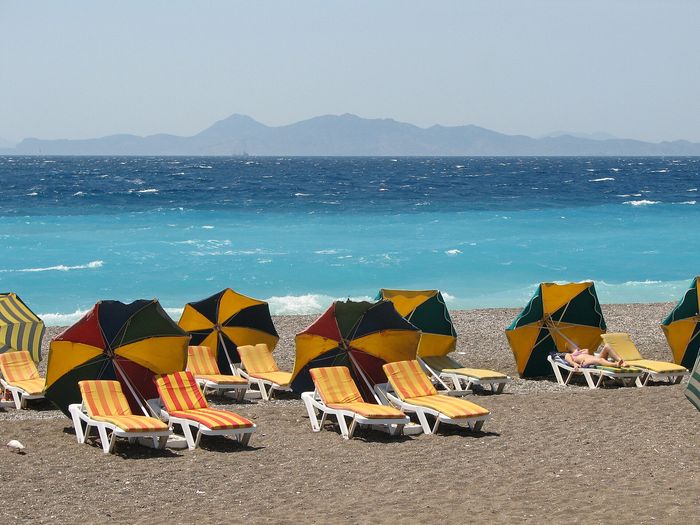
The two coasts
The east is for swimming: Tsambika, Agathi and Kallithea have calm water without waves and a shallow entry. On the windy west, at Ixia and Ialysos, you hold your towel in the afternoon rather than lie on it. Both fit in a day by bus, but you pick one to sleep on.
free (beaches)


Stories from Rhodes
How it actually was when we were there, and what was worth it.

Rhodes beyond the package deal, the old town and two coasts
→Rhodes is sold as a beach resort on the east coast, and the walled town where people still live gets left out. The town and the wind between them decide how a week on the island goes.
Nomadinho scores out of 100, the same ones behind “Where to go”.
If you like Rhodes
Three places with the closest scores, from any country.


Two things you probably did not know
The Colossus of Rhodes, one of the seven wonders, stood for about fifty years before an earthquake toppled it in 226 BC. The pieces lay on the ground for eight centuries, because an oracle forbade raising it again.
The old town of Rhodes is the largest inhabited medieval town in Europe. The Knights of St John raised the walls in the fifteenth century, and several thousand people still live inside them.
Before you go
Short answers to what people ask most before setting out.
How many days do you need on Rhodes?
Five to seven, with two for the old town. Five days cover the town, Lindos and the west coast; a seventh would add the other coast, or a trip to Prasonisi or Symi.
Do you need to book Lindos in advance?
Yes, all year round: the 2025 reform introduced a timed entry slot for the acropolis, not just in July and August. Sites sell their own tickets: €20 for Lindos, €20 for the Palace, €10 for Kameiros.
Which side of Rhodes is best to stay on?
The east is calm and sheltered, which suits swimming and children. The west is sunnier but gets the meltemi, so Ixia and Ialysos are where people windsurf and kite.
Ready for Rhodes?
Within reach from here
Places sorted by straight-line distance from Rhodes — day trips or weekends.

Greece
→The north by road, the Cyclades by ferry, Rhodes by air — pick the region first and the island second

Turkey
→Istanbul, then one direction: Cappadocia by plane, Ephesus and Pamukkale by train, or the Lycian coast by bus

Montenegro
→The Bay, the riviera or Ulcinj for the sea, Durmitor for July — choose the coast by its beaches and the north by the month
All 292 places we write about sit on one page — narrow them down by continent, country, price or what you are travelling for.
Guides that mention it
Front row for the next trip
Leave your email and we'll let you know when a new destination or story goes up.