

Rhodes beyond the package deal, the old town and two coasts
- Published
- 25 August 2021
- Reading
- 5 min read
- Where
- Rhodes, Greece
- Prices checked
- 22. Sep 2026.
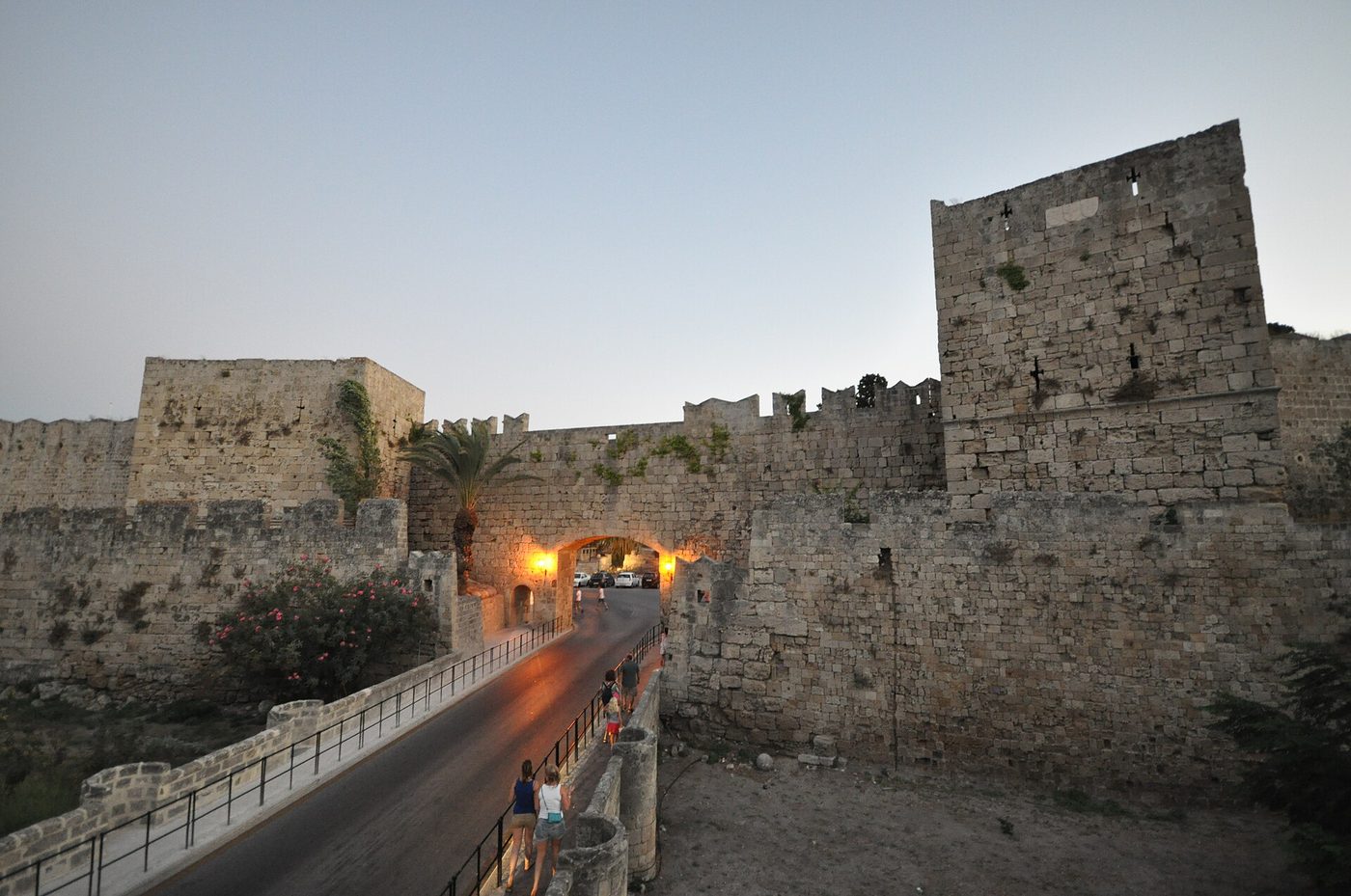
Rhodes is sold as a beach resort on the east coast, and the walled town where people still live gets left out. The town and the wind between them decide how a week on the island goes.
Package holidays skip two things on Rhodes: an inhabited medieval town, and the fact that the island has two coasts with different weather. Nobody prints the second one in a brochure, yet it is the one that tells you which beach to pick on a given morning.
The old town, and one claim that keeps repeating
Start with who built it. The Knights of St John held Rhodes from 1309 to 1523 and spent those two centuries turning the town into a fortress, which UNESCO listed in 1988. The Palace of the Grand Master at its centre looks medieval and is only partly so. Italians rebuilt it between 1937 and 1940 to a Gothic ideal of their own, and the mosaics inside came from the island of Kos. Entry for adults is €20, and the first slot at about nine is the one to book, because the courtyard is quiet then and crowded by noon.
The line that keeps repeating, "the largest inhabited medieval town in Europe", does not appear in UNESCO's description, and the blogs that print it also call the town the oldest, with no ranking behind either. What can be said is simpler. People live here, in flats and above cafés and behind shop counters, and cars stay outside the walls unless they belong to residents or deliveries. That matters for choosing a bed. Cruise ships dock from about eight in the morning, the streets are busiest around midday, and the ships leave between four and six. A room inside the walls gives you the town before the first gangway and after the last, while the Jewish Quarter around the Kahal Shalom synagogue stays calm even in between.
Check the same room on both sites: price and cancellation terms can differ.

Two coasts, two different seas
The west coast faces the Aegean and takes the meltemi, the northern summer wind that blows from April to October and peaks in July and August. The water is cooler there and the waves bigger, and Ixia and Ialysos near the north-west corner are where the windsurf and kite schools sit. The east coast lies in the lee and stays calm. Tsambika is shallow sand under a monastery, Agati near the fishing village of Haraki is sheltered and full of families, and Anthony Quinn Bay has the snorkelling and fills up early. In the far south Prasonisi shows both seas at once: the Aegean side throws waves, the Mediterranean side lies flat, and in summer a sand bar joins the cape to the island with a lighthouse at the end. The wind there can blow off the land, which is no place for beginners.
So the plan gets made in the morning, looking at the sea. If the wind is up, go east. If the air is still, the west is emptier and the water clearer. The island is long and mountainous, and Prasonisi alone is about 92 km from Rhodes town, so the drive takes longer than the map suggests. A coast that cannot be reached before lunch is not a coast for today.
Lindos and the rest of the island
Lindos is the postcard, and the postcard is accurate. The village below has no cars, and the temple of Athena crowns a limestone cliff 116 metres above the sea. The acropolis costs €20 for adults, sold for a time slot. The taxi leaves you at the edge of the village and the climb goes over uneven stone with no shade, nothing is sold at the top and there is no toilet, so water and an early start are the whole plan. The worst hour is noon, when the excursion boats and cruise groups arrive. Lassu, on the slope just below the descent, has a better view than most terraces in the village. Kamiros on the west coast is a Doric city from the fifth century BC on a hill above the sea, quieter than Lindos, with entry at €10. Petaludes, the so-called Butterfly Valley, is full of moths that rest on the trees in summer, along a forest path with waterfalls and the Kalopetra monastery from 1484.


When to go and how to get there
The season is longer than the hotels admit. The best months are May–Jun · Sep–Oct, with the sea still warm in the autumn, while July and August bring peak prices and a meltemi at full strength. Winter is mild enough for walking. From Belgrade a direct flight runs in season, and outside it the route goes through Athens or Thessaloniki. The ferry from Piraeus takes a full day and a night at sea, so it suits a trip where the journey is the point. From the airport the RODA bus reaches the centre of Rhodes town in 35–45 min.

History and sea do not have to be chosen between. What gets chosen is the nights: two inside the walls, before the first ship and after the last, and the rest on whichever coast the wind has left calm.
Greece, in brief
What now
If this sounds like your trip, start here.
- Choose the beach by the wind, not by looks — the two coasts of the island have different weather.
- Leave time for the old town: 65.85 hectares inside the walls, still lived in.
- Know what you're seeing: the Street of the Knights and the Great Hospital are fifteenth century; the Grand Master's Palace is an interwar reconstruction.
Rhodes
→A medieval city people still live in, on an island with two different coasts

Rhodes in 5 days
→The first two days stay in town, on foot; the other three go by bus, but not the same one: the east and west…

Day trips from Rhodes
→Lindos and Kameiros are a half-day by bus; Prasonisi to the south and Symi across the water each need a full day and a different kind of plan.

Where to stay in Rhodes
→Rhodes town is the starting point for both RODA and KTEL Rodou, so it's the one base that doesn't force a choice between east and west: that decision waits for the coast, not the bed.

What Rhodes costs
→Greece is in the eurozone, so there's no currency conversion: the bed, food and all four sights have a price here, only the bus fare is missing.

Rhodes town beyond the Palace and the Street of the Knights
→A harbour with deer statues and windmills, the oldest synagogue in Greece and a hill with an ancient stadium, all off the main list and all without a bus.

What to eat in Rhodes
→Pitaroudia and melekouni aren't on every Greek menu: the two of them, alongside slow-cooked goat, keep Rhodian cooking different from islands running on Greek salad and gyros alone.

The best time to visit Rhodes
→The date in Rhodes doesn't just change the temperature: it also decides whether the Valley of the Butterflies is even open, and how full the ferry to Symi gets.

Getting around Rhodes
→Two companies split the island like two city lines that never cross: know which runs where, and you rarely wait at the wrong stop.

Mistakes everyone makes in Rhodes
→Anyone arriving on Rhodes assuming one bus and one ticket cover everything gets it wrong before setting off: RODA, KTEL Rodou and the 2025 reform change the plan more than anything else.

Greece
→The north by road, the Cyclades by ferry, Rhodes by air — pick the region first and the island second

Belgrade to Thessaloniki without a train: days, not hours
→The bus and the car each eat a day in every direction, while the plane takes an hour and a quarter, so a weekend of two days by coach turns into four days away from home.

Car hire in Greece: tolls, ferries and Athens
→Tolls are paid at plazas, the hire contract decides whether a car may board a ferry, and central Athens has an odd-even rule.
Front row for the next trip
Leave your email and we'll let you know when a new destination or story goes up.