

Pamukkale
Terraces climbed barefoot, and a city above them walked in shoes
- When to go
- October 20° · 2 rainy days
- Per day
- €€price 2 of 5
- How many days
- 1days
- For you
- 6 questions →
- Nearest airport
- 53 km Denizli
- Right now

Pamukkale is a day trip from Denizli, and the decision is which gate to use: through the lower one, in the village, you climb the white terraces up to Hierapolis; through the north or south gate you come in from above, into the ancient city first. One ticket, €30, covers the terraces, Hierapolis and the archaeology museum.
The name means “cotton castle”, and the whiteness is calcium from seventeen hot springs. Shoes aren't allowed on the travertine, so you carry them, and only along the marked path: the authorities regulate the water flow and close sections of the terraces from time to time so the surface can recover, which means not every pool from the photos is open.

From Denizli, on the lower level of the bus station, minibuses to Pamukkale leave every 15 to 20 minutes and take twenty to thirty minutes. For the lower gate, get off in the village; to start with the ancient city, stay on to the north entrance. On the way, if you ask the driver, it stops at Laodicea, another ancient city on the same plain.
What to see in Pamukkale
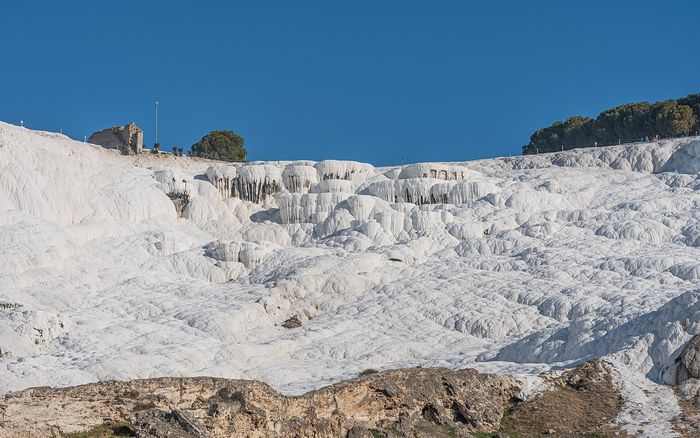
The climb up the terraces
From the lower gate to the top, uphill on wet stone. For anyone who wants the terraces as the main part of the day; if uphill walking is hard, come in from above and go down only to the first pools.
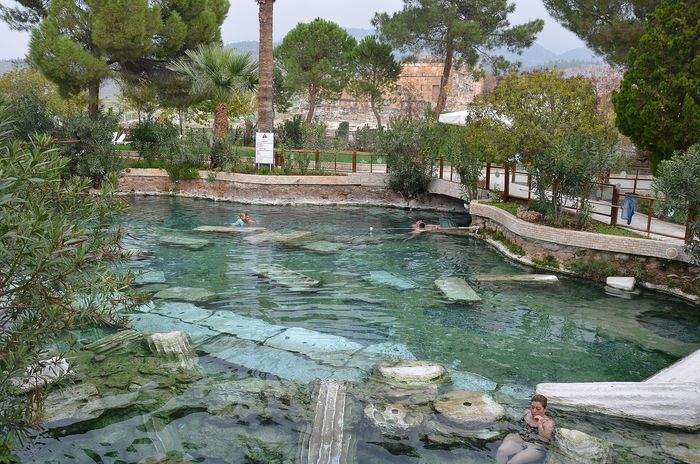
The Antique Pool
A swim in thermal water in the middle of Hierapolis, among Roman remains. It isn't in the main ticket and is paid separately; for anyone who brought a swimsuit and has a spare hour.
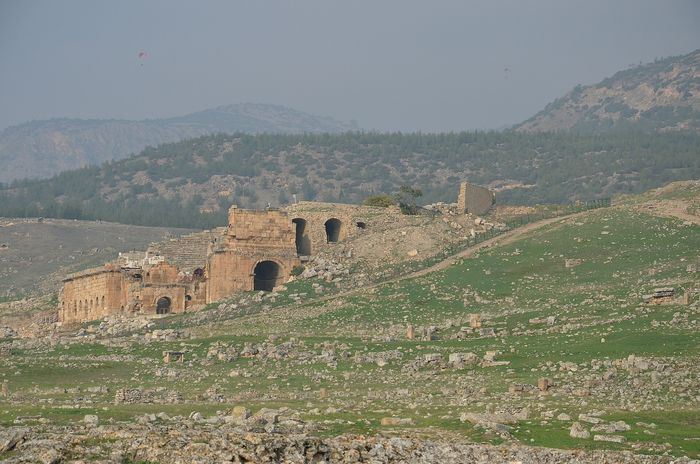
Hierapolis
The Romans didn't found it: the city dates from the Hellenistic period, came under Rome in 133 BC and was rebuilt in Roman style after the earthquake of AD 60. It went onto UNESCO's list together with the terraces in 1988; for anyone as interested in ruins as in travertine.
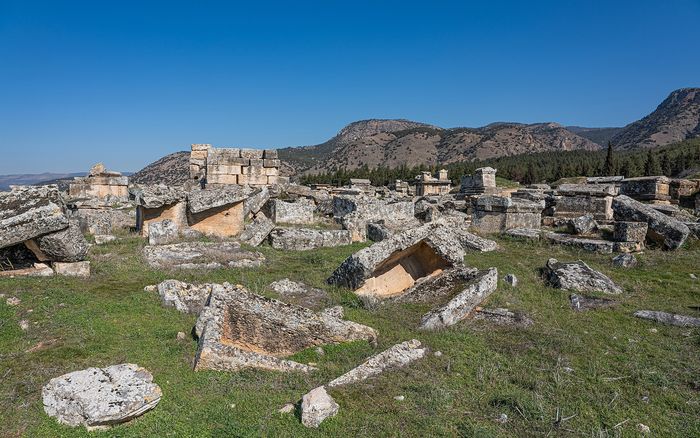
The theatre
A Roman theatre for around 15,000 spectators, from that rebuilt, Roman city. The reason not to head straight back from the terraces, for anyone with half a day for the ancient city as well.
The necropolis
More than two kilometres of graves along the ancient road, around 1,200 tombs. From the north gate you enter through it, so it's the first thing you see if you start from the north.
- P
Pluto's Gate
An ancient sanctuary over a fissure that gives off gas, walled up in Christian times and dug out again in 2013. A small site, for anyone more interested in ancient religion than in the view.


Two things you probably did not know
The white terraces are neither snow nor chalk but travertine, stone formed when warm calcium-rich water meets the air and leaves a deposit. The layer grows about a millimetre a year, so the terraces are still forming.
Above the terraces stands Hierapolis, an ancient city built around the springs for their cures. Cleopatra's pool is full of fallen Roman columns lying on the bottom. They came down in an earthquake and stayed.
Ready for Pamukkale?
Within reach from here
Places sorted by straight-line distance from Pamukkale — day trips or weekends.

Turkey
→Istanbul, then one direction: Cappadocia by plane, Ephesus and Pamukkale by train, or the Lycian coast by bus

Greece
→The north by road, the Cyclades by ferry, Rhodes by air — pick the region first and the island second

Serbia
→The north an hour away by train, the mountains three or four by car — Serbia divides by the time you have
All 277 places we write about sit on one page — narrow them down by continent, country, price or what you are travelling for.

Front row for the next trip
Leave your email and we'll let you know when a new destination or story goes up.