

Sidi Bou Said
A blue-and-white village on a cliff above the bay and, two stops before it, what is left of the city that was bigger than Rome
- When to go
- September 26° · 4 rainy days
- Per day
- €€price 2 of 5
- How many days
- 1days
- For you
- 6 questions →
- Nearest airport
- 10 km Tunis · 89 km Enfidha
- Right now

Sidi Bou Said and Carthage are one day, on one train: the ruins in the morning before the heat, the village in the afternoon when the streets are in shade and the café on the cliff has the light off the sea. Carthage disappoints anyone expecting Rome, and delights anyone who read what is written here before coming.
Carthage is not one site but a dozen scattered across a suburb, with a shared ticket of €6 valid for all of them on the same day. Everything visible is Roman — the Antonine baths by the sea, the villas on Odeon hill, the amphitheatre, the cisterns — because Punic Carthage was razed in 146 BC and what remains of it are foundations on Byrsa hill and two Punic harbours, today two quiet lakes with boats. The museum on Byrsa remains closed for reconstruction, with a target reopening at the end of 2026; the hill is climbed for the view of the gulf, which explains why the city was here in the first place.

The order that works: train to Carthage Hannibal station, walk up to Byrsa for the view, then downhill to the baths by the sea and the Punic harbours, then the train again two stops to Sidi Bou Said, at €0.24 a ride. The baths are the largest thing standing and the only place where the scale is felt; everything else is fenced parks of stones that need imagination. Anyone with time adds the Tophet, a few steps from the Punic harbours — the sanctuary where the Carthaginians, according to the Romans, sacrificed children, and according to some archaeologists only buried those who died young.
Sidi Bou Said is a village where Baron d'Erlanger popularised the blue-and-white scheme in the 1920s, and it has stayed that way. The main street is a hundred metres of shops, behind it are streets without a single one, and at the end are two cafés on the cliff — pick the farther, less famous one, which is better. Bambalouni, fried dough with sugar, is sold at the entrance to the village and eaten hot, walking.
Guides for Sidi Bou Said
Shorter, practical pages for one concrete question each — how many days, how much money, where to sleep, where to escape the city.

Sidi Bou Said in 1 day
→One train, one day. The ruins of Carthage while it's still cool, then two stops on, the village on the cliff as the…

What to eat in Sidi Bou Said
→The village is eaten walking and on a terrace. Fried dough at the entrance, tea with pine nuts on the cliff, and one…

The best time to visit Sidi Bou Said
→Neither Carthage nor the village has a seasonal closing day — the only thing that changes month to month is how early…
What to see in Sidi Bou Said
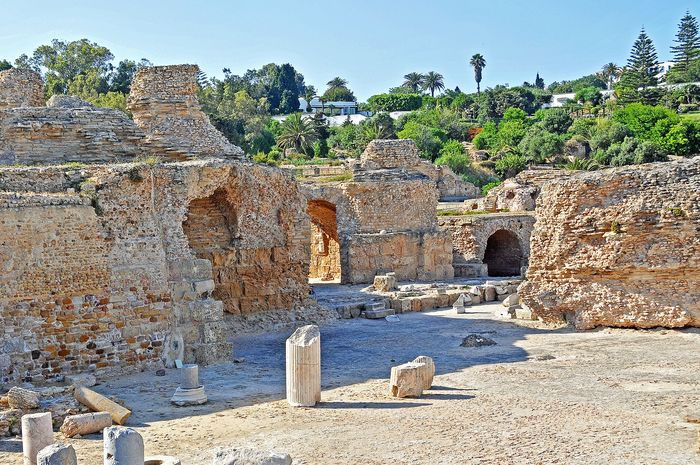
The Antonine baths
The largest Roman baths in Africa, right by the sea, with columns that show the hall was thirty metres high. The one part of Carthage where the scale is felt. In the morning, with the €6 Carthage ticket.
€6
Byrsa hill
The foundations of the Punic city and the 19th-century cathedral of St Louis, with the view of the gulf and of Tunis across the lagoon. It is climbed for the view.
€6 · closed museum closed (renovation, target end of 2026); grounds and cathedral open
- T
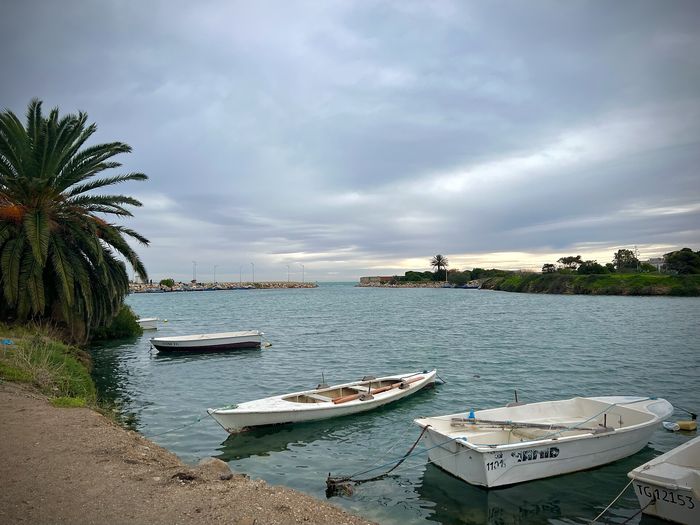
The Punic harbours
Two lakes, one round, where two hundred warships were moored. Today a walk along the water past fishermen's boats and a small museum with a model. Ten minutes, on the way from the baths to the station.
€6
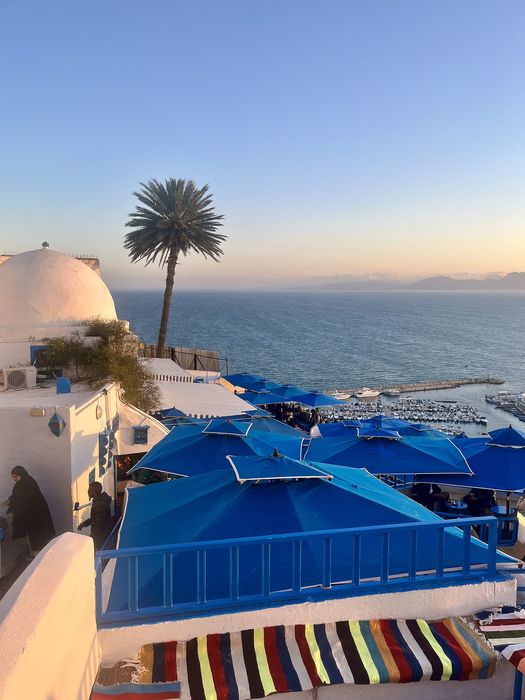
Café Sidi Chabaane
A café on terraces on the cliff, with the view of the marina and the whole gulf. Tea with pine nuts and a shisha; you sit for an hour in the afternoon. The Café des Nattes on the steps of the main street is more famous and worse.
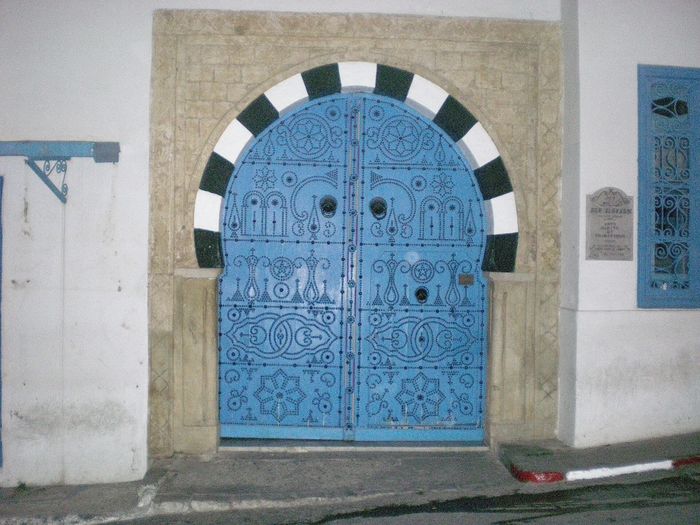
Dar el Annabi
An 18th-century house on the main street, open as a museum: courtyards, tiled rooms and a roof with the view of the gulf. Half an hour is enough, and it is the only way to get behind the blue doors.
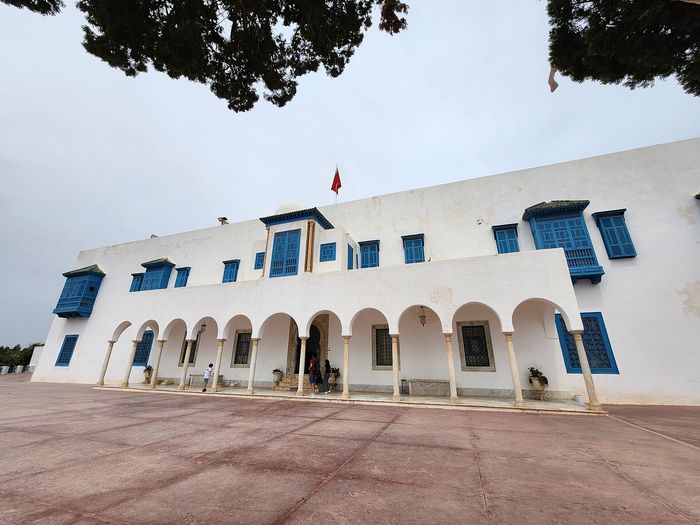
The Ennejma Ezzahra palace
The palace of Baron d'Erlanger, the man who painted the village, with gardens on the cliff and a centre for Arab music. Entry €2.97, open 1 Sep–30 Jun: 9–13 & 14–17; 1 Jul–31 Aug: 9–15:30, closed Monday and holidays; you come for the gardens and the view from the terrace.
€2.97 · closed Monday and holidays


Two things you probably did not know
The blue and white of Sidi Bou Said was prescribed in 1915 by the French baron Rodolphe d'Erlanger, who lived there. Painting a house any other way has been forbidden since, and the rule still holds.
Paul Klee, August Macke and Simone de Beauvoir all stayed in Sidi Bou Said. Klee's journey to Tunisia in 1914 is considered the turning point in his relationship with colour.
Ready for Sidi Bou Said?
Within reach from here
Places sorted by straight-line distance from Sidi Bou Said — day trips or weekends.

Tunisia
→Ten towns in a line, from the capital to the sand at Tozeur — in the order they're actually travelled, not listed

Egypt
→Two countries under one name: the Nile with its temples, which needs a plan, and the Red Sea, which needs only a charter — few people do both in one trip

Morocco
→The north by train, the south by road, and in July you leave Marrakech for the coast

Italy
→The cities on the high-speed line are an hour or two apart; the coast, Matera and the Tuscan hills lie off it
All 277 places we write about sit on one page — narrow them down by continent, country, price or what you are travelling for.
Front row for the next trip
Leave your email and we'll let you know when a new destination or story goes up.