

Matera: the city in the rock, from national disgrace to UNESCO
- Published
- 30 September 2026
- Reading
- 7 min read
- Where
- Matera, Basilicata
- Prices checked
- 29. Sep 2026.
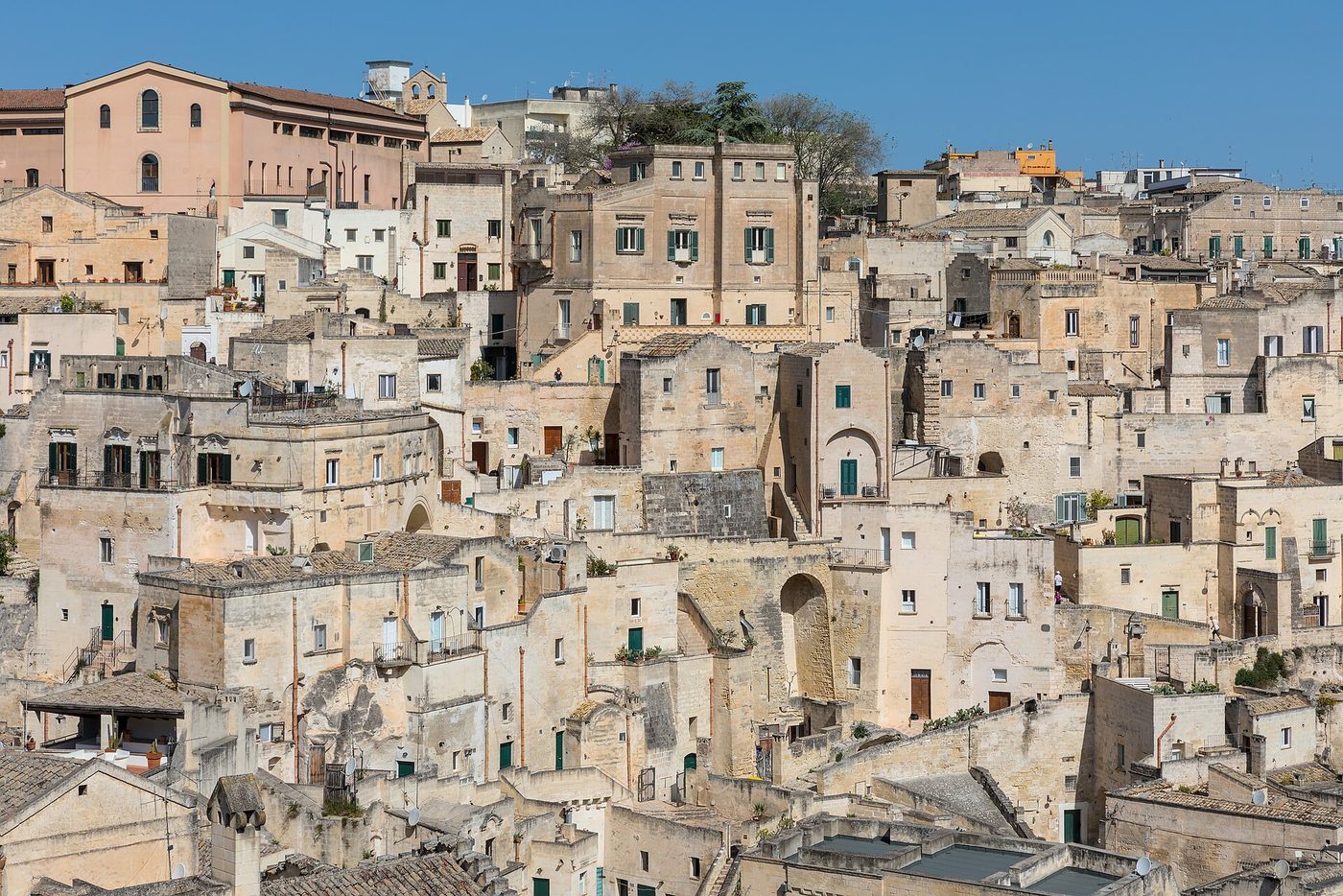
A city carved from pale, porous stone, which the state emptied of more than fifteen thousand people in 1952 and which the world now walks through.
Matera is best understood as a story of reversal: the cave quarters from which the state removed more than fifteen thousand people in 1952 are now on the UNESCO list, and in 2019 the city was a European Capital of Culture. Walking through that needs 2 days, and the first one begins on Piazza Vittorio Veneto, at the edge of the Sassi.

Arriving, and the square above the cistern
From Bari airport the city is reached by bus, SITA Sud/Cotrap bus, line 900, and the ride takes about 1 h 15. The walk starts on the main square, Piazza Vittorio Veneto, and beneath it, in living rock, lies the Palombaro Lungo, a vast underground cistern from 1832. Its pillars are carved from the rock and its vault rises above fifteen metres. Entry is €3, and if you only go underground once, make it here, because it shows how the town was built: a hollow in the rock served as cistern, house and church.
Bus
- Line
- 900
- Journey
- about 1 h 15
Private transfer
- a driver meets you at arrivals
- booked ahead, late flights too
- costs more than public transport
Civita and the two Sassi
Below the square the road drops into the Sassi, which take their name from the Latin saxum, 'stone'. They are two quarters on the steep slope of the Gravina ravine, Sasso Barisano facing Bari and Sasso Caveoso facing Montescaglioso. The houses are cut into calcarenite, a soft, porous limestone known here as tufo, so the whole hillside looks pale and honeycombed. Walking it is free (free). The cathedral on the high Civita was built in 1268–1270 and has been dedicated to Santa Maria della Bruna since 1389. From there you can see how narrow stairways, flat roofs and dark cave doorways tumble towards the ravine.
Life alongside the animals
The real scale of the Sassi only shows inside. Casa Grotta is a restored cave dwelling, furnished as it was until the 1952 evacuation, with one small room shared by the family, the donkey and the chickens. Entry is €8, the visit takes 15 min, and afterwards the rest of the city reads differently, because you know who once lived behind those openings.
Official ticket
- Entry
- €8
- Visit
- 15 min
Through a partner
- options with a guide or audio guide
- usually costs more than the official ticket
How disgrace became heritage
Carlo Levi showed Basilicata to the wider world in 1945 with 'Cristo si è fermato a Eboli' (Christ Stopped at Eboli), and Prime Minister Alcide De Gasperi visited the Sassi in July 1950. A special law of 17 May 1952 then emptied the quarters, and more than fifteen thousand people were moved to new districts on the plain. The Sassi then stood abandoned for decades. A law of 1986 allowed people to return, and from the late 1980s restoration went ahead with the help of the European Union and UNESCO, which inscribed the Sassi on 9 December 1993. Matera was chosen as European Capital of Culture for 2019 on 17 October 2014.

The rock churches
Next the route runs among the cave churches, about a hundred and fifty of them scattered across the Murgia plateau and the slopes of the ravine, medieval and often with painted walls. Most need their own ticket, €3–5 per church, so if you are short on time, pick two or three and stay in them longer rather than buying them all.
Official ticket
- Price
- €3–5 per church
Through a partner
- options with a guide or audio guide
- usually costs more than the official ticket
Belvedere Murgia Timone and the evening light
The day ends on the far side of the ravine, at the Murgia Timone viewpoint, from which the whole of the Sassi lies in front of you like one pale, tiered stage set. Entry is €10 (Apr–Oct), €7 (Nov–Mar), and a time slot is recommended. When the sun drops low, the pale stone turns to a warmer, honey colour, and it is easy to see why film crews came here: 'The Passion of the Christ' (2004) and 'No Time to Die' (2021) were shot in Matera.
Official ticket
- Apr–Oct
- €10
- Nov–Mar
- €7
Through a partner
- options with a guide or audio guide
- usually costs more than the official ticket


Check the same room on both sites: price and cancellation terms can differ.
Italy, in brief
What now
If this sounds like your trip, start here.
Matera
→A city where people were still living in caves in the 1950s
Matera in 1 day
→Both Sassi on foot in one full day, ending with a climb to the far side of the ravine when the stone turns the colour of honey.

Day trips from Matera
→A tour or a car takes you to Craco, a train takes you to Altamura and Gravina, and Bari and Alberobello are a different story.
Where to stay in Matera
→In Matera you are not choosing a district but a type of room, ordinary or carved into the rock, and the second kind books out months ahead.
What to eat in Matera
→Basilicata's peasant cooking: nothing goes to waste, the pasta is durum-wheat semolina, and the bread carries its own protected label.
The best time to visit Matera
→Bare stone with no trees holds and throws back the heat, so the season here changes not just the temperature but how long everything stays open.

Italy
→The cities on the high-speed line are an hour or two apart; the coast, Matera and the Tuscan hills lie off it

The Tuscany everyone photographs isn't in any town
→The Tuscany on the postcard has no name on the map and no entrance gate. It is a view from a road, so the real question is where you can stop the car.

Rome for a weekend: what we spent, and what we would change
→The bill from one October 2025 weekend in Rome, line by line: two people, two days, no luxuries, and the three decisions that would change it next time.

Pompeii and Herculaneum from Naples: what fits into one day
→Pompeii and Herculaneum are a train ride from Naples, while Vesuvius needs a transfer uphill, which is why the day so often gets overpacked.

Front row for the next trip
Leave your email and we'll let you know when a new destination or story goes up.