

- Published
- 30 November 2022
- Reading
- 6 min read
- Where
- Val d'Orcia, Italy

That postcard hill with the cypress row and one house at the top has no name on the map — just GPS coordinates, and a stretch of road where people pull over even though they're not really meant to.
Almost everyone plans Tuscany the same way: three nights in Florence, the Uffizi, the Duomo, a day in Siena, maybe Pisa on the way for a photo of the tower. All of it is fine and all of it is worth seeing. But the picture that made you want Tuscany in the first place — the rolling hill with a line of cypresses and one house at the top — is in none of those places.
It isn't a sight, either. No ticket office, no opening hours, no entry in the guidebook under things to see. It's a view from a road. Specifically, mostly from the SP146 between San Quirico d'Orcia and Pienza, and people get the shot by pulling onto a verge where you aren't really meant to stop.
That sounds like a letdown until you realise what it actually means: Val d'Orcia isn't toured, it's driven. A whole day here looks like leaving some small village in the morning, driving an hour on roads without a single straight stretch, stopping five times for no reason, and getting back in the evening twenty kilometres from where you started.
A few places on the way earn the stop. The strangest is Bagno Vignoni. It's a village that has a swimming pool instead of a main square — a rectangular sixteenth-century stone basin full of warm sulphurous water, with houses arranged around it the way they'd be arranged around a piazza. It wasn't built as an attraction; the water surfaces there at fifty degrees and has been used for centuries. You can't bathe in that central one — you look at it, from a café three metres away.
„A village where the square is a pool, and nobody finds that odd.“
— note from the road
Ten kilometres on is Pienza, which exists because a pope decided in 1459 to turn his birth village into an “ideal city” and rename it after himself. The works lasted three years. The pope died two years after that, so the ideal city never got further than its centre — which is exactly why that centre is today one uninterrupted Renaissance piece you can walk across in twenty minutes.
What makes this corner unusual is that the landscape everyone reads as untouched nature isn't nature. Those hills are clay and bare because they were ploughed for centuries; the cypresses were planted along the roads deliberately, to mark the approach to an estate. The whole scene is a by-product of farming, and it has been UNESCO-listed since 2004 precisely as a cultural landscape, not a natural one.

Without a car this essentially doesn't exist — buses between the villages run, but rarely, and not along the roads you came for. A good share of the side roads are strade bianche, white gravel, which you don't hurry on and which send the car back grey. And it's green in April and May; by late June everything is harvested and golden-brown, which is beautiful, but it isn't the photograph.

And most importantly: there is nothing to “do” here. No museum you must see, no list. If a holiday only counts when it's full, this corner will feel like a boring ninety minutes of driving. If it counts when you've stopped five times for no reason — then this is probably the thing you came to Tuscany for.
Italy, in brief
What now
If this sounds like your trip, start here.
- Don't look for that view in a town — it is from the SP146 road between San Quirico and Pienza.
- Take a car and leave the day open: five stops for no reason is the point here, not lost time.
- Stop at Bagno Vignoni — a village with a sixteenth-century stone pool instead of a main square.

Italy
→The cities on the high-speed line are an hour or two apart; the coast, Matera and the Tuscan hills lie off it

Rome for a weekend: what we spent, and what we would change
→"Rome for a weekend" is a phrase everyone says easily. This isn't a guide but the bill from one actual trip…

Pompeii and Herculaneum from Naples: what fits into one day
→All three sit half an hour by train from Naples, which is exactly why the day gets overloaded. Here is which…

A ticket for the Last Supper: how you actually get one
→The ticket costs €15 and goes on sale in waves a few times a year, then disappears the same day. Here is the…
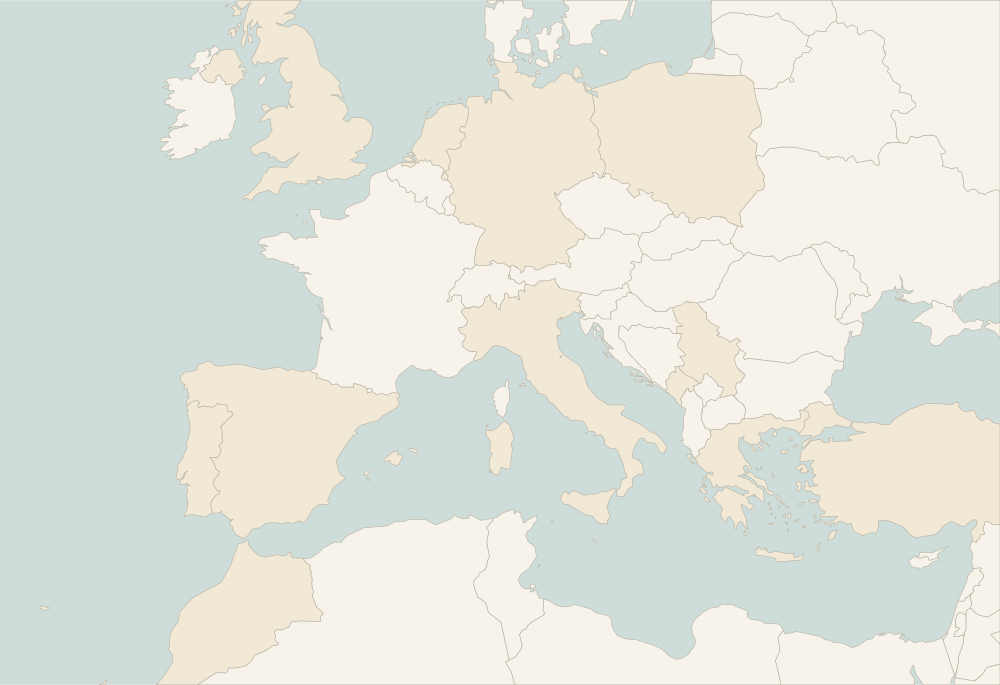
Val d'Orcia, Siena and San Gimignano from this story
See which of them suits you, then pin what you have already done.
Front row for the next trip
Leave your email and we'll let you know when a new destination or story goes up.