

Puglia: Bari as a base, then Alberobello, Matera and Lecce
- Published
- 30 September 2026
- Reading
- 7 min read
- Where
- Bari
- Prices checked
- 29. Sep 2026.
Bari as the starting point, then south in order: coast, conical trulli, a city in the rock and honey-coloured baroque stone.
Puglia works best from a single base, and Bari is the natural one: three trips leave straight from it, Matera lies across the regional border, and Lecce is a destination of its own at the southern tip of the peninsula. The route runs from sea to stone, so you see the white coast first, then the conical trulli, then a city carved into the rock, and finally baroque the colour of honey.
Bari, the base
Bari Vecchia, the old town, sits on a narrow peninsula between two harbours, so the sea is a few steps from every lane. In the tight alleys of Arco Basso women make orecchiette by hand on tables outside their doors. Building of the Basilica of St Nicholas began in 1087, when the relics arrived from Myra, and it was consecrated in 1197. The large cathedral in Apulian Romanesque style dates from the last decades of the 12th century. The Teatro Petruzzelli opened in 1903, burned in 1991 and reopened in 2009. The basilica is free, the cathedral free (crypt about €1).
Check the same room on both sites: price and cancellation terms can differ.


Polignano a Mare and Monopoli
The first trip runs south along the Adriatic. Polignano a Mare stands on a high cliff above the sea, with the small Lama Monachile beach and the Grotta Palazzese hotel-restaurant, and Trenitalia regional train, direct goes there, 16–20 min. The next town on the same line is Monopoli, about 28 min from Bari, Trenitalia regional train, direct, and it has an old harbour and the Castle of Charles V, completed in 1525, which in 1529 withstood a three-month Spanish siege.

Alberobello, the trulli
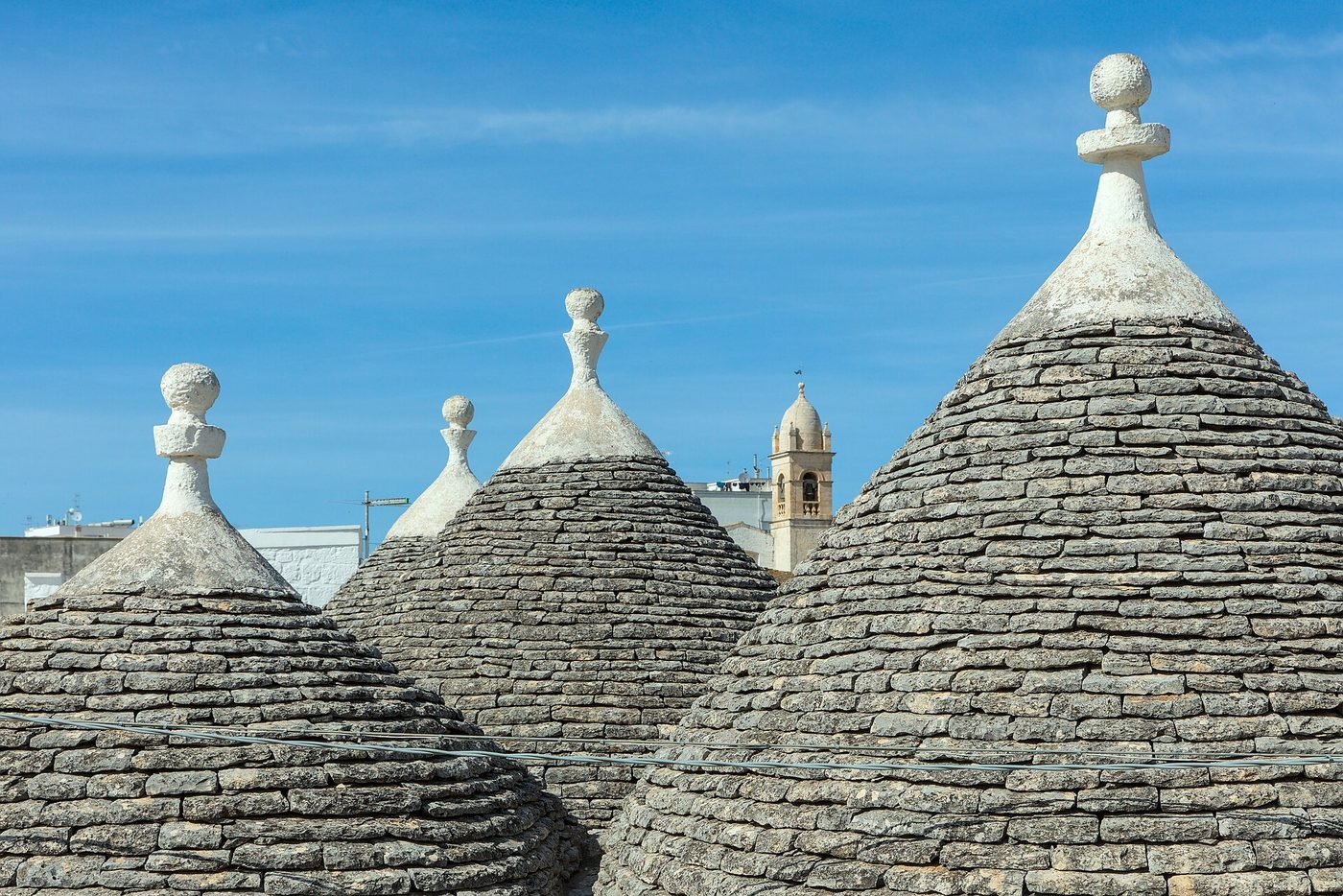
From the coast the route turns inland, into the Itria Valley, where the trulli stand: low houses of dry stone, built without mortar from limestone of the local karst, with a conical roof and a decorative pinnacle. Alberobello has two quarters, Rione Monti and Aia Piccola, and UNESCO has listed it since 1996. Getting there means FSE (Ferrovie del Sud Est) train or bus, about 1 h 15 – 1 h 40 each way, and the return ticket is €12. The whole trip takes half a day to a full day.
On your own
- Train or bus
- 1 h 15 – 1 h 40
- Ticket
- €12 return
With a guide
- transport arranged
- a guide on site
- costs more than going alone
Matera, across the regional border
Matera is not in Puglia but in Basilicata, yet Bari is its nearest big city, so the trip starts there: the return fare is €6.80 and the trip takes a full day. The city sits on the right bank of the Gravina canyon and is carved into soft limestone, and the Sassi districts and the rock churches were inscribed by UNESCO in December 1993. People lived in the caves until 1952, when the state moved them to the new part of town, and in 2019 Matera was European Capital of Culture. Anyone with a single day should spend it in the Sassi themselves.
On your own
- Ticket
- €6.80 return
With a guide
- transport arranged
- a guide on site
- costs more than going alone

Lecce, the end of the peninsula
Lecce, capital of Salento, is the last stop; it lies at the southern tip of the peninsula and needs a trip of its own. It is called the "Florence of the South" because it is carved from Lecce stone, a soft limestone that is easy to cut. The façade of the Basilica of Santa Croce, full of animals, grotesques and a rose window, took from 1353 to 1695 to build, more than three centuries. Entry is €11 (€21 with the bell tower), and it is open April–September 9–21; October–March 9–18. On Piazza Sant'Oronzo a Roman amphitheatre is partly visible, while the Porta Napoli gate dates from 1548. Days for Lecce: 1–2; 3–4 as a base.
Official ticket
- Entry
- €11
- With the bell tower
- €21
Through a partner
- options with a guide or audio guide
- usually costs more than the official ticket


Italy, in brief
What now
If this sounds like your trip, start here.

Bari
→An Adriatic port where women still make pasta on the street outside their doors
Bari in 1 day
→The basilica and the pasta street in the morning, the cathedral before its break, the castle and the gallery after lunch, and the promenade and opera to end the day.
Day trips from Bari
→Polignano is 16–20 min by train, Monopoli about 28 min, Alberobello about 1 h 15 – 1 h 40, and Matera a full day.

Where to stay in Bari
→Two districts really split the choice: the old town on its peninsula, where everything is on foot, and Murat, a regular street grid with a promenade.

What Bari costs
→The old town, the basilica, the cathedral and the promenade are free, and what costs money is the bed, the castle, the gallery and the day trips.
What to eat in Bari
→Four dishes for Bari: orecchiette from the street, fried panzerotto, fried polenta and focaccia, with the price of each that is known.
The best time to visit Bari
→Late spring and early autumn for walking, a hot and crowded summer, and May and December each bring a feast of Saint Nicholas.

Getting around Bari
→The airport is in the city itself, the train to the station takes 15 min, and the rest is done on foot or by city transport.

Italy
→The cities on the high-speed line are an hour or two apart; the coast, Matera and the Tuscan hills lie off it

The Tuscany everyone photographs isn't in any town
→The Tuscany on the postcard has no name on the map and no entrance gate. It is a view from a road, so the real question is where you can stop the car.

Rome for a weekend: what we spent, and what we would change
→The bill from one October 2025 weekend in Rome, line by line: two people, two days, no luxuries, and the three decisions that would change it next time.

Pompeii and Herculaneum from Naples: what fits into one day
→Pompeii and Herculaneum are a train ride from Naples, while Vesuvius needs a transfer uphill, which is why the day so often gets overpacked.
Front row for the next trip
Leave your email and we'll let you know when a new destination or story goes up.