

Ravenna and its mosaics: five monuments on one ticket, and three left outside it
- Published
- 30 September 2026
- Reading
- 5 min read
- Where
- Ravenna, Italy
- Prices checked
- 29. Sep 2026.
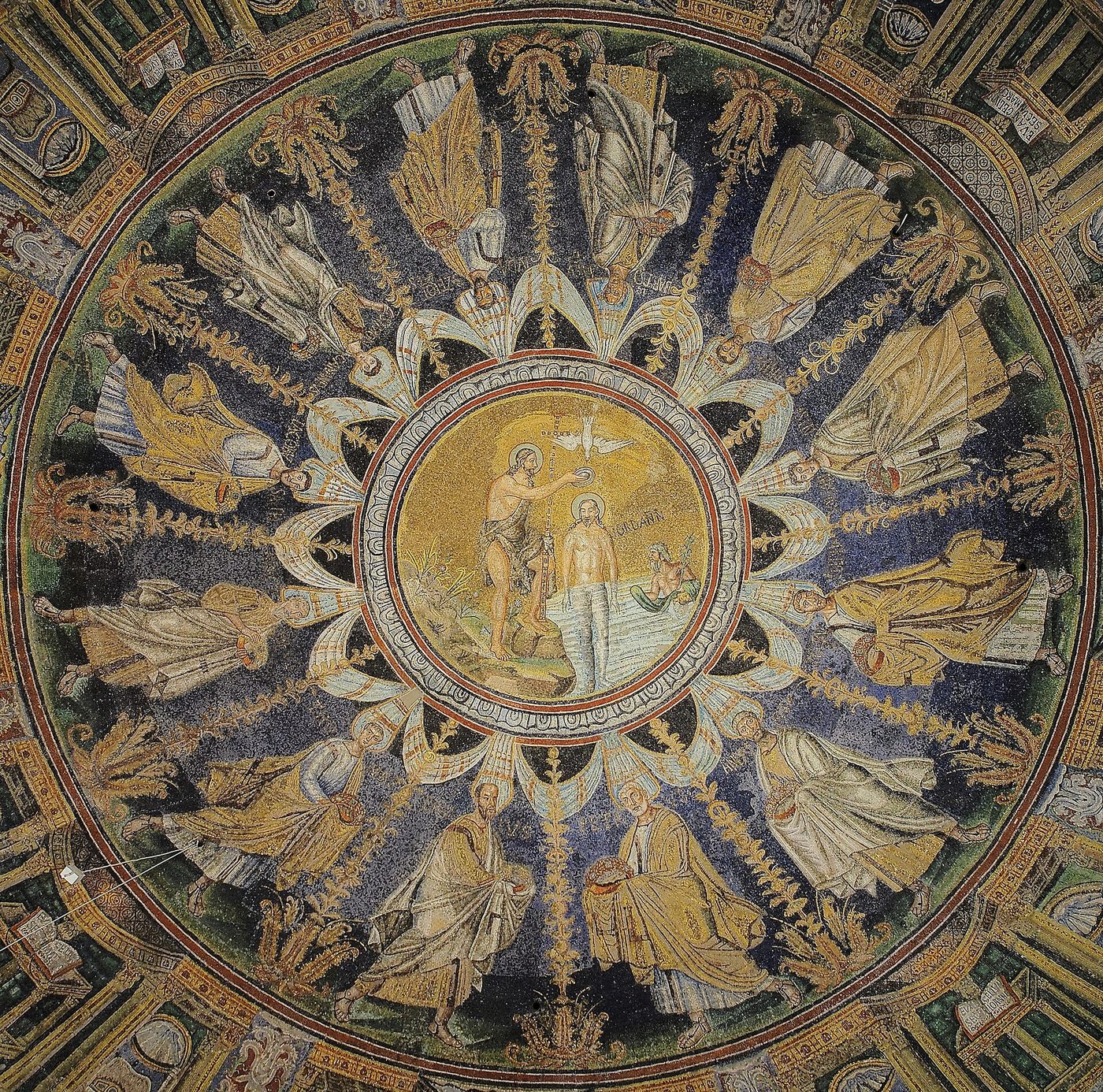
One ticket, five entrances and gold set into glass. The order to walk them in, and the three UNESCO monuments the ticket leaves out.
Eight monuments in Ravenna, all from the 5th and 6th centuries, were inscribed on the UNESCO list in 1996, and the combined Ravenna Mosaici ticket covers five of them: the Basilica of San Vitale, Sant'Apollinare Nuovo, the Mausoleum of Galla Placidia, the Neonian Baptistery and the Archiepiscopal Museum with the Chapel of St Andrew. The other three, the Arian Baptistery, Sant'Apollinare in Classe and the Mausoleum of Theodoric, are bought separately.
 2 daysThe whole schedule by the hour, with Classe and the mausoleum on day two:Ravenna in 2 days →
The ticket and its slots
The ticket comes in versions for two, four or five monuments, and the difference is this: the double has only San Vitale and Sant'Apollinare Nuovo, the four-monument one adds Galla Placidia and the Neonian Baptistery, and the five-monument one adds the museum. For the Mausoleum of Galla Placidia, the Baptistery and the museum, a timed slot must be booked, so it is wise to fix those slots before deciding what to do with the rest of the day.
An octagon under gold
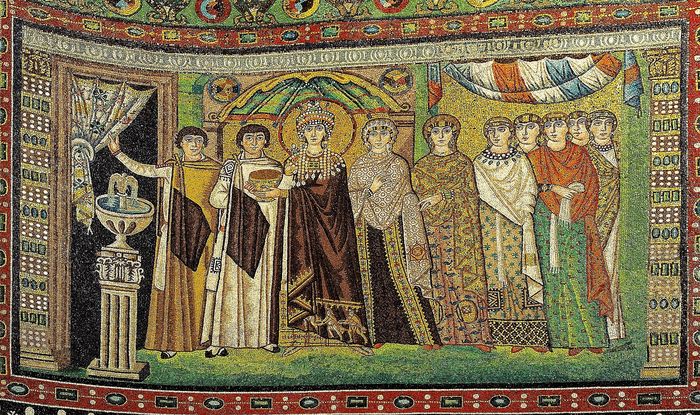
The first entrance is the Basilica of San Vitale, an octagonal building begun in 526 and consecrated in 547. In the apse Christ sits on a blue globe, offering a martyr's crown to Saint Vitalis, and opposite it, stand the two panels: Emperor Justinian in Tyrian purple with a golden halo, and Empress Theodora with her attendants. The panels were finished in 547, the year of the consecration, and rank among the most recognisable images of Byzantine Italy.
Stars on blue
Next door is the Mausoleum of Galla Placidia, small and dark, cruciform, built between 425 and 450. It is enough to look up: the vault is covered in golden stars on a deep blue ground, and light enters through alabaster window panels. The name misleads. Galla Placidia is not buried here. By best estimate she lies in Rome, and the misconception about her tomb dates from the 13th century.
A dome above water
The Baptistery is the oldest monument still standing in Ravenna, octagonal, of brick, partly raised on the site of a Roman bath. Inside, in the dome, Christ stands waist-deep in the waters of the Jordan, and a procession of twelve apostles runs beside him. The eight sides in the plan carry a meaning: the seven days of the week and an eighth, the day of resurrection.

Two processions
The Basilica of Sant'Apollinare Nuovo is Theodoric's, from the first quarter of the 6th century, and began as an Arian church. Along the nave two processions run: twenty-two virgins led by the three Magi towards the Virgin, and twenty-six martyrs led by Saint Martin towards Christ enthroned. When the figures of Theodoric and his court were later removed from the mosaic, hands remained on the columns.
The Archiepiscopal Museum
The fifth entrance on the ticket is the Archiepiscopal Museum with the Chapel of St Andrew. It is included only in the five-monument ticket, and its slot is booked in advance too.


Italy, in brief
What now
If this sounds like your trip, start here.

Ravenna
→Eight early Christian and Byzantine monuments with mosaics of gold and glass, spread across a city that was once the capital of the Western Roman Empire and the Ostrogothic Kingdom.
Ravenna in 2 days
→The first day keeps the centre and its six mosaics in one walking loop, the second goes out to a basilica…
Day trips from Ravenna
→Ravenna has no airport with regular flights, so Bologna doubles as both the arrival point and a day trip…

What Ravenna costs
→Ravenna has no airport of its own, so every trip in and out is paid through Bologna, and the rest of the day…
Ravenna: three monuments off the main ticket
→A small baptistery, a free archaeological site and a mausoleum without mosaics: three places the…
What to eat in Ravenna
→Romagna cooking: piadina stands in for bread, while cappelletti and passatelli are served in broth.

The best time to visit Ravenna
→Ravenna sits on the Po plain, a few kilometres from the sea: summer is hot and humid, and in winter the…

Italy
→The cities on the high-speed line are an hour or two apart; the coast, Matera and the Tuscan hills lie off it

The Tuscany everyone photographs isn't in any town
→That postcard hill with the cypress row and one house at the top has no name on the map — just GPS…

Rome for a weekend: what we spent, and what we would change
→"Rome for a weekend" is a phrase everyone says easily. This isn't a guide but the bill from one actual trip…

Pompeii and Herculaneum from Naples: what fits into one day
→All three sit half an hour by train from Naples, which is exactly why the day gets overloaded. Here is which…
Front row for the next trip
Leave your email and we'll let you know when a new destination or story goes up.