

The Amalfi Coast by bus or by ferry: Positano, Amalfi, Ravello and Salerno
- Published
- 30 September 2026
- Reading
- 6 min read
- Where
- Positano
- Prices checked
- 29. Sep 2026.
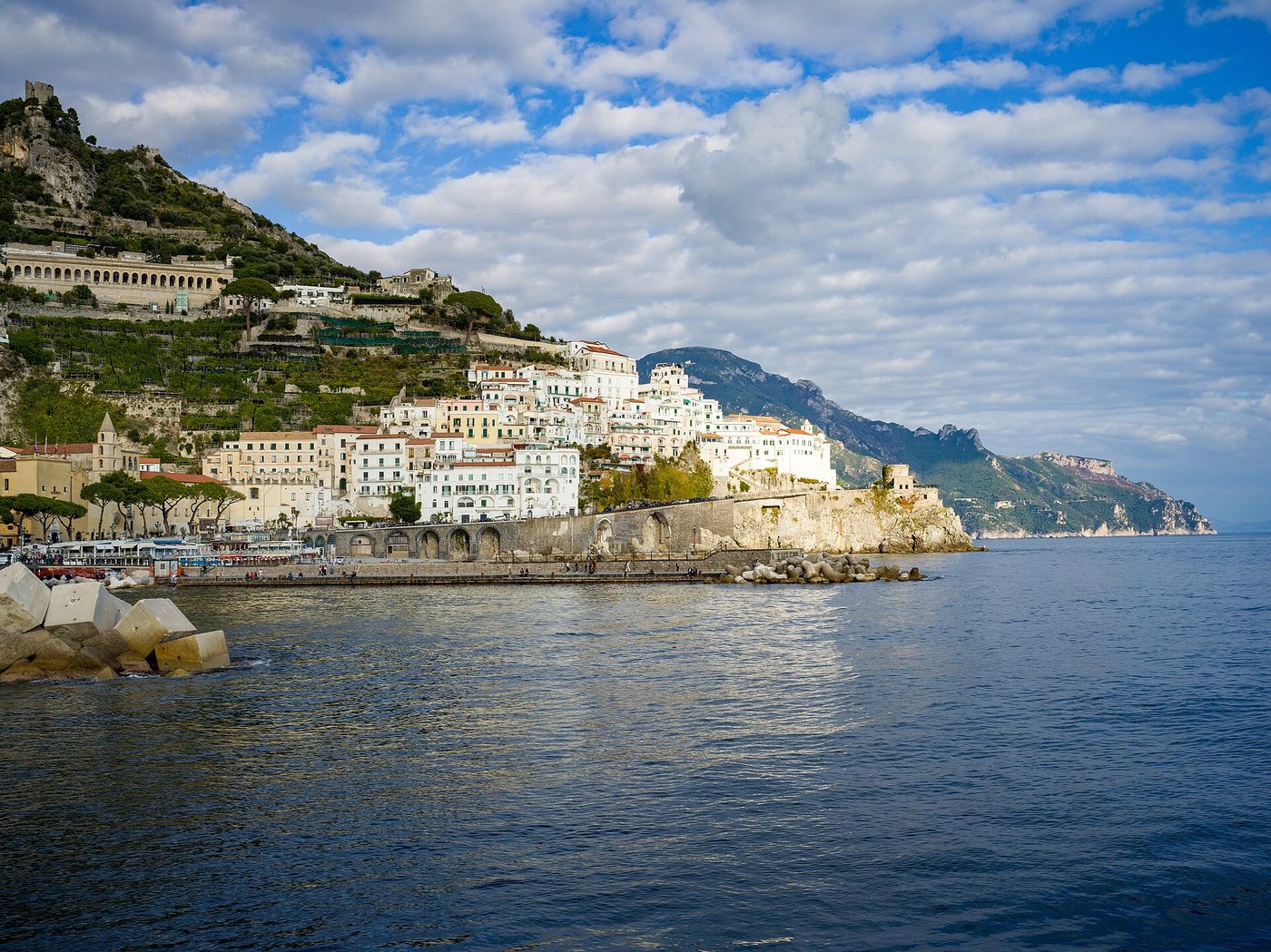
One narrow road along the cliff and one open sea beneath it: the coast can be covered by bus, by ferry or by a mix, and each has stretches the other cannot reach.
On the Amalfi Coast the bus and the ferry take turns: the ferry is quicker and prettier when the sea is calm, while the bus is cheap, runs when the ferries stay in port and is the only one of the two that reaches Ravello. Between Amalfi and Positano allow about 45–50 min (bus) by bus, while the ferry takes about twenty minutes. Anyone with a fixed flight home should treat the bus as the safer way back.

Getting onto the coast: from Naples airport
The coast is entered from one end, and the usual gateway is Naples airport. To Amalfi runs a direct SITA bus, line 5080 (Amalfi–Agerola–Castellammare–Naples): about 2 h 15, fare €10. Positano is reached differently, by Curreri bus to Sorrento, then SITA bus to Positano, about 2 h in all for €15.60. In season there is also a direct ferry from Naples to Positano, just over an hour. Because the two towns need different routes, the first night is best booked in the one that is easier to reach.
Bus
- Amalfi
- SITA 5080, about 2 h 15, €10
- Positano
- about 2 h, €15.60
Private transfer
- a driver meets you at arrivals
- booked ahead, late flights too
- costs more than public transport
One road along the cliff
SITA buses run along a single narrow road, the state road SS163, which from Positano towards Amalfi keeps to the steep cliff above the sea, and the coast has been on the UNESCO list as a cultural landscape since 1997. Anyone sitting on the right of a bus heading from Positano to Amalfi has the sea under the window, because the coast faces south. It is worth boarding early to take that side. Fares are paid by zone: Ravello from Amalfi costs €3, Positano €4.80, Salerno €5.60, and the COSTIERASITA day ticket €10, which pays off only when the bus is ridden several times in a day.

The coast from the angle it was built for
From the water you see what the road hides: the towns were built to face the sea. Amalfi was a maritime republic from the ninth to the twelfth century, and Positano reads from a boat as a cascade of pastel houses down the steep slope, with the dome of Santa Maria Assunta covered in majolica. Ferries link Salerno, Amalfi and Positano, but they do not always sail: winter (Dec–Mar), in rough seas; the return by ferry should therefore not be the only plan, and the bus stays as the fallback.
An organised visit with a guide.

When the ferry cannot help
Ravello sits on a high hill more than three hundred metres above the sea, so no ferry goes there and the way is uphill by bus, about 25–30 min from Amalfi; allow half a day. Plan the day around the bus timetable. Up there are the Villa Rufolo, in whose garden Wagner found the model for Klingsor's garden in Parsifal in 1880, and the Villa Cimbrone, with a terrace called the Terrace of Infinity that looks straight out over the open sea.
On your own
- Bus
- about 25–30 min from Amalfi
With a guide
- transport arranged
- a guide on site
- costs more than going alone
The far end, and a second entrance
Salerno is at the other end of the coast, about 1 h 15 from Amalfi by bus, so allow a full day. The cathedral holds the tomb of Pope Gregory VII, and the city is on the fast-train line, so it can also be reached by rail and left by ferry to Positano in an hour and a quarter. That is the alternative to the Naples gateway for anyone arriving from the direction of Rome.

For most plans a mix works: the bus for Ravello and Salerno, the ferry between Salerno, Amalfi and Positano when the sea is calm, and the bus back. That keeps the return independent of the weather.

Check the same room on both sites: price and cancellation terms can differ.
Italy, in brief
What now
If this sounds like your trip, start here.
Amalfi
→A former maritime republic around its cathedral, and a base for the rest of the coast

Amalfi in 2 days
→The cathedral, paper mill and arsenal on day one; on day two the climb to Pontone and back down through the tunnel.
Day trips from Amalfi
→Atrani through the tunnel, Ravello uphill, Positano along the coast and Salerno for a full day.

Amalfi off the promenade: Pogerola, Santa Croce and Pontone
→A village above town where locals eat, a cove reached only by boat, and the village where the trails begin.
The best time to visit Amalfi
→Best in May, June, September and October; in summer the beach fills with clubs, and in winter the arsenal opens shorter hours.

Italy
→The cities on the high-speed line are an hour or two apart; the coast, Matera and the Tuscan hills lie off it

The Tuscany everyone photographs isn't in any town
→The Tuscany on the postcard has no name on the map and no entrance gate. It is a view from a road, so the real question is where you can stop the car.

Rome for a weekend: what we spent, and what we would change
→The bill from one October 2025 weekend in Rome, line by line: two people, two days, no luxuries, and the three decisions that would change it next time.

Pompeii and Herculaneum from Naples: what fits into one day
→Pompeii and Herculaneum are a train ride from Naples, while Vesuvius needs a transfer uphill, which is why the day so often gets overpacked.
Front row for the next trip
Leave your email and we'll let you know when a new destination or story goes up.