- Published
- 15 May 2026
- Reading
- 5 min read
- Where
- Strasbourg, France

The title of Europe's oldest market does not survive a check, though the title is not why anyone goes. The problem is that every decision is made before the dates appear.
Strasbourg has held a Christmas market since 1570, and that part is true. What is not true is the clause half the travel sites attach to it — that it is the oldest in Europe. It is not; it is the oldest in France, which is still reason enough to go, with one practical catch: when you are planning the trip, the official dates usually do not exist yet.
Who is actually the oldest
Dresden's Striezelmarkt is first documented in 1434 and is counted as the first true Christmas market. Vienna appears in 1298, Munich in 1310, Bautzen in 1384 and Frankfurt in 1393, but those were December markets — fairs held in the pre-Christmas month rather than markets tied to the feast. Strasbourg has run the Christkindelsmärik, the market of the Christ Child, since 1570, introduced after the Reformation to replace an earlier St Nicholas fair. Which is why the city's own website says 'five centuries of tradition' rather than 'the oldest in Europe' — a distinction marketing routinely swallows.
The dates land in autumn — and that's the problem
The city publishes its schedule late. The 2025 edition ran from 26 November to 24 December, and in early September 2026 the official site still says the dates and programme are being finalised. Which means rooms and travel for December get booked on last year's pattern: opening late November, closing on Christmas Eve. Colmar is the counter-example — its 2026 dates are already out, 23 November to 29 December, eight days longer and including the week after Christmas that Strasbourg does not have.

Where the markets are, and where the crush is
It is not one market but a network across the old town, UNESCO-listed since 1988. The main sites are:
- Place Broglie — the Christkindelsmärik, the historic core of the whole thing and the oldest point on the list.
- Place Kléber — the big tree and the day's densest crowd; also the tightest entry checks.
- Cathedral square and Place du Château — stalls under the 142-metre spire; the cathedral is France's second most visited even without a market.
- Petite France — Benjamin Zix and Saint-Thomas, the most photographed quarter and the narrowest lanes, which also makes it the slowest.
- Carré d'Or and the Marché aux Poissons — smaller, calmer, and unlike Kléber you can actually stand still and drink without being shoved.
December rooms, and why people sleep out of town
December is Strasbourg's most expensive month and prices behave as they do for a major event, which is what it is. A double in the city in December realistically runs about €150–280 a night, while the same class in Colmar or Obernai is about €90–160. Colmar is half an hour by train, has its own network of six markets and runs shuttles out to the smaller Alsatian towns. Come at a weekend in the first fortnight of December and you pay the most; come on a weekday in the last week of November and you pay the least and walk the easiest.
Entry to the markets — free, in both towns
What is eaten and drunk
Mulled wine is the market's base currency, served in a ceramic mug against a deposit you get back when the mug goes back. With it come bredele, the small Alsatian biscuits baked weeks in advance, mannele, a sweet man-shaped roll, and gingerbread. For an actual meal you sit down: flammekueche is thin stretched dough with cream, onion and bacon, baked in a minute or two in a very hot oven and ordered for a table to share. Alsace is also a wine region where roughly ninety per cent of production is white — riesling is 21.7 per cent of the plantings, gewurztraminer 18.6 — and in December that wine is drunk both cold and mulled.

Crowds, checks and what that means in practice
The market has been under reinforced security for more than two decades, and after the attack of 11 December 2018, in which five people were killed near Place Kléber, the checks became a permanent part of the experience. In practice: the centre is closed to cars, barriers and police stand at the approaches, bags are searched, and at peak hours there is a wait to enter certain zones. That is not a reason to stay away, it is a reason not to arrive by car and to allow an extra twenty minutes per zone. The heaviest crush is 5pm to 9pm at weekends; a weekday morning is the same city with half the people.

All told: Strasbourg in December is one of the rare places where the tourist story and the reality sit close together — the market is old, it is big and it is beautiful. It is simply not the oldest in Europe, not cheap and not empty. Accept that in advance, sleep thirty kilometres away, and you get the best version of the same trip.
France, in brief
What now
If this sounds like your trip, start here.
- Don't trust the line about the oldest in Europe — Strasbourg's is the oldest in France, from 1570.
- When you plan, expect that the official dates for that year usually aren't out yet.
- If the first market really matters to you, that is Dresden's Striezelmarkt, first mentioned in 1434.
Strasbourg
→A cathedral that was the world's tallest building for two centuries, and a market five hundred years old

France
→From Paris the TGV reaches Lyon, Bordeaux and Strasbourg in about two hours — France is chosen by direction, not by city

The Paris Museum Pass in 2026, and the maths that changed
→For a traveller who lives outside the EEA the same museum pass now behaves differently than for a visitor…

Lyon or Bordeaux for a long weekend, and how to pick one
→Both sit two hours from Paris by train and both sell themselves on food and drink. The difference is where…

Fleeing 1000 degrees: two mothers, two daughters, one mountain
→Two mothers who'd known each other for years got out of the same car with two daughters meeting for the first…
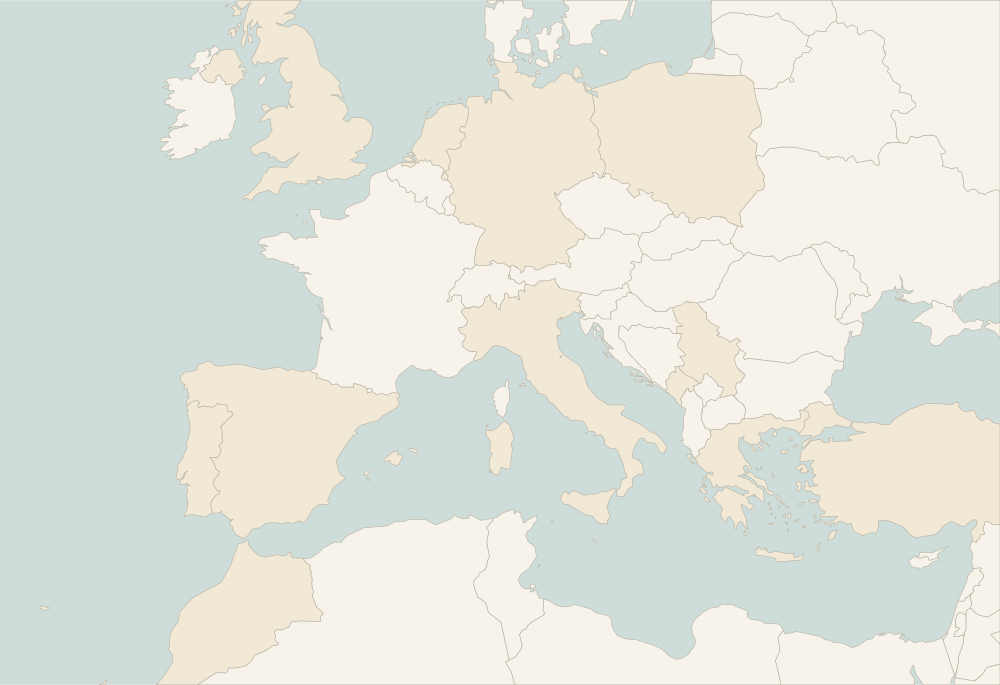
Strasbourg, Lyon and Paris from this story
See which of them suits you, then pin what you have already done.
Front row for the next trip
Leave your email and we'll let you know when a new destination or story goes up.