Bordeaux
A pale-stone city on a river bend, with a hundred and ten thousand hectares of vines around it
- When to go
- October 16° · 14 rainy days
- Per day
- €€€€price 4 of 5
- How many days
- 3days
- For you
- 6 questions →
- Nearest airport
- 11 km Bordeaux · 87 km Bergerac
- Right now

Twenty years ago Bordeaux was black with soot and turned its back on its river. Then the facades were cleaned, the quays became a promenade, and in 2007 the eighteenth-century core was listed by UNESCO as the Port of the Moon, after the bend of the Garonne that wraps around it. It holds over three hundred and sixty protected monuments, more than anywhere in France except Paris.
There are around ten thousand wine estates around the city, and the split is simple: the left bank of the Garonne holds Cabernet Sauvignon and the 1855 classification, the right bank Merlot and Saint-Émilion. You can do it in a day from town — the Bordeaux tourist office sells a half-day château tour from €55 and a full day in Saint-Émilion from €99, guide and tastings included. With more time, the train gets you to Saint-Émilion on your own.

La Cité du Vin opened in 2016 and isn't a museum of Bordeaux wine but of wine generally — from Georgian clay jars to Californian valleys. Give it two to three hours, and not on the same day as the vineyards — it belongs to the afternoon of a day spent walking the city.
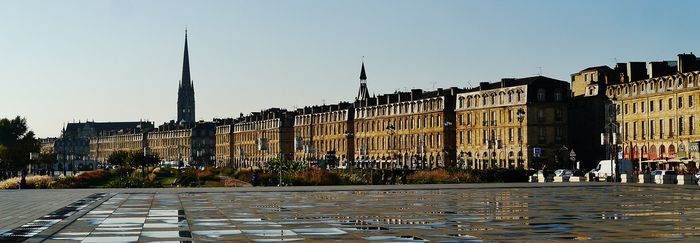
The city itself is walked. Place de la Bourse was designed by the elder and younger Gabriel in the middle of the eighteenth century, and since 2006 the water mirror has stood in front of it — a granite slab under two centimetres of water, with the whole facade reflected in it. The entire protected centre is crossed on foot through the same pale eighteenth-century stone. The river underneath it isn't blue but brown: the Garonne carries silt from the whole of Aquitaine and changes level with the tide, because the ocean is downstream.
What to see in Bordeaux
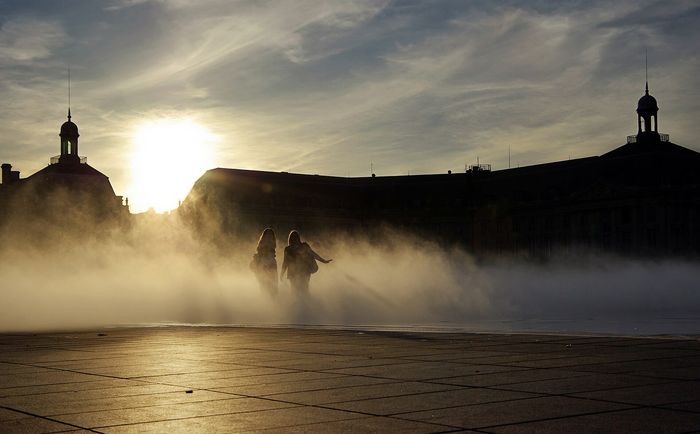
Place de la Bourse and the water mirror
A classical facade from 1730–1775 and, across from it, the most photographed spot in the city. The mirror works in cycles: it fills, reflects the building, then turns into knee-high mist. Children walk into the water, adults wait for the reflection — both are free.
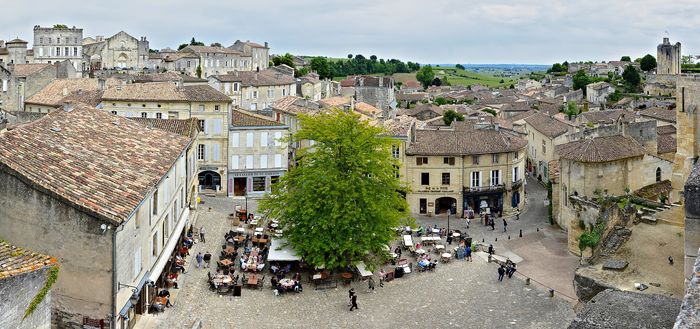
Saint-Émilion
Thirty-five kilometres east, a village of sixteen hundred people listed by UNESCO in 1999 together with its vineyards. Under the square is an eleventh-century monolithic church, thirty-eight metres long and twenty wide, hollowed out of solid rock — some fifteen thousand cubic metres of limestone removed. Guided visits only.
- L
La Cité du Vin
Fifty-five metres of curved glass and aluminium on the quay, twenty minutes by tram from the centre; the building is meant to look like wine swirling in a glass. The exhibition is interactive and runs in a dozen languages, and the ticket includes a glass of wine on the eighth-floor belvedere, which takes in the whole river bend.
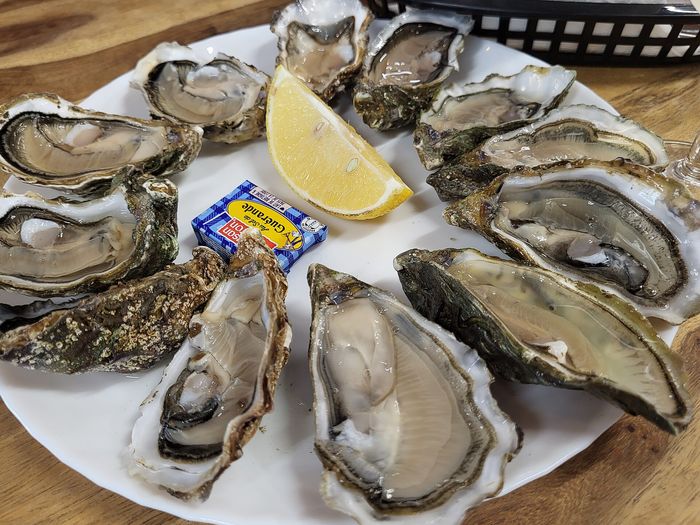
Arcachon and the oysters
An hour west by train. The bay covers a hundred and fifty square kilometres at high tide and forty at low, and yields around seven thousand tonnes of oysters a year. They're eaten in huts along the shore, with bread and a small sausage on the side. Two houses on stilts stand out in the middle of the bay.
- T
The Dune du Pilat
The tallest sand dune in Europe: a hundred and one and a half metres at the 2025 measurement, two and a half kilometres long, half a kilometre wide, some sixty million cubic metres of sand. It's measured every year because it moves inland and swallows the forest behind it. Sixty kilometres from Bordeaux, next to Arcachon.
The quays and the tram
Six lines, and no overhead wires in the historic core — power comes up out of the rail, which is why photographs of the quays come out without cables. The walkway along the Garonne runs for several kilometres and fills with cyclists in the evening; on Sunday mornings the quayside road closes to cars. Line A goes to the airport.


Two things you probably did not know
Phylloxera, an aphid brought from America, destroyed the vineyards around Bordeaux in the late nineteenth century. They were saved by grafting French vines onto American rootstock resistant to it. Almost all European wine now grows on American roots.
The water mirror in front of the stock exchange is the largest of its kind in the world: two centimetres of water on granite that turns to mist every twenty minutes or so. It was built in 2006 on what had been a car park.
Ready for Bordeaux?
Within reach from here
Places sorted by straight-line distance from Bordeaux — day trips or weekends.

France
→From Paris the TGV reaches Lyon, Bordeaux and Strasbourg in about two hours — France is chosen by direction, not by city

Italy
→The cities on the high-speed line are an hour or two apart; the coast, Matera and the Tuscan hills lie off it

Spain
→A country where dinner is at ten and the city wakes up as everywhere else turns the lights off
All 277 places we write about sit on one page — narrow them down by continent, country, price or what you are travelling for.
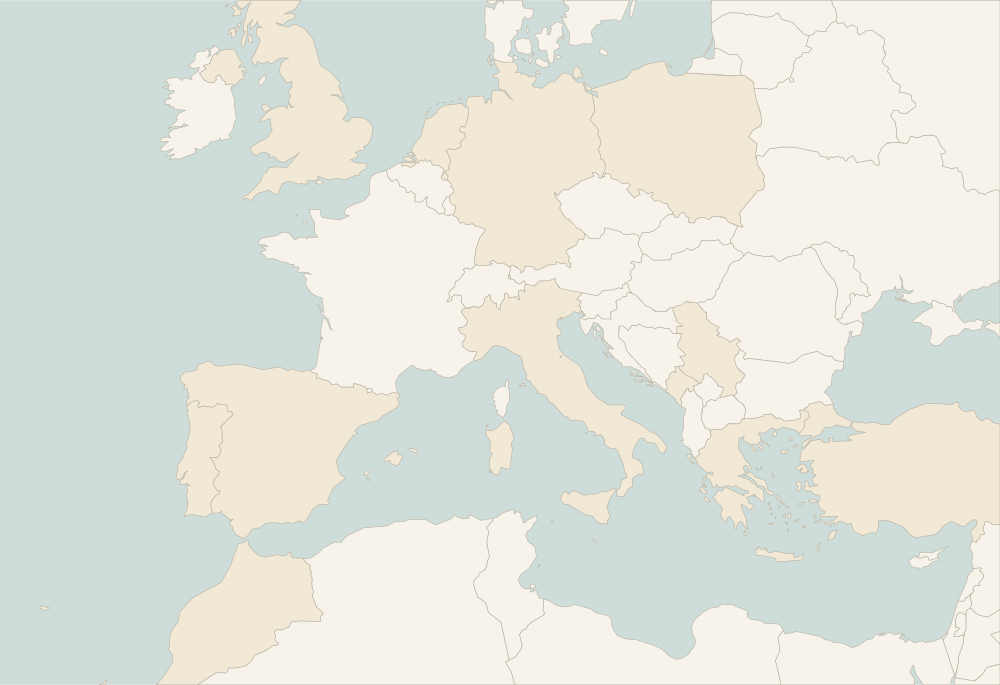
Within reach from here: San Sebastián, Mont Saint-Michel and Lyon
See how much of that actually suits you — or pin Bordeaux if you have been.
Front row for the next trip
Leave your email and we'll let you know when a new destination or story goes up.