

San Sebastián
A hundred and eighty-eight thousand people, one perfect bay and the densest stars in Europe
- When to go
- September 19° · 14 rainy days
- Per day
- €€€€price 4 of 5
- How many days
- 2–3days
- For you
- 6 questions →
- Nearest airport
- 16 km San Sebastián · 66 km Pamplona
- Right now

San Sebastián is a city of under two hundred thousand where dinner is eaten standing up, one piece at a time, in bars packed side by side. The same food culture supports three restaurants with three Michelin stars within ten kilometres, so one week can hold a five-euro meal and a two-hundred-euro one.
Pintxos are not tapas. They don't come with the drink; each is paid for separately, around three to four euros a piece, and the hot ones are made to order rather than left on the counter. The rule is one per bar, two at most, then move on — the Parte Vieja packs dozens of bars into a few streets, so a whole dinner fits inside three hundred metres. It happens in two waves, around one in the afternoon and after eight in the evening; in between the city empties.

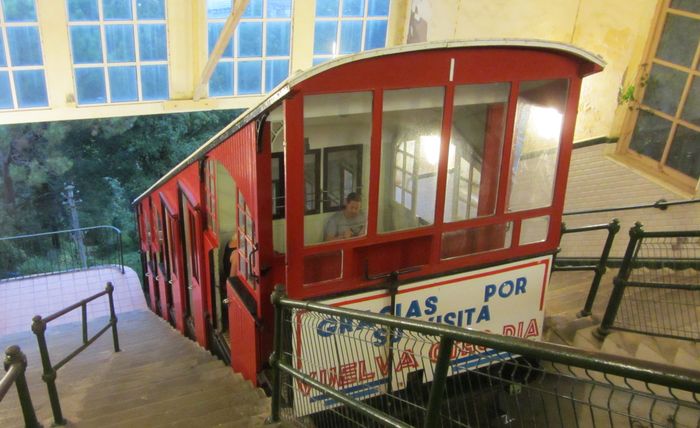
La Concha bay is closed off by hills on both sides, which is why the water here is never rough. To the east stands Urgull with its fortress and a twelve-and-a-half-metre statue of the Sacred Heart; twenty minutes on foot and free. To the west is Igeldo, a summit a hundred and eighty-one metres above the sea, reached by an old funicular. At the top sits a small amusement park from another era, and the view on every postcard of the city.
Rain is part of the deal: around one thousand six hundred and fifty millimetres a year across some hundred and forty wet days, more than London gets. That is why it is greener than the rest of Spain and why summer here means twenty-one degrees rather than thirty-eight. The other surprise is the language: Basque is related to no other known language in Europe, half the adults in Gipuzkoa speak it fluently, and the city's name in it is Donostia — which is what the signs say too.
What to see in San Sebastián
Pintxos, bar by bar
The cold ones sit on the counter; the hot ones you order off a board above it. The opening classic is the gilda — olive, anchovy and a hot green pepper on a stick. You pay on the way out rather than up front, and on your own word. Five bars usually land inside thirty euros a head, and that is dinner.
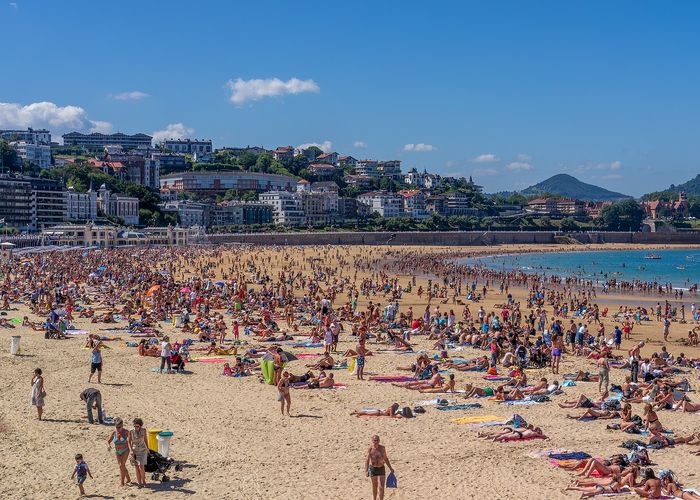
La Concha
A city beach in a shell-shaped bay, with the white wrought-iron railing that runs the whole length of the promenade and became the city's emblem. Two hills close off the entrance, so the water is calm and shallow far out — swimmable in June, fine with children, and without the surf of the coast around it.
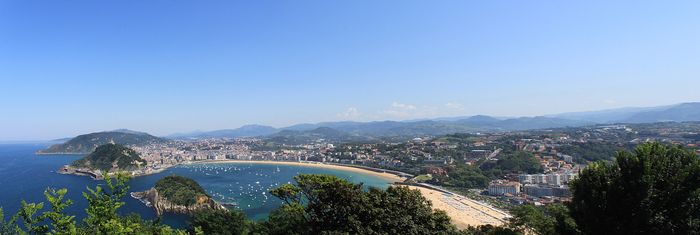
Igeldo and Urgull
Two hills on either side of the bay. A funicular climbs Igeldo, a hundred metres up; Urgull is twenty minutes on foot past the fortress. One gives you the postcard, the other the same frame free from the opposite side.
- T
Three stars, three times
Arzak has held three Michelin stars without a break since 1989, joined by Akelarre in the city and Martín Berasategui in neighbouring Lasarte. Per head of population the city ranks second in the world for stars, behind Kyoto. All three are booked months ahead.
- T
The film festival
The 74th edition runs 18–26 September 2026, centred on the Kursaal on the seafront. A regular screening is €8.75, the Velodrome gala fifteen, and a film-plus-dinner in the Culinary Zinema strand ninety. General sales open on 16 September, with same-day tickets released at eight in the morning.
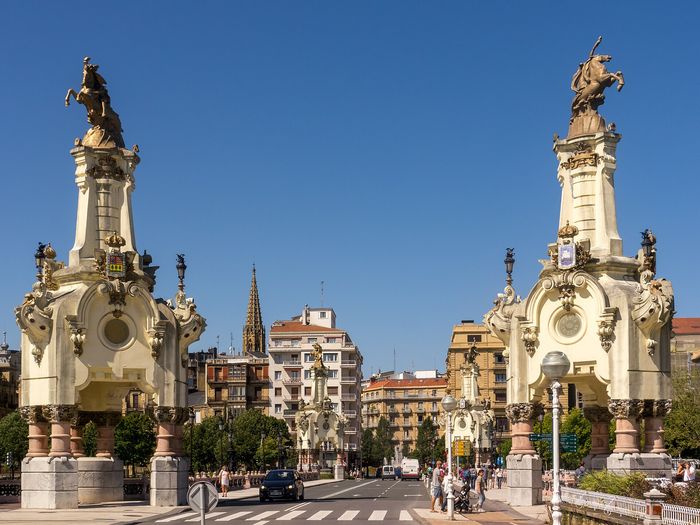
Donostia, not San Sebastián
Signs, menus and announcements are bilingual, and Basque is spoken on the street, not only in institutions — in the cafe and in the bread queue too. The fastest word to learn is 'agur', goodbye, the second 'eskerrik asko', thank you. Both are worth using and both get noticed, even though everyone here speaks Spanish as well.


Two things you probably did not know
San Sebastian has one of the highest concentrations of Michelin stars in the world, in a city of under two hundred thousand people. It also has closed gastronomic societies, txokos, where members cook for themselves and charge themselves.
Basque is not related to any known language in the world. It has no proven link to Indo-European or to any other family, and it has been spoken in the same place longer than any language around it.
Ready for San Sebastián?
Within reach from here
Places sorted by straight-line distance from San Sebastián — day trips or weekends.

Spain
→A country where dinner is at ten and the city wakes up as everywhere else turns the lights off

Portugal
→A country that spent centuries looking at the ocean instead of the Europe behind it

France
→From Paris the TGV reaches Lyon, Bordeaux and Strasbourg in about two hours — France is chosen by direction, not by city
All 277 places we write about sit on one page — narrow them down by continent, country, price or what you are travelling for.
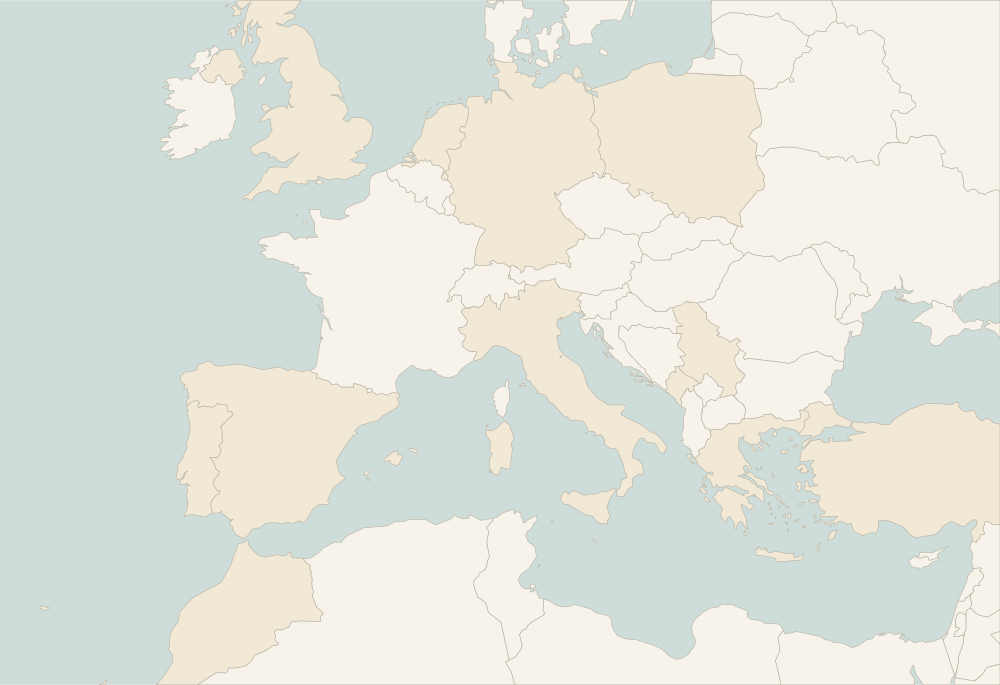
Within reach from here: Bordeaux, Albarracín and Madrid
See how much of that actually suits you — or pin San Sebastián if you have been.
Front row for the next trip
Leave your email and we'll let you know when a new destination or story goes up.