

Gjirokastër
The stone city on a steep cobbled hill: Ottoman tower houses, a castle above the bazaar and a Cold War tunnel, four hours from Tirana
- When to go
- October 16° · 9 rainy days
- Per day
- €€price 2 of 5
- How many days
- 1–2days
- For you
- 6 questions →
- Right now
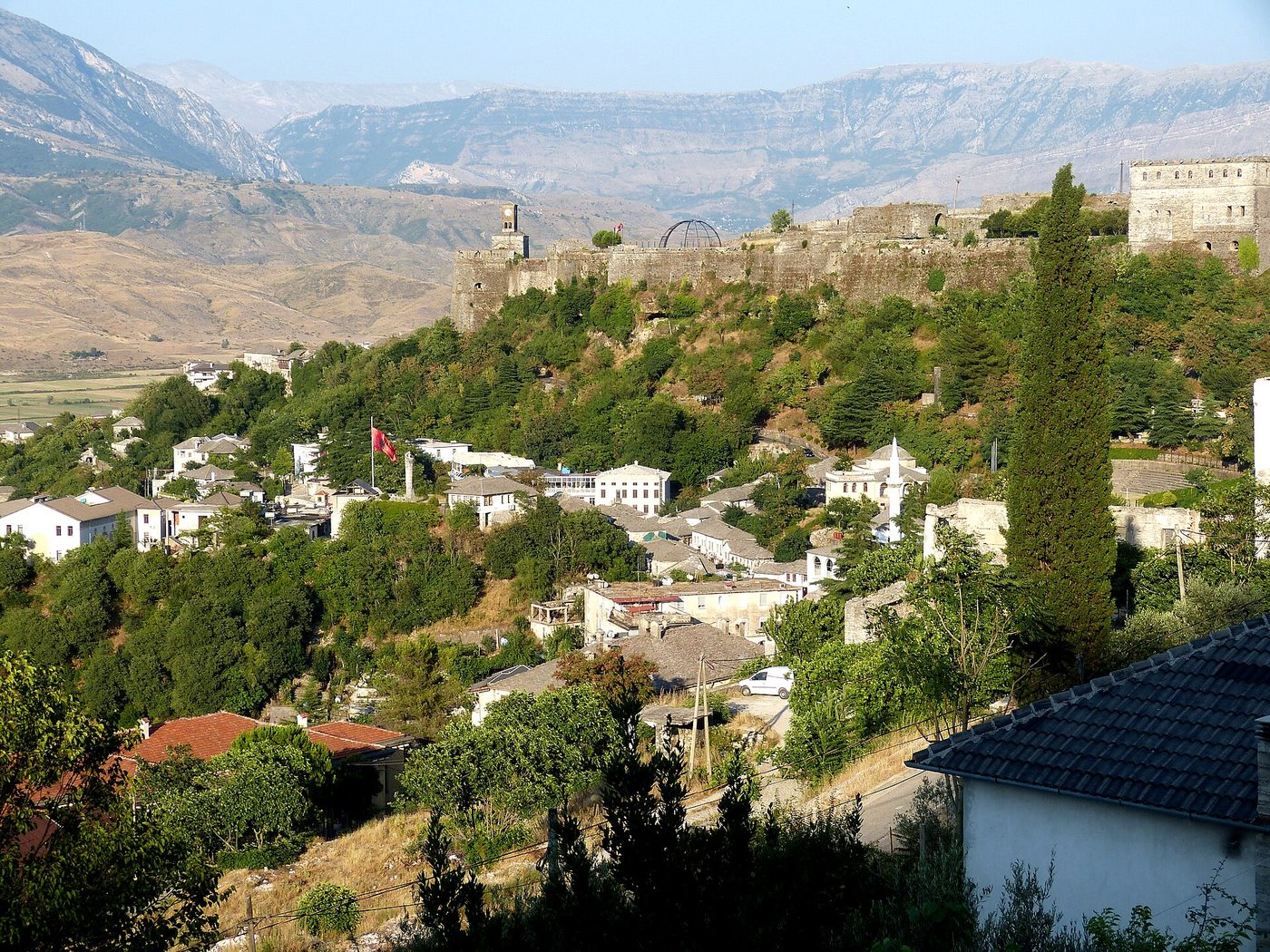
Gjirokastër takes one to two days, and the bus from Tirana takes 3 h 30–4 h 10. That long ride is the entry fee for a town that UNESCO listed in 2005 as a museum city, an Ottoman settlement of grey stone built up a hillside around a citadel, with tower houses (kule) that took shape in the 17th century. Few places in the Balkans reward the effort so plainly, and most of the reward is vertical.
Start in Tirana, at the South & North Terminal, where the Gjirokastër buses leave from beside Casa Italia Mega Outlet. The fare is €13–15, and the journey takes 3 h 30–4 h 10. The bus station lies in the new part of town on the SH4, below the old quarter, so the last stretch to your bed is a taxi ride uphill. The town sits in a valley between Mount Gjerë and the River Drino and counted 16,569 people in the 2023 census, which explains why everything feels close and why nothing is flat.
The name is older than the Ottomans. In medieval Greek it was Argyrókastro, silver town or silver fortress, and the Ottoman name Ergiri kept the sound. What UNESCO protects is the stone: slate roofs in grey, two-storey tower houses, a bazaar of steep cobbled lanes and a castle that looks down on all of it. The streets are narrow, some run one way, and none has been made for a suitcase.
Take the town in the order the slope suggests. The castle comes first, early in the day, then Zekate House in the Palorto quarter before 4 pm, because it has no electric light. Skenduli House and the Ethnographic Museum fill the middle of the day, and the Cold War tunnel needs a guide, so register for it the moment you arrive. The bazaar is for the evening. One day covers the main sights, and one night is the better plan, since the bazaar and the lit castle are best after dark. Pack shoes with grip, since wet limestone turns to glass.
Beyond the town there are four good reasons to stay a second day: the Blue Eye spring, the coastal town of Sarandë, the ruins of Butrint and the hill-top ancient city of Antigonea. May, June and September suit the climb best. July and August are hot on the exposed castle ridge, and November is the wettest month, with 299 mm of rain. Carry cash in lek, because tickets and buses are paid for in banknotes, and keep some small ones.
hostel, dorm bed, per night
Timed-entry tickets and guided tours in one place.
Guides for Gjirokastër
Shorter, practical pages for one concrete question each — how many days, how much money, where to sleep, where to escape the city.

Gjirokastër in 2 days
→Day one is stone and houses from the castle to the bazaar, day two a trip to the Blue Eye or the coast.

Day trips from Gjirokastër
→Sarandë and Butrint by bus, the Blue Eye by the old road and Antigonea in half a day by car.

Where to stay in Gjirokastër
→The old town for evenings and stone, the new town for the bus, and hostels start at ten euros.

What to eat in Gjirokastër
→Qifqi as a starter, a grill in the bazaar, cake in the old town and a fig pudding to finish.

The best time to visit Gjirokastër
→May, June and September for stone and climbing, summer for mornings and evenings, winter for rain and closed guesthouses.

Getting around Gjirokastër
→From Tirana by bus in about four hours, around town on foot and uphill, and to the Blue Eye by taxi.
What to see in Gjirokastër
- G
Gjirokastër Castle
The castle holds an arms museum with cannons and monuments to the resistance, a clock tower, a prison from 1932 and an American Lockheed T-33 forced down in 1957. The ridge is exposed, so in summer come early or late and look down on the slate roofs.
€4.40
- T
The Old Bazaar
Entry is free. The bazaar was first mentioned in the 17th century and rebuilt in the 19th after a fire, and it still has steep cobbles, two-storey stone shops and a mosque dating from 1757, the only one to survive of the 13 working in 1945.
free
- Z
Zekate House
Built in 1811 and 1812 for Beqir Zeka, an official of Ali Pasha, this tower house stands in the Palorto quarter, on a steep climb above the bazaar. It has no electric light, so go before 4 pm, and from its rooms you get the best view of the town.
€2.20–3.30
- S
Skenduli House
This is a house you visit with the family. A member of the household leads the tour, so you see the rooms with the people who look after them.
€2.20–3.30 · 30–45 min
- T
The Cold War Tunnel
Dug in secret in the early 1970s as a shelter for the leadership against nuclear attack, the tunnel is 800 m long and has 59 rooms. The entrance is by the municipality building, you go in only with a guide, and you register on the spot, so do it early.
€2.20 · about 20 min · booking: recommended
- T
The Ethnographic Museum
The museum was built between 1964 and 1966 on the site of the house where Enver Hoxha was born in 1908. The house was damaged on 16 December 1997 and rebuilt. Go for the rooms and the exhibits.
€2.20
Nomadinho scores out of 100, the same ones behind “Where to go”.
If you like Gjirokastër
Three places with the closest scores, from any country.


Ready for Gjirokastër?
Within reach from here
Places sorted by straight-line distance from Gjirokastër — day trips or weekends.

Albania
→Three cities for one trip: a capital with bunkers and a cable car, and two UNESCO-listed towns

Montenegro
→The Bay, the riviera or Ulcinj for the sea, Durmitor for July — choose the coast by its beaches and the north by the month

Greece
→The north by road, the Cyclades by ferry, Rhodes by air — pick the region first and the island second

North Macedonia
→Skopje on the Vardar, Ohrid on a UNESCO lake and about three hours of road between them

Bosnia and Herzegovina
→Two cities, a mark pegged to the euro and mountains that were Olympic in 1984
All 292 places we write about sit on one page — narrow them down by continent, country, price or what you are travelling for.
Front row for the next trip
Leave your email and we'll let you know when a new destination or story goes up.