

Vietnam from north to south: Hanoi to Ho Chi Minh City in nine days
- Published
- 7 October 2026
- Reading
- 7 min read
- Where
- Hanoi
- Prices checked
- 7. Oct 2026.
From Hanoi to Ho Chi Minh City the railway runs 1,726 kilometres, but nobody rides all of it. Nine days fit four stops, and Sapa is a three-day detour.
Vietnam is a long, thin country with 1,726 kilometres of railway between Hanoi and Ho Chi Minh City. The way to see it is to ride or fly the right pieces rather than the whole line. Nine days are enough for Hanoi, Ha Long Bay, Hoi An and Ho Chi Minh City, and Sapa is a detour of three more days from the north. March and April are the one stretch in which every stop except Sapa is in its good season.
Two days, and the north is done first
The route starts in Hanoi, which gets two days, because the Old Quarter and the lake fit into one and the second belongs to whatever is added. North to south has one practical advantage over the reverse. The two detours, the bay and Sapa, both begin in Hanoi and both end back in it. Doing them first means they are finished before the long leg south, and nobody doubles back.
Check the same room on both sites: price and cancellation terms can differ.

Two days, one night on a boat
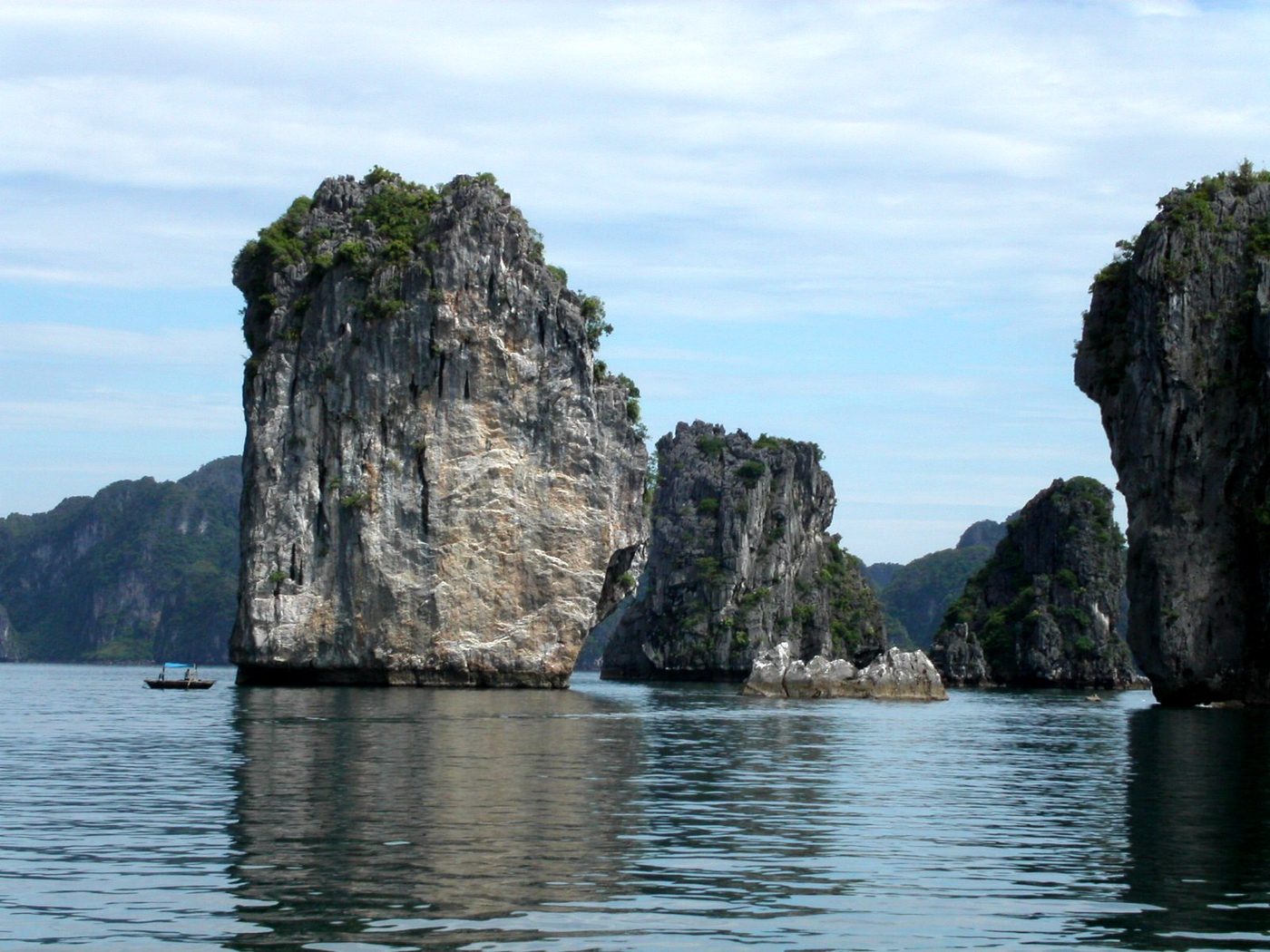
The bay sits about 170 kilometres east of Hanoi, roughly three hours on the motorway, and one night aboard is the minimum that makes the trip worth it. Go by road. The direct Hanoi–Ha Long train has not run since the pandemic, and the rail alternative, a train to Haiphong of two to two and a half hours followed by local buses, only adds changes.
Sailings are cancelled for weather without notice, so a spare day after the boat stays free in Hanoi, and no flight south is booked for the next morning. October, November, March and April are the safest months.
An organised visit with a guide.

The detour that costs three days
Sapa belongs to the north and cannot be bolted on to the south, so it goes between the bay and the flight. The overnight train SP1 leaves Hanoi at 21:35 and reaches Lao Cai at 05:15, about 7 hours 40 minutes for 296 kilometres. The town lies another 38 kilometres up the hill, around 50 minutes by road. A lower berth in a soft sleeper is about €15; the return train, SP2, leaves Lao Cai at 20:55 and is back in Hanoi at 04:35.
Time it by the terraces rather than by the rest of the route: May and June for the flooded fields, September for the gold before the harvest. From November to March the terraces are brown and the town sits in cloud. A trip that falls in March and April can drop Sapa and give the days to Hoi An.

The train for one night, the plane for the rest
The line runs 1,726 kilometres, and the express SE1 covers the whole of it in about 33 hours, leaving Hanoi at 20:50 and reaching Ho Chi Minh City at 05:45 two days later. Nobody has a reason to ride it end to end when a short, nonstop flight takes about 2 hours 10 minutes. The train earns its place on the first leg only: SE1 reaches Da Nang at 12:12 the next day, 15 hours 20 minutes after leaving, so it uses a night you would have spent in a bed anyway.
A soft seat costs about €22 and a lower berth in a soft sleeper about €43. The alternative is the direct flight, about 1 hour 20 minutes into Da Nang, which saves the whole night and the morning. The sleeper reaches Hue at 09:35, and between Hue and Da Nang lies the ridge of the Hai Van pass, about 21 kilometres of it, so that part of the ride falls in daylight.
Three days, reached through Da Nang
Hoi An has neither a station nor an airport, so by train or by plane the arrival is in Da Nang, and the rest is a taxi or minivan of 30 to 45 minutes, about €12 from the station. It takes three days, two for the old town and one for the tailors, who need a day for fittings. February to May is the dry stretch; in October and November the town floods.

Ho Chi Minh City: the last two days
From Da Nang the flight to Ho Chi Minh City takes about 1 hour 30 minutes, while the train, SE1 at 12:27, arrives at 05:45 the next morning, 17 hours 20 minutes later. The train costs an afternoon and a night and passes no stop in this guide, so the short flight wins. Anyone who rides the whole line anyway pays, for a lower berth from Hanoi, about €59.
Two full days work here: one for the war and its history, one for the Mekong Delta or the quieter districts. December to April is the dry season, so a trip that ends in March or April lands inside it.
An organised visit with a guide.


Vietnam, in brief
What now
If this sounds like your trip, start here.
Hanoi
→A capital where you cross the street by not stopping

Vietnam
→A country sixteen hundred and fifty kilometres long, where north and south are never in season together

eSIM for Vietnam: roaming, local SIM or travel eSIM
→Vietnam is a long trip, and one data plan has to last from Hanoi to Ho Chi Minh City.

New Year's Eve in Ho Chi Minh City: Nguyen Hue countdown and fireworks
→Ho Chi Minh City sees in the solar new year on a closed-off walking street, with a stage, a countdown and fireworks at midnight.

New Year's Eve in Hanoi: Hoan Kiem Lake and the fireworks
→Hanoi counts down at Hoan Kiem Lake with a free programme and city fireworks planned for a quarter to midnight.

Hanoi, Ha Long Bay and Sapa from this story
See which of them suits you, then pin what you have already done.
Front row for the next trip
Leave your email and we'll let you know when a new destination or story goes up.