

Sarajevo in 3 days
The bazaar and the City Hall on day one, the cable car and the bobsled track on day two, the National Museum and the Tunnel of Hope on day three, with Monday and Sunday changing the order.
- City Hall
- daily 9–17
- National Museum
- Tue–Fri 10–19
- Tunnel of Hope
- €10.23 (20 KM), cash in marks only
Three days in Sarajevo hang on three fixed points, and none of them can be moved to suit you. The combined cable car and City Hall ticket is valid only on the day you buy it, the Tunnel of Hope takes cash in marks and nothing else, and the National Museum is shut on Mondays, so everything else bends around those. The plan puts the old town on the first day and the hill on the second. The museum and the tunnel come last, and the short section after day two explains what a Monday or a Sunday changes.
The bazaar, the mosque and the children's war museum
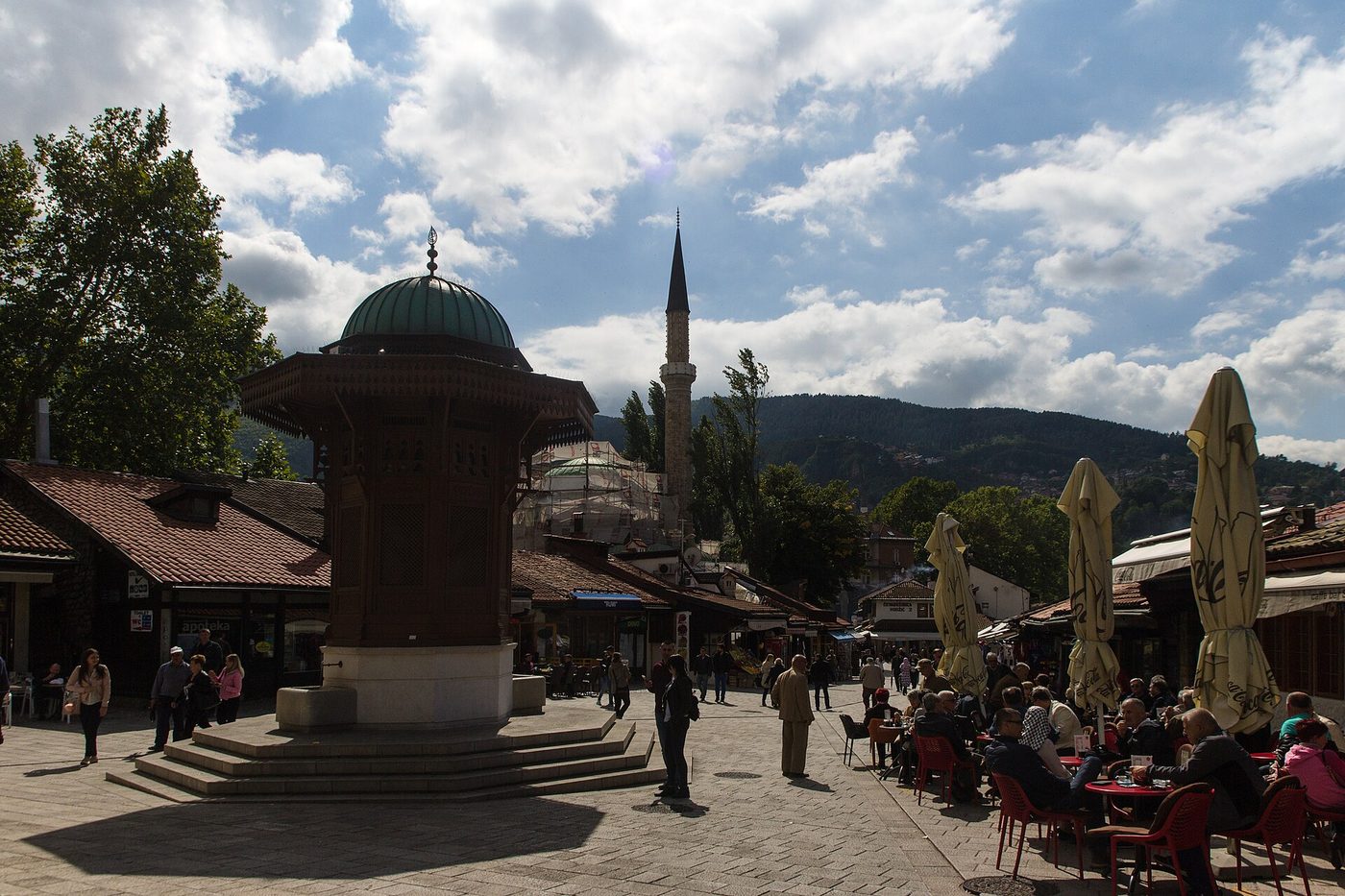
Start in Baščaršija at the Sebilj, the wooden fountain rebuilt in 1891 a few metres from the spot where its predecessor burned down, and drink from it, because legend says whoever does will come back to Sarajevo. Walk on to the Gazi Husrev-beg Mosque of the 1530s, with nine domes and a minaret 47 m high. Then comes Morića Han, built in 1551 and the only han left standing in the city, where a restaurant and shops now fill the courtyard.
The Latin Bridge is a stone span of 1565, rebuilt in 1798 and 1799 after a flood. A plaque on the corner at its northern end marks the assassination of 28 June 1914. From there go to Svrzina Kuća at Glođina 8, an 18th-century house of four sections around two courtyards and two gardens. Entry is €2.56 (5 KM), and the house is closed on Sundays, so on that day swap it for a second coffee.
Ćevapi in the bazaar, where Željo, Petica Ferhatović and Hodžić near the Sebilj all grill them, and a portion costs €4–6 (8–12 KM).
The War Childhood Museum at Logavina 32 tells the siege through objects that belonged to children. Entry is €7.67 (15 KM), hours are daily 11–19, last entry 18.30, and visits run in slots of 30 minutes that you can book online or at the desk.
Bosnian coffee in the bazaar, €1–2 (2–4 KM), with the stalls closing around you.

The city in the morning, the hill in the afternoon
Be at the City Hall when it opens at 9.00, before the day fills up. It is worth the early start. Opening hours are daily 9–17, and the entry ticket is €5.11 (10 KM). The building dates from 1896 and stands on the bank of the Miljacka, and the exhibition in its basement includes the foundation stone, carved with the names of the builders.
Buy the Duo ticket, which joins the cable car and the City Hall, for €17.89 (35 KM). The two bought separately come to more, and the ticket is good only on the day of purchase, so the hill has to follow the same day.
The cable car climbs from Bistrik to Trebević in cabins of ten people, 33 of them on the line, and arrives at the station called Ramo Biber. From there the bobsled track of the 1984 Winter Olympics runs downhill for 1,300 m. It is free, with no fence, guard or ticket, and walking it takes one to one and a half hours. Keep to the marked path, because the ground around it is still suspected of containing mines.
Ride back down to the bazaar. Pick any table.
Official ticket
- Entry
- €5.11 (10 KM)
- Duo with cable car
- €17.89
Through a partner
- options with a guide or audio guide
- usually costs more than the official ticket

The Haggadah at noon, Butmir after lunch
The National Museum opens on Tuesday to Friday at 10, and entry is €10.23 (20 KM). On Tuesdays and Thursdays, and on the first Saturday of the month, the Sarajevo Haggadah can be seen from 12 to 13 on an ordinary ticket. The manuscript dates from around 1350, probably from Barcelona, and it is kept in a climate-controlled room, so time the visit to reach that room at noon, then spend the rest of the morning in the galleries around it.
Eat in town. Butmir is next.
The Tunnel of Hope waits in Butmir, and entry is €10.23 (20 KM), cash in marks only (bring enough), and the last entry is 30 minutes before closing (1 Apr–31 Oct 8.30–17, 1 Nov–31 Mar 9–16). The whole tunnel under the airport runway was 340 m long. The visit covers the original entrance in the Kolar family house, 25 m of authentic tunnel and 100 m of rebuilt pipe. The simplest way out to Butmir is a taxi from the city or a tour that includes the tunnel.
A ticket with a chosen time slot, booked ahead.
If there is a fourth day
Mostar is the fourth day for anyone who wants to leave the city and see the famous bridge. The train to Čapljina leaves Sarajevo at 07.15 and 16.46, stops in Mostar and takes about two hours. Vrelo Bosne is the lighter choice. Tram 3 runs from Baščaršija to Ilidža in about half an hour, and a 3 km avenue leads on foot or by horse carriage to the source. Entry is €3.07 (6 KM), and the mountains are worth the trip only in winter, when they turn into ski slopes.


Where to next
Day trips from Sarajevo
→Vrelo Bosne by tram in half a day, Mostar by train or bus in a full day, and Jahorina and Bjelašnica mostly in winter.

Mostar · 71 km
→The Old Bridge, the cobbles of Kujundžiluk and the Neretva in its gorge, with Blagaj, Počitelj and Kravice within forty kilometres

How well does Sarajevo suit you?
→Six questions: a score for this place and others like it.
Nomadinho scores out of 100, the same ones behind “Where to go”.
If you like Sarajevo
Three places with the closest scores, from any country.


Ready for Sarajevo?
Front row for the next trip
Leave your email and we'll let you know when a new destination or story goes up.