

- Published
- 23 November 2020
- Reading
- 7 min read
- Where
- Serbia

Vlasina has islands that physically float on the surface. Perućac fills and drains on the hydro plant's schedule, not the season's — and you can see it with the naked eye.
Serbia has no coastline, but it has six lakes different enough that none reads as a stand-in for another — one is the country's highest, one used to be an imperial spa, one is fourteen kilometres long.
„One lake floats on its own islands. Another changes its shoreline week to week, depending on a hydro plant.“
— note from the road
Lake Vlasina — the floating islands
At 1,200 metres above sea level, Lake Vlasina is Serbia's highest artificial lake, formed by damming the Vlasina river. Peat moss that floats on the surface like islands, pushed around by the wind, is a rare phenomenon in Europe — the only other place it happens at this scale is Scotland. Waves rarely exceed half a metre, which suits both kayaking and pedal boats, and the surrounding birch forests are known for mushrooms.
Lake Zaovine — the most isolated
Zaovine was formed between 1975 and 1983 by damming the Beli Rzav river, sits at 881 metres, and reaches depths of up to 110 metres — the water is clean enough to be used for drinking supply. The water level fluctuates because the lake serves as a reservoir for the reversible Bajina Bašta hydro plant, so the shoreline's shape can change from one week to the next. This is where botanist Josif Pančić discovered the Serbian spruce.
Lake Perućac — canyon and border
Perućac was formed alongside the Bajina Bašta hydro plant, just 13 kilometres from town, and part of its shore runs along the border with Bosnia and Herzegovina. A catamaran runs through the Drina canyon to Višegrad, and kayaks can be hired on the lake too; the beach has pools for kids and showers, and the swimming season runs July and August.
Lake Gruža — for anglers and rowers
Built in 1979 by damming the Gruža river, it covers 900 hectares with a 40-kilometre shoreline. Known for carp, pike and catfish — a fishing permit is required — and in summer it hosts rowing and kayak clubs; in 2019 it held the European kayak-fishing championship. 87 bird species have been recorded here, 25 of which nest on the shore.
Palić — the lake that was a spa
Palić, near Subotica, was developed as a bathing resort from the second half of the 19th century, and in 1912 gained an Art Nouveau complex designed by Marcel Komor and Dezső Jakab. The lake is shallow, over eight kilometres long, and today combines fishing and a 1950 summer stage tied to a film festival.

Silver Lake — the longest of them all
It was formed when an old branch of the Danube was dammed on both sides to protect against groundwater, near Veliko Gradište. It runs 14 kilometres, took its name from the way the water shimmers, and offers developed beaches, a pool complex for a thousand people and a promenade along the whole shore. Nearby are Ram Fortress, Golubac Fortress and Tumane Monastery.
„Silver Lake was formed when a branch of the Danube was dammed off. What's left is a 14-kilometre lake, named for the way the water shimmers.“
— note from the road
Which one, when
- Vlasina and Zaovine are cooler and mountainous — best in July and August, for swimming and kayaking alike.
- Perućac and Silver Lake have developed beaches and infrastructure — pick these if you're travelling with kids.
- Gruža is for anglers and rowers, not for the beach.
- Palić runs year-round thanks to its spa complex, but nobody swims in the lake: the water is class five.
What they share is that none of them is a “substitute for the sea” — each is a reason on its own, and almost all sit near something already on your list: Zaovine is part of Tara, Perućac is half an hour from Drvengrad, Silver Lake is the gateway to Đerdap.


Serbia, in brief
What now
If this sounds like your trip, start here.
- Pick the lake by reason, not by distance: Vlasina for the floating islands, Zaovine to be left alone.
- For Zaovine check the water level before you go — the reservoir changes the shore from week to week.
- Vlasina sits at 1,200 m: bring something warm even when it is summer down below.

Serbia
→The north an hour away by train, the mountains three or four by car — Serbia divides by the time you have

Fleeing 1000 degrees: two mothers, two daughters, one mountain
→Two mothers who'd known each other for years got out of the same car with two daughters meeting for the first…

Serbia got a glass skywalk, and everyone went the same month
→More than three thousand people went up Kablar on the first weekend, while entry was free, and over twenty…

Fruška Gora has 16 monasteries. Here are six worth the detour
→Sixteen monasteries don't get seen in one day, and don't need to. Each has its own story — some for their…
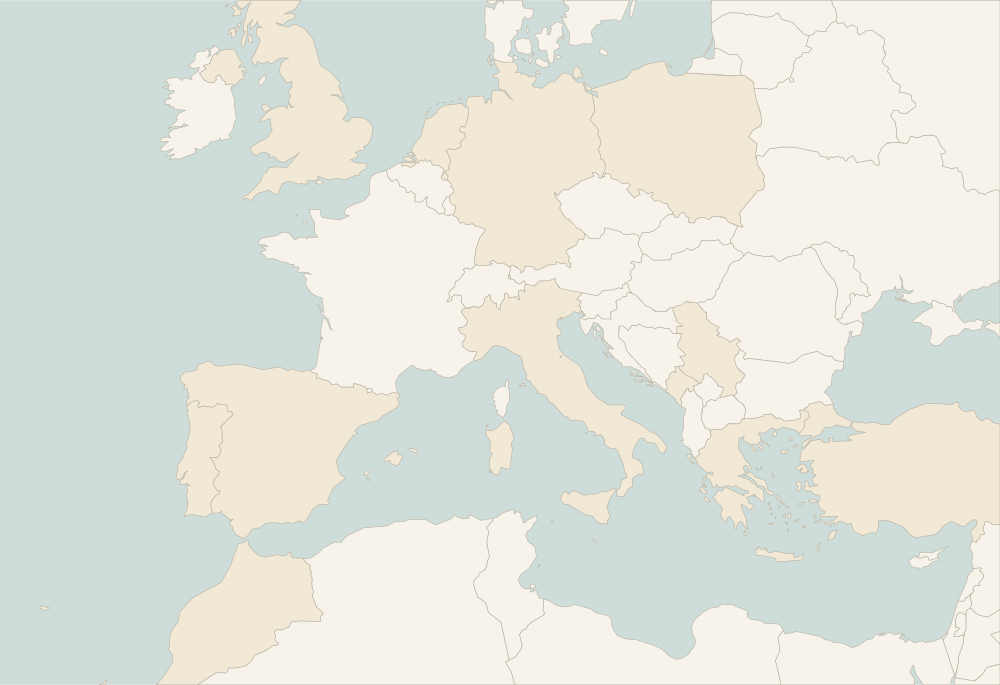
If this sounds like you, there is also Belgrade, Novi Sad and The Iron Gates
Serbia has no page of its own yet, but the region does. See which of them suits you, then pin what you have already done.
Front row for the next trip
Leave your email and we'll let you know when a new destination or story goes up.