

Las Fallas in Valencia: mascletà, ofrenda and cremà day by day
- Published
- 28 October 2026
- Reading
- 6 min read
- Where
- Valencia, Spain
- Prices checked
- 28. Oct 2026.
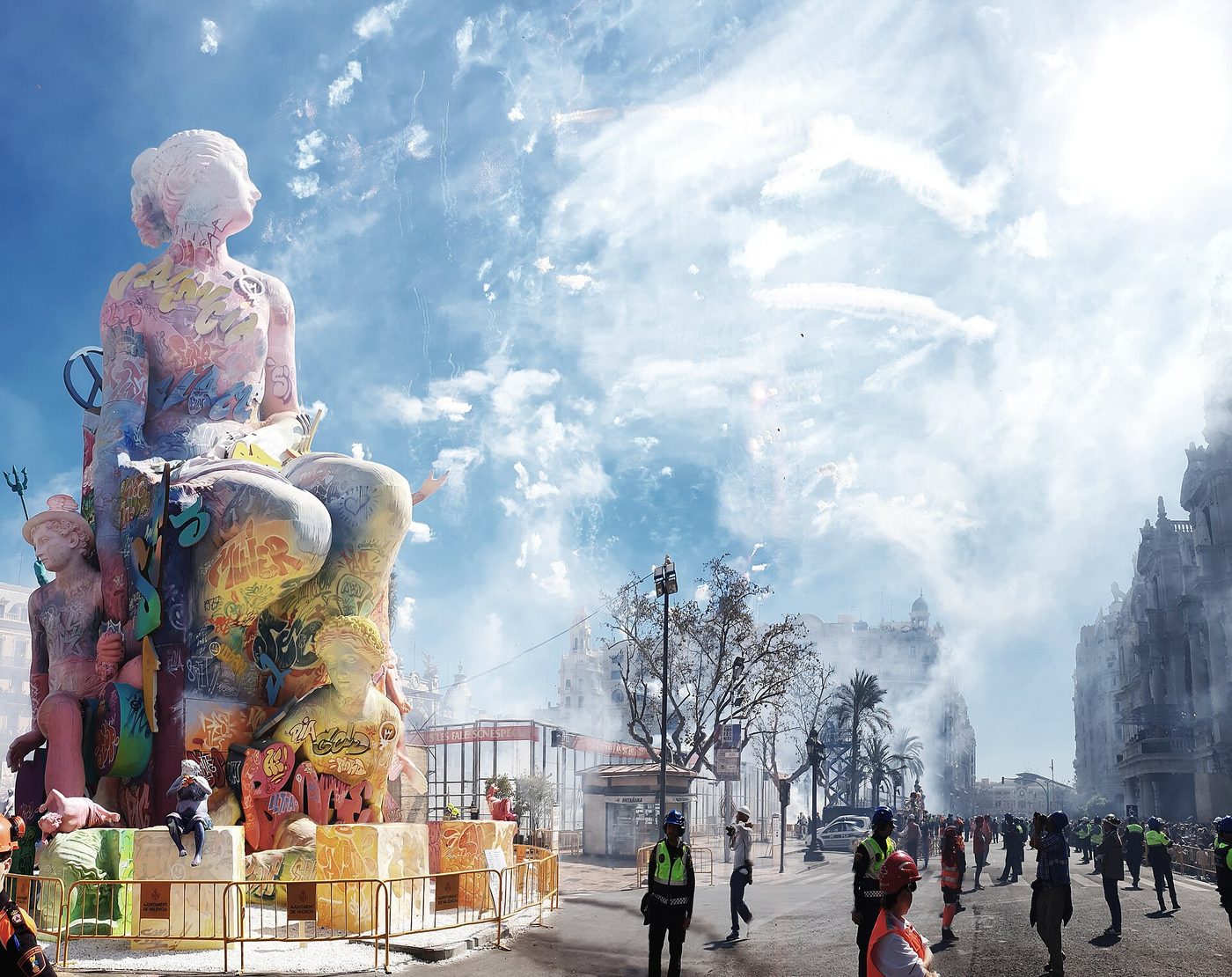
Las Fallas in Valencia is a programme of weeks, with one daily explosion at 2pm and one night of fire at the end. This page lays out the days, the mascletà, the cremà, the closed metro stations and the food.
Las Fallas is not one night of fire. The Fallas festival in Valencia starts weeks before the big weekend, with a daily mascletà, a flower offering and a procession, and it ends with the burning of the monuments on the night of San José. The edition of 2026: 2026: programme from 22 Feb to 19 Mar, main days 15–19 March. No official programme for 2027 exists yet, but the fixed dates are known, and in 2027 15 March falls on a Monday and 19 March, the night of the cremà, on a Friday. With one day only, choose 19 March.
When it runs and what counts as Fallas
The season opens with the cridà, the call that invites the city to the festival: 2026: Sunday 22 February at 7.30pm, Torres de Serranos. The cabalgata del ninot, a parade of the small figures, goes through the centre: 2026: Saturday 28 February at 5.30pm, from Glorieta to Calle Xátiva. The plantà is the day when the falles, the huge satirical monuments, are raised on the street, and the city closes around them: 2026: children's fallas 15 March at 9am, all fallas 16 March at 8am. From then on the days run in a fixed order, which is why most visitors arrive for the four days before the burning and stay for the cremà.
The mascletà at 2pm
The mascletà is a daytime barrage of firecrackers, noise rather than colour, and the sound hits the chest before the ears. The daily programme: 2026: daily at 2pm, 1 to 19 March. Different pyrotechnic houses fire on different days, Peñarroja on the first and Hnos Caballer on the last, so the show changes from day to day. The city's tourist office advises getting there early, and a separate booking exists for visitors with disabilities. Metro lines L3, L5 and L9 reach the square, and so do buses 4, 7, 8, 19, 35, 60, 62 and 63.
The ofrenda and the Nit del Foc
The ofrenda de flores is a long procession in which falleras walk to the Plaza de la Virgen with flowers for the Virgin, and the streets fill with people for most of the day: 2026: 17 and 18 March, from 3.30pm (Calle de la Paz and Calle de San Vicente), until about 1am. Its route runs through Calle de la Paz and Calle de San Vicente. The Nit del Foc, the night of fire, follows on the second day: 2026: 18 March at 11.59pm, Puente de Monteolivete. The nights around it have midnight castillos, aerial fireworks such as L'Alba de las Fallas, fired near the Puente de Monteolivete, so the late evenings are not quiet either.
The cremà on 19 March
The cremà is the end of the festival, when each falla is set on fire in turn. The Cabalgata del Fuego, a fire parade, comes first: 2026: 19 March at 7pm, from Calle de la Paz to Porta de la Mar. Then the burning starts: 2026, 19 March: 8pm children's fallas; 10pm all fallas; 10.30pm first-prize falla (Sección Especial); 11pm Town Hall falla with fireworks. The falla in front of the town hall burns last, with fireworks by the pyrotechnic house Hnos Caballer. One figure per year is saved, the ninot indultat, which is a custom and not a rule of the day.
The mascletà, the ofrenda, the cabalgatas and the cremà are street events. Tickets matter for the places around them, and the Museo Fallero, the official museum of the festival, gives the festival a calm indoor side.
Metro, closed stations and night transport
The metro and the tram ran without a break in 2026: 2026: 168 hours without a break, from Friday 13 March to the early hours of 20 March. Two central stations were shut around the mascletà: 2026: Xàtiva and Colón closed to passengers 12.30–2.30pm, 14 to 19 March; alternatives Alameda, Plaça Espanya, Àngel Guimerà. The pedestrian passage was closed too: 2026: closed 12.20–2.30pm from 14 to 19 March; 17 and 18 March also 10pm–2am (fireworks). After midnight the city switched to special lines: 2026: from Monday 16 March special night lines (117N, 118N, 134AN, 135N, 145N, 150N, 161N, 182N). Bicycles and scooters were off the network: 2026: not allowed on the network from 13 to 19 March. The practical lesson is to sleep next to a metro stop outside the closed core and to walk the last part, because taxis crawl through streets that are shut to traffic.
Buñuelos and churros
The festival tastes of fried dough. Buñuelos de calabaza, fritters made of pumpkin, appear in the shops with the season, and churros with thick chocolate come from stands all over the city: 2026: 146 authorised stands, opening from 2 March. Bertal and Chocolatería Valor on the Plaza de la Reina are both good names for a breakfast. Dr. Collado on Calle Ercilla 13 has been selling chocolate and buñuelos since 1892, and Bienve uses pumpkins from Vilamarxant. Paella is the lunch many people choose after the mascletà.
When the centre is too loud, the city offers a calm side. The Ciutat de les Arts i les Ciències holds the Oceanogràfic and the Hemisfèric, and the Lonja de la Seda, the old silk exchange, is a quiet interior of stone columns. The Albufera, a lake south of the city, is the place for the sunset.
A ticket with a chosen time slot, booked ahead.
A ticket with a chosen time slot, booked ahead.
An organised visit with a guide.


Check the same room on both sites: price and cancellation terms can differ.
Spain, in brief
What now
If this sounds like your trip, start here.
Valencia
→The city that moved its river out of its bed and built a park in it

Valencia in 3 days
→Three days arranged by opening hours: the market and the old town in the morning, the aquarium at opening, the lagoon before sunset.
Day trips from Valencia
→Sagunto on the C6, Xàtiva on the C-2, Llíria by metro and the Albufera by city bus: all without a car.
Where to stay in Valencia
→The old town for a first visit, Ruzafa for going out, Cabanyal for the sea and the City of Arts and Sciences for an early start there.

What Valencia costs
→Transport and entry fees in the old town are small change, the Oceanogràfic is the biggest ticket, and the room is the one item without a figure because it moves with the month.

Valencia off the main axis: gates you can climb and the frescoes of San Nicolás
→A gate still marked by French cannon fire, a church painted to the last inch of its vault and a station that wishes travellers a good journey in several languages.
What to eat in Valencia
→The esmorzaret at ten, paella at noon, horchata in the afternoon — in Valencia every meal keeps its own hour.
The best time to visit Valencia
→May, June and early September for sightseeing and the sea, August for the heat, March for Fallas, and autumn for the heaviest rain.
Getting around Valencia
→Metro from the airport in about twenty minutes, the old town on foot, the beach by tram and the Albufera lagoon by city bus 25.

Mistakes everyone makes in Valencia
→The market after three, the cathedral on a Saturday afternoon, the wrong airport fare and the metro to the mascletà: small slips that cost half a day in Valencia.

Spain
→A country where dinner is at ten and the city wakes up as everywhere else turns the lights off

Is Valencia a cheaper Barcelona? Where it is, and where not
→Three Gaudí tickets in Barcelona cost more than the whole of old Valencia put together.

Pintxos for beginners: how to eat bar by bar in San Sebastian
→Pintxos are not tapas: nothing arrives with your drink, and every bite is ordered and paid for on its own.

Valencia, Alicante and Albarracín from this story
See which of them suits you, then pin what you have already done.
Front row for the next trip
Leave your email and we'll let you know when a new destination or story goes up.