Haggling in Marrakech: a benchmark instead of the rule of thirds
- Published
- 30 March 2025
- Reading
- 4 min read
- Where
- Marrakech, Morocco

The trick worth more than any haggling advice: stop by the state-run fixed-price craft shop before the souk, so you know what something is actually worth before you start negotiating at all.
In Moroccan souks a price isn't a number, it's the start of a conversation. The question is how far it moves, how you know you've stopped in the right place, and where haggling isn't done at all.
The rule of thirds isn't a rule
The line you hear most about Marrakech is that the first price comes down to a third, but guides don't give the same number. Some advise countering at about a fifth of the asking price and ending at a third; others countering at about 40 percent and closing at half to two-thirds. All they agree on is this: the first price isn't the price, the counter-offer goes below half, and the deal lands somewhere in between.
The strongest move in the whole process isn't a sentence but a step: if the price is wrong, thank them and walk on. If your offer was realistic, they'll call you back. If they don't, the price was fair and you go back yourself. Neither outcome is a failure.
A benchmark before the souk
Since a percentage doesn't help, a benchmark does. Before you enter the souk, visit the Ensemble Artisanal, a state-run crafts complex by the Bab Nkob gate on Avenue Mohammed V. Prices there are fixed and marked for every craft, so in the souk you can tell if a seller is asking double or five times as much — and how realistic your counter-offer is.

What is NOT haggled
- Food in a café or restaurant, and medicine at the pharmacy — there the price is the price.
- Shops and cooperatives with clearly marked fixed prices.
- A petit taxi: the meter is required by law, and in the evening, after 8 or 9 pm, it adds about 50 percent by itself. If the driver won't switch it on, agree the fare before moving off — or take the next one.
- Entry tickets to museums, palaces and gardens — fixed, and paid at the desk.
Photographs aren't free
On Jemaa el-Fnaa the snakes, monkeys and henna look like part of the atmosphere, but they are a service: step into the circle or point a camera and you're expected to pay, and henna offered as a “gift” gets charged for once it's on your hand. Agree the price before, not after. The same goes for anyone who offers, unasked, to take you to a sight — they often take you to a friend's shop first.
Morocco, in brief
What now
If this sounds like your trip, start here.
- Before the souk, visit the state craft shop with fixed prices — that is where you learn the real range.
- Counter below half the first price and be ready to walk; if the offer was fair, they will call you back.
- In a petit taxi ask for the meter, and for a photo or henna on Jemaa el-Fnaa agree the price before, not after.

Morocco
→The north by train, the south by road, and in July you leave Marrakech for the coast

Road to the Sahara: Marrakech to the dunes, stage by stage
→The road from Marrakech to the dunes is about 560 kilometres and eight to nine hours of pure driving. Anyone…

Fleeing 1000 degrees: two mothers, two daughters, one mountain
→Two mothers who'd known each other for years got out of the same car with two daughters meeting for the first…

A ticket between two continents: Istanbul from a city ferry
→For the price of one city ferry ride you see from outside everything the old city charges you to enter. You…
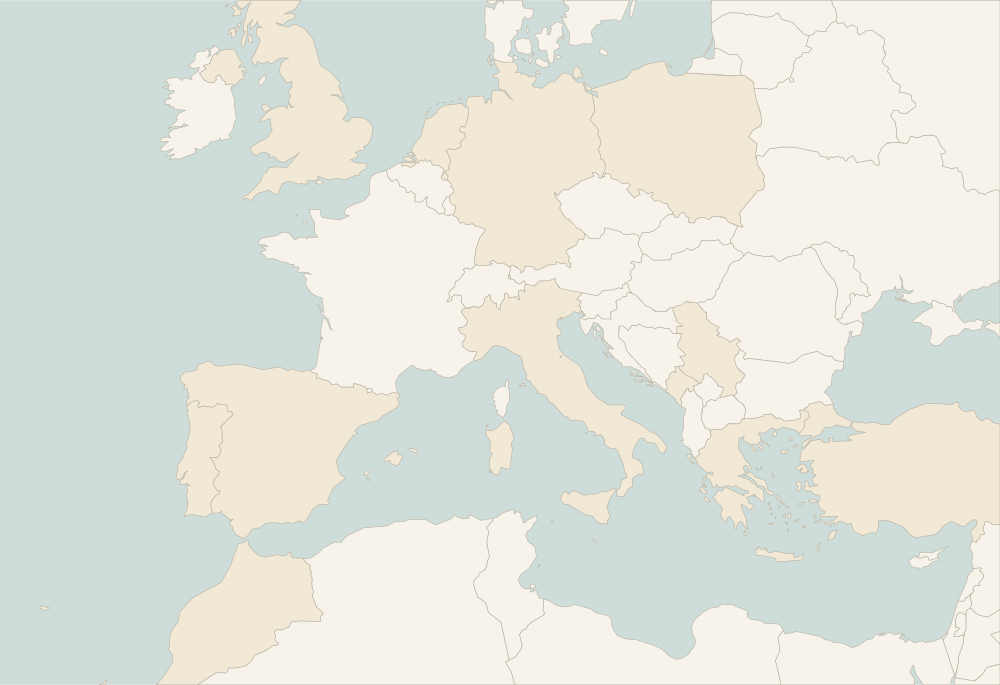
Marrakech, Ait Ben Haddou and Essaouira from this story
See which of them suits you, then pin what you have already done.
Front row for the next trip
Leave your email and we'll let you know when a new destination or story goes up.