

Day trips from Lisbon
Six day trips from Lisbon by public transport — from Sintra, forty minutes and €2.05 away, to Évora, which wants a whole day and €13.90 each way.
- Closest
- Sintra
- For the beach
- Cascais
- For one view
- Cabo da Roca
Lisbon has a rare advantage: the two closest trips, Sintra and Cascais, leave from city stations and run on the same card as the metro. The question isn't whether to go, but how much to cram into one day — and the answer is nearly always less than you planned.
The Sintra and Cascais trains are suburban city services: no reservations, one every 20–30 minutes, paid for with zapping on a Navegante card. Évora, Setúbal and anywhere north need their own ticket, and on the Évora train a seat reservation is compulsory.
The only trip that genuinely needs planning is Sintra: Pena Palace and the Quinta da Regaleira sell entry for an exact date and time slot, online. Everything else can be decided over breakfast.
Sintra — palaces on a hill, and too many of them
The train from Rossio station reaches Sintra in about 40 minutes, every 20–30 minutes, and the fare is €2.05 one way with zapping on a Navegante card; the Lisboa Card includes it. From the station, the 434 loop bus climbs to Pena and the Moorish Castle — or you walk up through the woods. Pena 'Essential' (the palace in your slot plus the park) is €20; which palace is which, and which to skip, is on the Sintra page.

How to do it in one day without running: the first train from Lisbon around 8, a Pena slot at 9:30 (the palace runs 9:30–18:30, the park 9–19), then downhill on foot to the Moorish Castle, into town for lunch, and one thing in the afternoon — Regaleira or the National Palace, not both. Pena and Regaleira sell entry for a time slot, online; the rest are bought on the day. Who should skip it: anyone with three days in Lisbon who hasn't seen Belém, and anyone who hates crowds.


Cascais — a town, a beach and no admissions
The train from Cais do Sodré runs along the water to Cascais in about 40 minutes, every 20 minutes, for the same fare as Sintra. A former royal summer resort, now a town with a marina, three small beaches in the middle of it (Conceição, Rainha, Moitas) and a museum in a seafront villa. Twenty minutes west on foot is Boca do Inferno, a fissure in the cliff the sea batters through, free. From there a cycle path runs another nine kilometres to Guincho beach, which is cold, windy and serious. Who should skip it: anyone after monuments — nothing here is toured, it is sat in.

Cabo da Roca — the westernmost point in Europe
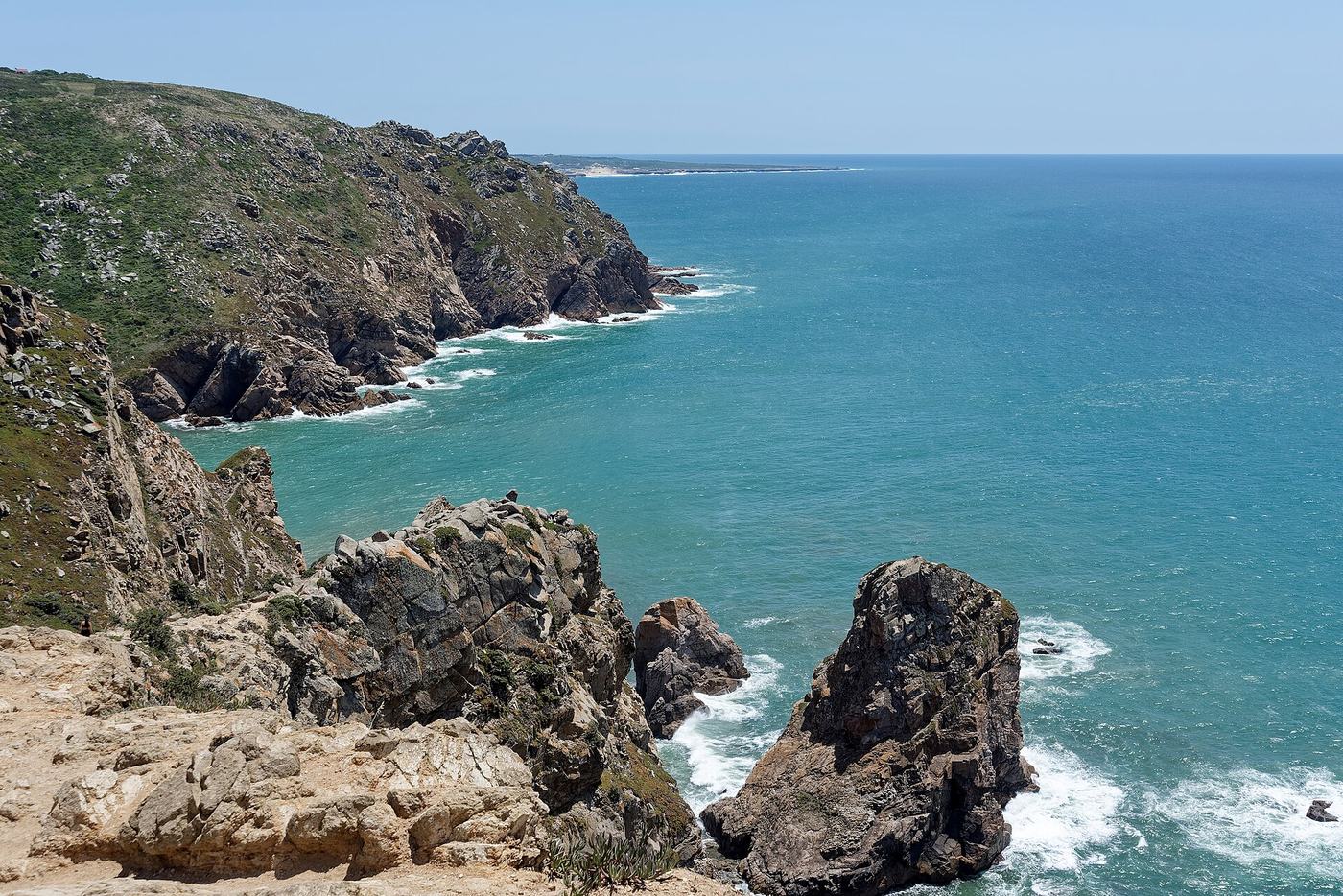
A 140-metre cliff over the Atlantic with a stone marker and a line from Camões: where the land ends and the sea begins. Carris Metropolitana bus 1624, which replaced the old 403 in 2023, runs between Sintra and Cascais along the coast and stops at the cape; the whole line takes about an hour. Up top there's a lighthouse, a kiosk and a visitor centre selling a certificate that you stood at the edge of Europe. The wind is strong even in good weather and fog can swallow the entire view. Who should skip it: anyone with one day — this is half an hour of looking and an hour of travelling, and it only makes sense as a stop between Sintra and Cascais.
Setúbal and Arrábida — fish, dolphins and a white beach
South of Lisbon, over the 25 de Abril bridge. The Fertagus train from Roma-Areeiro, Entrecampos or Sete Rios crosses on the bridge's lower deck and reaches Setúbal in about an hour, €5.70 one way. Setúbal is a working port with the Livramento fish market and restaurants that sell grilled fish by the kilo. Boats leave the harbour to watch the dolphins that live year-round in the Sado estuary. West of town is the Arrábida nature park, with white beaches and still water (Portinho da Arrábida, Galapinhos). Who should skip it: anyone coming for the beach outside summer.

Évora — a Roman temple and a chapel of bones
A walled town in the Alentejo, UNESCO-listed in its entirety, with a 1st-century Roman temple of Diana in the middle of a square and a cathedral you can walk across the roof of. The Intercidades from Oriente, Entrecampos or Sete Rios takes about 1 hour 45; a second-class ticket is €13.90 one way and a seat reservation is compulsory. There are five or six trains a day, so buy as soon as you know the date. In town: the Capela dos Ossos, a chapel in the church of St Francis lined with bones from the town's cemeteries; the temple of Diana, in the open and free; and the cathedral, whose roof you can walk across. A full day: the last train back leaves after seven in the evening and reaches Lisbon around nine. Who should skip it: anyone with fewer than four days in Lisbon, and anyone with small children — three and a half hours on a train there and back is a real cost.


Nazaré and Óbidos — waves and walls in one day
North, by coach. The Rápida Verde express from the Campo Grande terminal reaches Óbidos in about an hour: a medieval town inside walls you can walk along, with ginja served in a chocolate cup on every corner. Rede Expressos from the Sete Rios terminal (metro Jardim Zoológico) runs to Nazaré in an hour and a half to two hours: a fishing town with a funicular up to the Sítio quarter on the cliff, looking down on Praia do Norte, where record waves have been surfed. The waves run October to March; in summer it's an ordinary beach with a strong current. Who should skip it: anyone going in summer purely for the waves, and anyone wanting both towns in one day without a car — it can be done, but it's twelve hours and three coaches, from two different Lisbon terminals.

If you pick one
- First time in Portugal, one free day: Sintra, on the first train, with a 9:30 Pena slot and only one more thing after lunch.
- With children, or with tired legs: Cascais. A train along the sea, a beach in the centre, nothing to pay and a return whenever you feel like it.
- For food and sea without the crowds: Setúbal and Arrábida — fish by the kilo, dolphins, and a beach that looks nothing like the rest of the coast.

Porto — a second city, not a day trip
Porto is in the north, at the far end of the main line, and wants two nights at least. It does not fit into a day out of Lisbon, though it links easily as the second stop on the same trip.

What transport costs
All prices — per person, one way
The Sintra and Cascais trains need no reservation and run off the same Navegante card as the metro; Fertagus has its own ticket, bought at the station. A car makes sense only for Arrábida and for pairing Nazaré with Óbidos; for Sintra it is the worst choice, since the road up to Pena is narrow and jammed and there is almost no parking at the top.

Before you go
Short answers to what people ask most before setting out.
Can Sintra be done in half a day?
Not honestly. The train is 40 minutes each way, the bus up to Pena another twenty with the queue, and each palace wants an hour and a half. For one real impression, count on eight in the morning to seven at night and no more than three sights.
Which Sintra tickets need booking?
Pena Palace and the Quinta da Regaleira — both sell entry for an exact date and hour, online, Regaleira only through its own official site, with an hour's grace. The Moorish Castle, Monserrate and the National Palace are bought on the day.
Which trip runs on a city ticket?
Sintra and Cascais: both trains are part of the suburban network and run on zapping from a Navegante card. Setúbal, Évora and anywhere north need their own tickets.
Ready for Lisbon?
Where to next
Where to stay in Lisbon
→Six Lisbon neighbourhoods to sleep in, judged on what listings leave out — how high up it is, how many steps…
Sintra · 22 km
→Royal palaces on a mountain the mist keeps cooler than Lisbon
How well does Lisbon suit you?
→Six questions: a score for this place and others like it.
Front row for the next trip
Leave your email and we'll let you know when a new destination or story goes up.