

Swakopmund
A German seaside town between the desert and the cold Atlantic, with more than 180 days of fog a year — a rest from the gravel and a base for dunes, lagoon and seals
- When to go
- October 15° · 0 rainy days
- Per day
- €€€price 3 of 5
- How many days
- 2days
- For you
- 6 questions →
- Nearest airport
- 36 km Walvis Bay
- Right now

Swakopmund is the pause on a loop round Namibia, between the dunes and Etosha: two days in a town with pavements and restaurants after the gravel, and a base for trips — Sandwich Harbour, where the dunes run down into the ocean, the Moon Landscape with its welwitschias, the seals at Cape Cross and the Walvis Bay lagoon. The sea is cold all year and is not why you come.
The Germans founded the town in 1892 as the main port of German South West Africa, because the only natural deep-water harbour on this coast, Walvis Bay, was British. Walvis Bay later passed to South Africa and was handed back to Namibia only on 1 March 1994, four years after independence — which is why two towns stand thirty kilometres apart on the same coast. German is still spoken in Swakopmund, and the centre has stayed colonial.

The cold Benguela current makes the fog: the coast gets more than 180 days of thick fog a year and less than twenty millimetres of rain, and monthly average temperatures sit between 15 and 25 degrees. For the Moon Landscape and the Welwitschia Drive the permit is bought at the ministry office (MEFT/NWR) in the town centre — it is a day ticket for the Namib-Naukluft park, €15 per person plus the vehicle — and Sandwich Harbour needs its own permit from the same office. From here you go north, along the Skeleton Coast into Damaraland, or via Uis and the Brandberg towards Etosha.
What to see in Swakopmund
- S
Sandwich Harbour
A bay and lagoon south of Walvis Bay, inside the Namib-Naukluft park, where the dunes come right down to the ocean; the lagoon has been a Ramsar wetland for its birds since 1995. The only way in is the beach between dunes and surf, passable for just a few hours around low tide — so you go by 4x4 with a driver who knows the tide, on a half-day tour from Walvis Bay.
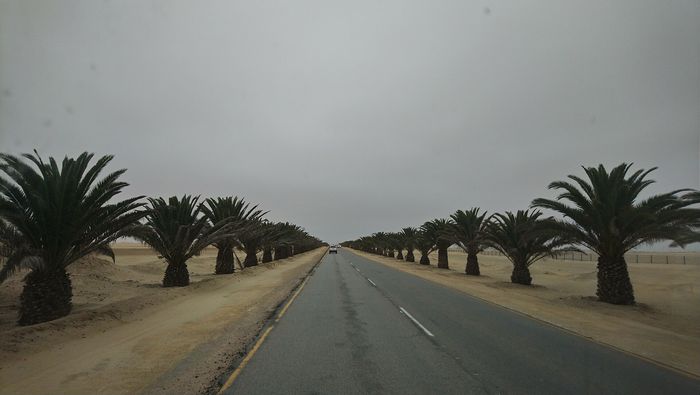
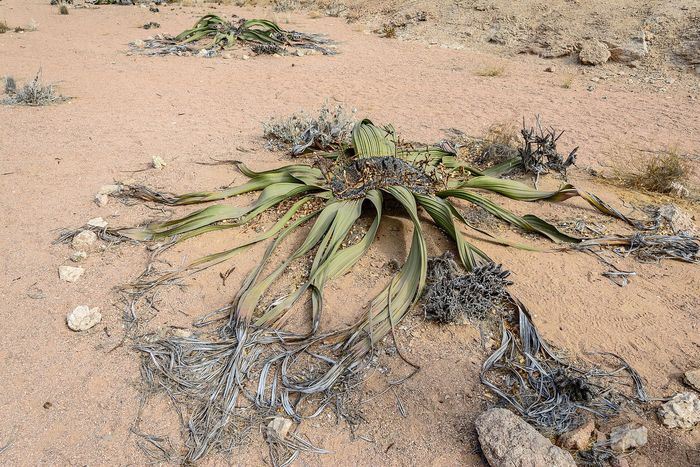
The Moon Landscape and the welwitschias
Valleys the Swakop river has cut into the rock, half an hour's drive east of town, then a plain of welwitschias — plants with only two leaves that live for more than a thousand years. The drive has thirteen numbered markers and is done in your own car on gravel; the largest welwitschia is estimated to be over 1,500 years old.
- C
Cape Cross
A seal reserve 116 kilometres north in a straight line, with a boardwalk through the colony. In November and December, when the pups are born, the cape holds up to 210,000 seals. Half a day from town, or the first stop for anyone carrying on up the Skeleton Coast.
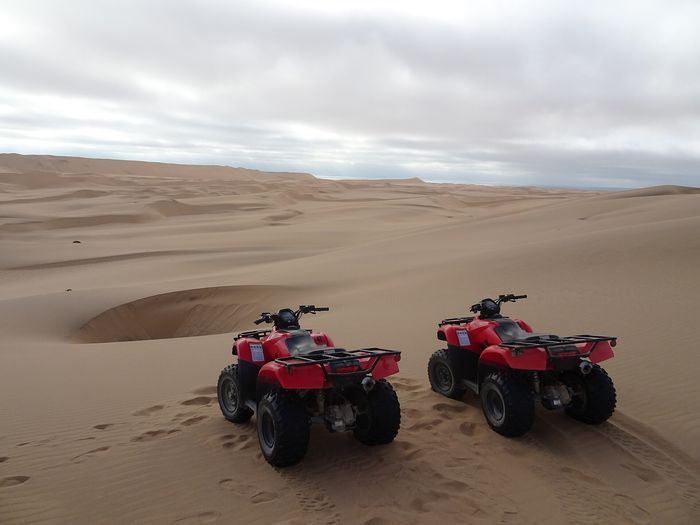
The dunes at Langstrand
Quad bikes, sandboarding, camel rides, skydiving and paragliding are all on offer in the dunes near Langstrand, south of the Swakop river mouth, on the road to Walvis Bay.
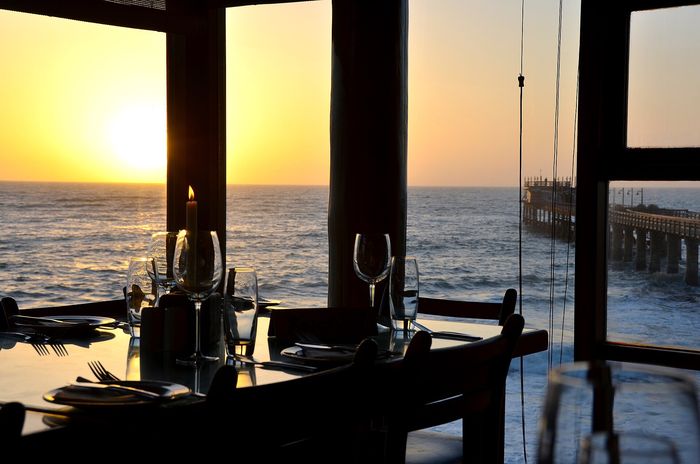
The Woermannhaus and the jetty
The Woermannhaus of 1906, with its Damara tower, is now the town library. The jetty is steel, begun in 1914 when the wooden one of 1905 proved inadequate for a port; today it is a promenade over the Atlantic.
The Walvis Bay lagoon
A lagoon thirty-one kilometres south in a straight line, a Ramsar wetland since 1995, with flocks of lesser flamingos along the shore. The Sandwich Harbour tours leave from here, so the day joins up: the lagoon in the morning, Sandwich Harbour at low tide.


Two things you probably did not know
Swakopmund looks like a German seaside town because it was one: founded in 1892 as the main port of German South West Africa. German is still heard in the street and the bakeries sell strudel.
The town sits where the desert meets the cold Atlantic, so dense fog rolls in almost every morning. That fog is the only water for plants and insects in this desert. Some beetles catch it on their backs.
Ready for Swakopmund?
Within reach from here
Places sorted by straight-line distance from Swakopmund — day trips or weekends.

Namibia
→A country you drive rather than visit: about four people per square kilometre, gravel roads without end, and a safari done in your own car as in Kruger — only without the fence

South Africa
→A country of long distances and reversed seasons, driven on the left throughout

Kenya
→A safari charged by the day, not by the trip — a reserve whose gate fee doubles in July, while a whole trip costs only half as much more

Chile
→A country 4,300 kilometres long and 180 wide — driest desert on earth to glacier, without a single turn
All 277 places we write about sit on one page — narrow them down by continent, country, price or what you are travelling for.
Within reach from here: Skeleton Coast, Sossusvlei and Windhoek
See how much of that actually suits you — or pin Swakopmund if you have been.
Front row for the next trip
Leave your email and we'll let you know when a new destination or story goes up.