

Sossusvlei
Red dunes up to 325 metres, a clay pan of trees dead for six centuries, and a gate that decides who is on a dune before the sun
- When to go
- November 25° · 1 rainy day
- Per day
- €€€€price 4 of 5
- How many days
- 2days
- For you
- 6 questions →
- Right now
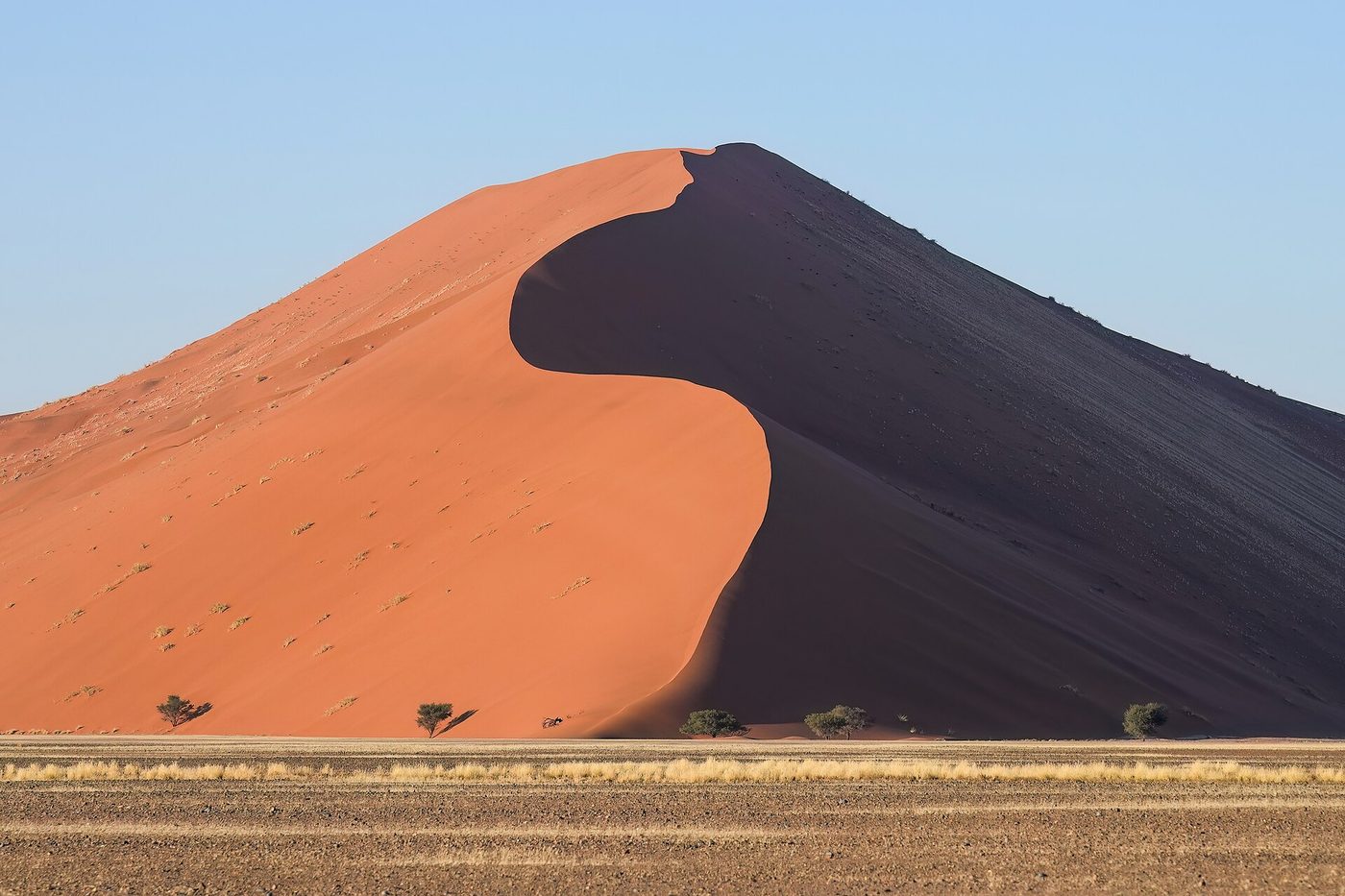
Sossusvlei is a morning in the Namib desert, which is why it needs two nights. The gate at Sesriem opens with the sunrise, and the white pan of Deadvlei lies sixty kilometres down the tarmac, then five kilometres of deep sand and a kilometre's walk beyond. Entry to the Namib-Naukluft park is €15 per person for 24 hours, plus the vehicle.
The schedule is set by the gate. The outer gate at Sesriem opens at sunrise and closes at sunset, while the inner gate, for guests of the Sesriem camp and Sossus Dune Lodge inside the fence, opens an hour earlier and closes an hour later. Sleep outside and you reach the dunes with the sun already above them; sleep inside and you climb in the half-dark and watch the colour come up.

The tarmac ends at the car park for ordinary vehicles, and from there to Sossusvlei the sand is deep. A 4x4 with deflated tyres gets through, since a ban on self-drive 4x4s announced for the end of 2025 was postponed and the ministry has confirmed they may carry on. An ordinary car stays in the car park, because in the soft sand it gets stuck and the morning goes on digging it out. Anyone without a 4x4 can take the shuttle that the park concessionaire runs from the car park to the end of the sand and back.
Fill the tank at the pump in Sesriem before you go in, because the next fuel, together with a bakery and a shop, waits only at Solitaire, on the long road to the coast and Walvis Bay.
Check the same room on both sites: price and cancellation terms can differ.
Timed-entry tickets and guided tours in one place.
Guides for Sossusvlei
Shorter, practical pages for one concrete question each — how many days, how much money, where to sleep, where to escape the city.

Sossusvlei in 2 days
→One morning decides the whole visit: the gate opens with the sun, Deadvlei is sixty-five kilometres away, and the colour lasts until eight, so everything else is waiting.

Day trips from Sossusvlei
→Guided drives from the Sesriem camp and a balloon flight: what each costs, who it fits and what combines in one day.

Where to stay in Sossusvlei
→Three places to sleep, and one gate that decides who reaches the dunes before the sun.

The best time to visit Sossusvlei
→The dunes look the same all twelve months, and what changes is how cold the dawn is, how much sand is in the air and whether the pan holds water.
What to see in Sossusvlei
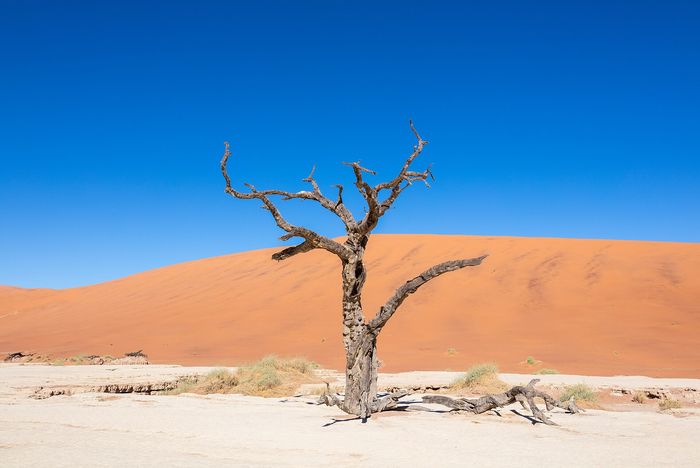
Deadvlei
A white clay pan a kilometre's walk from the end of the sand, which the Tsauchab river once flooded and used to feed the camel-thorn trees until the dunes cut it off. The trees dried out six to seven centuries ago and in the dry air they never rotted, so black trunks now stand on white clay with a tall red dune behind them, which is the picture you come for.
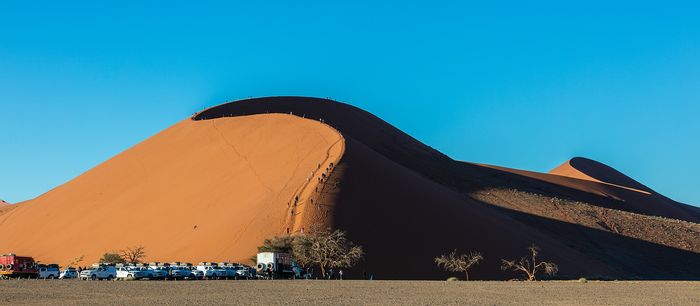
Dune 45
A dune over 170 metres high right beside the road, at kilometre 45 from Sesriem, which is how it got its name. It is the first dune on the way, so at dawn it is also the busiest, and anyone who wants a quiet ridge should drive on towards Sossusvlei.
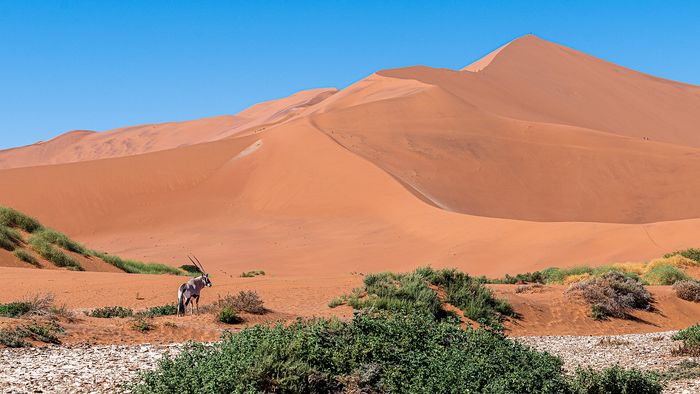
Big Daddy
At about 325 metres the highest dune around Sossusvlei, standing above Deadvlei. You climb the long ridge in the morning with plenty of water, and come down the steep face straight onto the white pan.
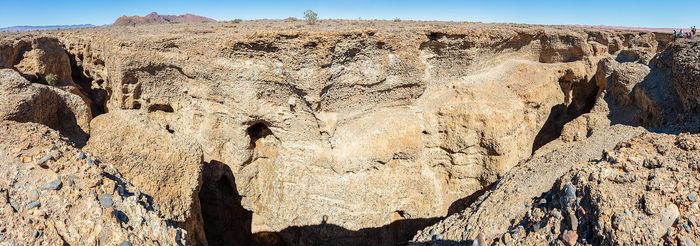
The Sesriem canyon
The Tsauchab's narrow cut four kilometres from Sesriem, about a kilometre long, up to thirty metres deep and two wide in places, with a stretch that holds water all year. The name is Afrikaans for "six thongs", the number of rawhide straps settlers tied together for a bucket to reach the water.
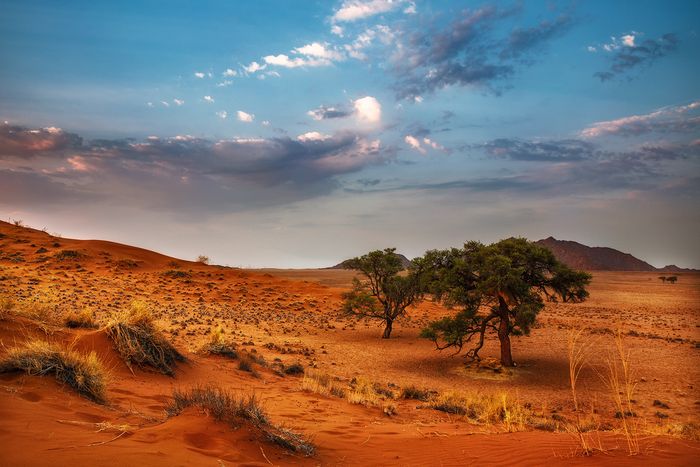
Elim dune
A free-standing dune five kilometres past the gate, the closest to the camp, and its sunset belongs to those sleeping inside the fence, because the outer gate closes at sunset and the inner gate an hour later.
- T
The sky over the Namib
The neighbouring private NamibRand reserve, which shares a hundred-kilometre boundary with Namib-Naukluft, has been an International Dark Sky Reserve since 2012, so a second night here is for the Milky Way as much as for the gate at dawn.


Stories from Sossusvlei
How it actually was when we were there, and what was worth it.

Sossusvlei at dawn: the sun by month, a dune's shadow and a balloon for the second morning
→Sunrise at Sossusvlei slides by an hour and forty minutes between December and July, and every plan for the dunes has to slide with it.
Nomadinho scores out of 100, the same ones behind “Where to go”.
If you like Sossusvlei
Three places with the closest scores, from any country.


Two things you probably did not know
The dunes at Sossusvlei are among the tallest in the world, up to three hundred metres. The sand is red because the iron in it has oxidised over millions of years. The older the dune, the redder it is.
The dead trees at Deadvlei have stood for some nine hundred years without rotting. The air is so dry that the wood cannot decay, so they remain where they died when the river changed course.
Before you go
Short answers to what people ask most before setting out.
How many days does Sossusvlei need?
Two nights: a morning for the dunes and Deadvlei, an afternoon for the canyon and the Elim dune sunset. A third day has nothing to add.
Do you need a 4x4 for Sossusvlei?
The tarmac ends at the car park, so an ordinary car stops there. For the deep sand beyond it you need a 4x4 or the park shuttle, which runs both ways. Fuel is at Sesriem, the next pump at Solitaire.
When is the best time to visit Sossusvlei?
May to September: cold mornings, clear air and the best light, with a lighter afternoon wind than in summer. June is best if you choose once; December to February brings the worst heat.
Ready for Sossusvlei?
Within reach from here
Places sorted by straight-line distance from Sossusvlei — day trips or weekends.

Namibia
→A country you drive rather than visit: about four people per square kilometre, gravel roads without end, and a safari done in your own car as in Kruger — only without the fence

South Africa
→A country of long distances and reversed seasons, driven on the left throughout

Kenya
→A safari charged by the day, not by the trip, and a reserve whose gate fee doubles in July

Chile
→A country 4,300 kilometres long and 180 wide — driest desert on earth to glacier, without a single turn
All 292 places we write about sit on one page — narrow them down by continent, country, price or what you are travelling for.
Guides that mention it

Within reach from here: Swakopmund, Windhoek and Skeleton Coast
See how much of that actually suits you — or pin Sossusvlei if you have been.
Front row for the next trip
Leave your email and we'll let you know when a new destination or story goes up.