

What to eat in The Dolomites
Casunziei in the east, Schlutzkrapfen in the west, canederli in both valleys, and lunch often in a hut up the mountain.
- Canederli
- €24
- Cream of polenta
- €18
- Main course at the Molignon hut
- €15–25
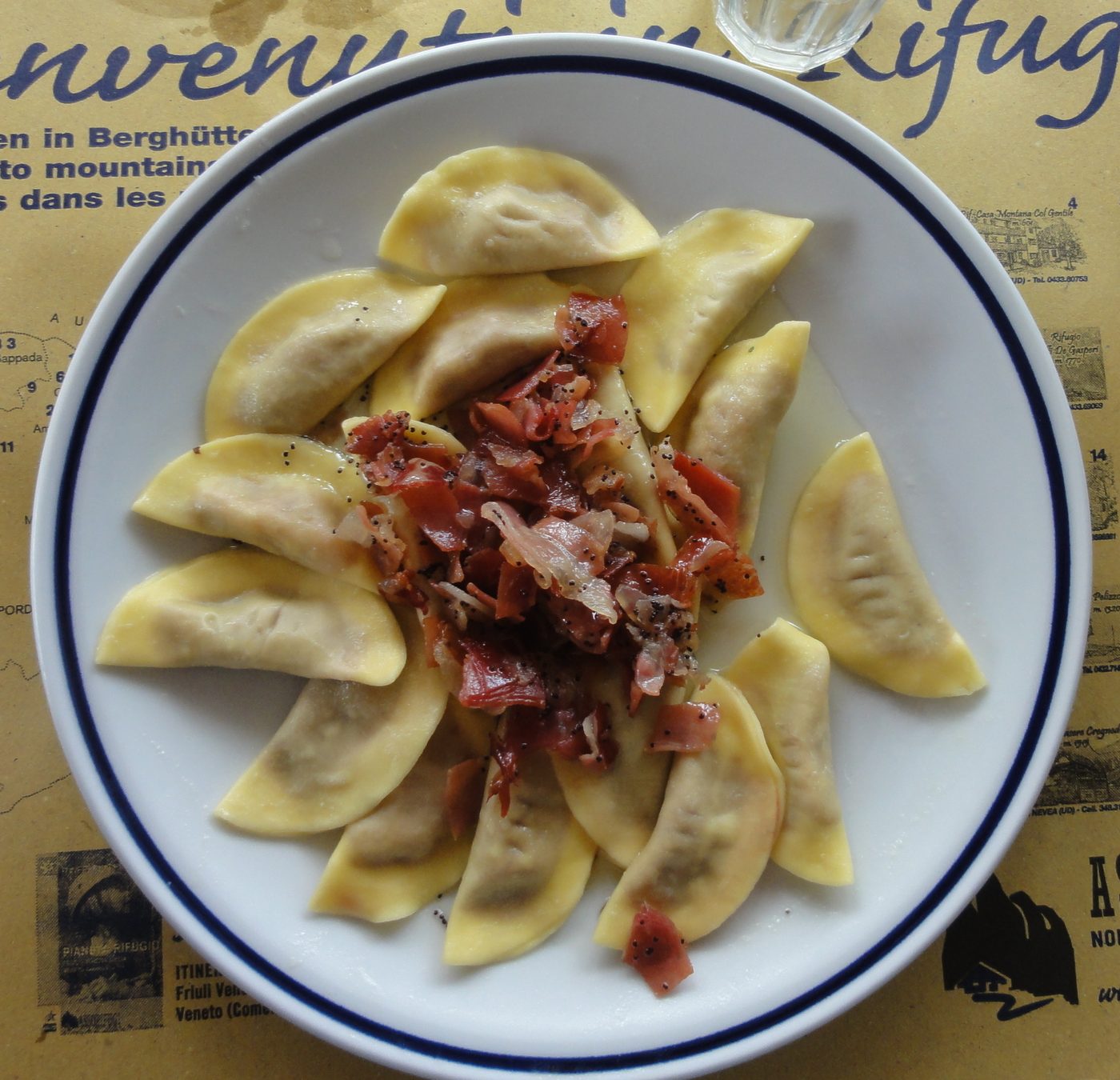
The Dolomites have no single cuisine, and the menu changes with the valley. Around Cortina in the east the plate is Ladin and Venetian, while around Ortisei in the west it turns South Tyrolean and German-speaking, and the two meet in half-moon dumplings that carry different names. Lunch holds the other surprise, because it is often eaten in a mountain hut on the trail rather than in the town below.
The pasta of Cortina
Casunziei are half-moon pasta, and the Ladin name means exactly that. The red version is filled with boiled beetroot and comes under melted butter, grated Parmesan and a scatter of poppy seeds, the detail you recognise on the plate before the first bite. A green one exists too, filled with spinach.
Beetroot and poppy seed taste of Central Europe, which makes sense for a valley that passed to Italy only in 1918. Ristorante Tivoli in Cortina has a Michelin star and its kitchen has cooked the dish for the press, yet casunziei also turn up in plain local places, since every hut, hotel and restaurant makes its own version. For a menu built from Ladin recipes alone, Dolom'Eats in Cortina serves casunziei all'ampezzana.
Check the same room on both sites: price and cancellation terms can differ.
Schlutzkrapfen in Val Gardena
Cross into Val Gardena and the same dumpling changes its name. It is Schlutzkrapfen in South Tyrolean German, crafuncins in the local Ladin and mezzelune in Italian. The dough here is made from rye and wheat flour, the filling is spinach and ricotta, and the dumplings come boiled with melted butter and Parmesan as a starter or as the main course. Anyone who has eaten casunziei in Cortina does not need to hunt for them twice. Huts and farm restaurants serve them, and Paratoni in Santa Cristina is one name to look for.
In broth or with butter
Canederli are the Dolomites' dumpling of stale bread: large balls of bread, milk and eggs, called Knödel in German and chenedi in Ladin. The flavours run from cheese and speck to mushrooms, spinach and liver. They arrive in a clear soup or beside a goulash, and in Cortina they come with meat or with cheese. At Ristorante De Len canederli with speck sit in a vegetable broth for €24.
The mountains do their own versions, and a hut lunch on the way to a viewpoint is where most people meet them. Baita Daniel on Seceda serves canederli with speck on a terrace with a long view, and Baita Odles on Col Raiser adds game, soups and a board with speck and homemade cheese. In Val Gardena, Rifugio Fermeda above Santa Cristina does a broth with a knödel in it.
Polenta, goulash and game
Polenta is the second undisputed star of the kitchen, and at Ristorante De Len it arrives as a cream with mushrooms for €18. Goulash is served on a bed of polenta or with spätzle. Barley soup, zuppa d'orzo, is the favourite starter and appears mostly in autumn. Game means deer, roe deer and wild boar, while chamois is rare and mostly shows up as salami or as Kaminwurz.
Speck and the marenda
Speck is eaten in thin strips with Schüttelbrot, a hard spiced bread, and the combination is an afternoon habit rather than a first course. The marenda starts around 4 pm, a peasant pause before the end of the working day, and the board carries speck, Schüttelbrot, Kaminwurzen and a mountain cheese, with a glass of Vernatsch, also known as Schiava. Farms, huts and restaurants all serve it, so it is the easiest South Tyrolean meal to fit into a day on foot.
Strudel and Kaiserschmarrn
Kaiserschmarrn is a torn pancake dusted with icing sugar and served with cranberry or berry jam, and apple strudel comes with vanilla. At the Molignon hut the apple pie arrives fresh from the oven.
Lunch in a hut
The price of a hut lunch is a range, and it can be lower than people expect. The Molignon hut on Alpe di Siusi, also called Mahlknechthütte, sells a dish of the day for €12–14. A main course there costs €15–25, and a set menu costs €25. The gourmet menu costs €28–45. These figures belong to Molignon alone, which serves a Tyrolean Geröstl and apple pie, and other huts set their own prices.
Most high-mountain huts open from mid-June or early July and close at the end of September or the start of October, and outside that window they are mostly shut. A few can be reached by cable car in winter, and Sofie Hut on Seceda sits inside the ski area. Dinner at the fixed hour is part of an overnight stay, since guests sleeping in a hut get half board and everyone eats at the same time, with drinks extra.
What the dishes cost
Prices come from one restaurant menu and one hut; other places differ.
Where to try what
Names come from tourist guides; menus change.


Where to next
The best time to visit The Dolomites
→Cable cars, roads and car parks run in a summer window, so the month you choose decides what you can reach.

Venice · 123 km
→A city without a single car, built on 118 islets

How well does The Dolomites suit you?
→Six questions: a score for this place and others like it.
Nomadinho scores out of 100, the same ones behind “Where to go”.
If you like The Dolomites
Three places with the closest scores, from any country.


Before you go
Short answers to what people ask most before setting out.
What are casunziei and where do you eat them?
The name is Ladin for half moons: a pasta from Cortina filled with beetroot and finished with butter, Parmesan and poppy seeds, with a green spinach version alongside. Ristorante Tivoli and Dolom'Eats in Cortina both serve them, and many huts and hotels in the valley make their own.
How much does lunch in a mountain hut in the Dolomites cost?
At the Molignon hut on Alpe di Siusi a dish of the day costs €12–14 and a main course €15–25. The set menu costs €25 and the gourmet menu €28–45. Other huts have their own prices, so Molignon is a reference point and not a rule.
When are the huts in the Dolomites open?
The high ones keep a summer season, from mid-June or early July to the end of September or the first days of October, and are shut around it. Some can be reached by cable car in winter. The Molignon hut works in summer and winter and stays shut between the two seasons.
Ready for The Dolomites?
Front row for the next trip
Leave your email and we'll let you know when a new destination or story goes up.