

Valley of the Kings: Tickets, Which Tombs to Pick and What Costs Extra
Three tombs in the ticket, three supplements and a tram of three minutes
- Ticket
- €13 for three tombs of your choice
- Supplements
- Seti I €34
- Hours
- 6 am–5 pm, every day
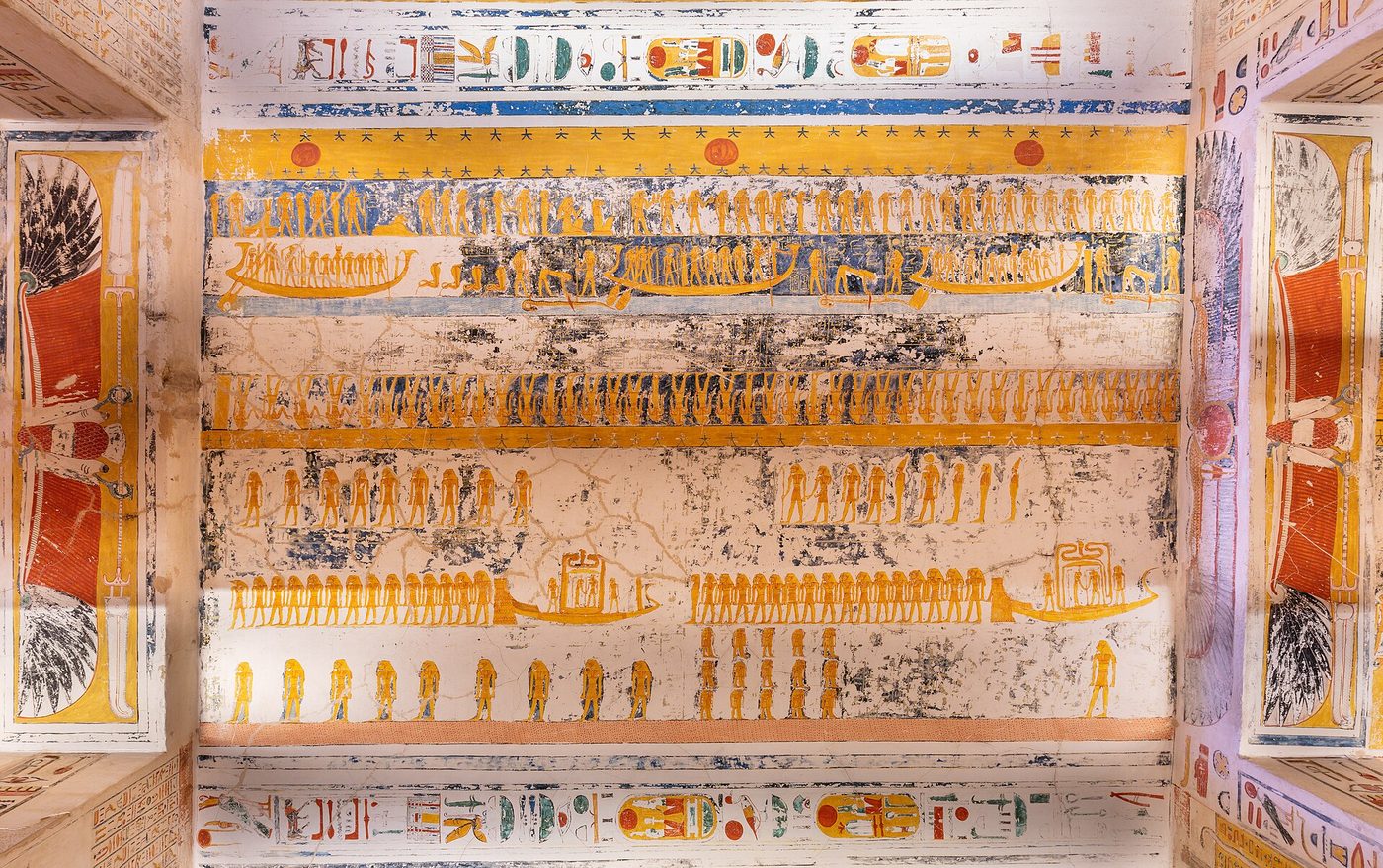
The Valley of the Kings is paid for in three layers: the ticket, the tram and the supplements. Only one of those decisions has a deadline, and it falls at the ticket office, because nobody on the tram can sell you a second ticket. Work out there which tombs are worth the extra money, and the rest of the morning runs by itself.
Which Valley of the Kings ticket to buy, and what costs extra
The general ticket costs €13 for foreign adults and opens three tombs of your choice from the list of those open that day, which runs to about ten. Students pay half. The ticket office is in the Visitor Centre, it takes cards only and there is no cash window to fall back on. The valley is open 6 am–5 pm every day, with the same hours in winter and summer.
Four tombs sit outside that ticket and are paid for separately: Seti I at €34, Tutankhamun at €12, the shared tomb of Ramesses V and VI at €3.70, and the tomb of Ay, whose price is quoted at the ticket office. The tram costs €0.34 return. The partner ticket for the valley is temporarily unavailable on Tiqets, but the same page offers a private six-hour tour that bundles the valley with Hatshepsut's temple and the Colossi of Memnon, lunch included. A tour pays for the driver and for a guide who must wait outside, since guides are not allowed into the tombs, so it suits anyone who would rather not bargain with a taxi.
Supplements are bought at the ticket office of the Visitor Centre, before the tram, and paid by card only. The list of open tombs changes, so you pick three from the one valid on the day of your visit.
On your own
- Tour
- private, with transfer and lunch
- Covers
- Valley, Hatshepsut, Colossi of Memnon
- Guide
- cannot enter the tombs
With a guide
- transport arranged
- a guide on site
- costs more than going alone
When to come and how to get there
Arrive at six, or at least before eight, or come in the last hour or two before closing. From ten until two the crowds are at their thickest. In summer the early start is also the cool one, while in winter the afternoon works almost as well. From the Visitor Centre the tram takes about three minutes, and the farthest tomb is another ten minutes uphill on foot.
From Luxor the usual way is a taxi hired for the whole day, about 45 minutes over the Luxor Bridge. The alternative is the ferry across the Nile, which leaves every ten to fifteen minutes and leads to a taxi on the west bank. Pay the driver for the day rather than for one leg, since the valley is only the first stop here. The Colossi of Memnon stand by the road and cost nothing, and Hatshepsut's temple at Deir el Bahri comes next at €7.40.
The three tombs in the ticket and the three supplements
Choose the three tombs by who is open, because the list rotates, and expect them to be long sloping corridors with painted walls whose colours differ from door to door. One guide's order of taste starts with Ramesses IV (KV2), moves to Ramesses IX (KV6) and then to the shared tomb of Tausert and Setnakhte (KV14). Ramesses III (KV11) is the swap if one of those is shut. Time needed: about two hours at an easy pace for three tombs, and about three hours for six.
If you pay for only one supplement, make it Seti I (KV17). It is the dearest of the lot, and guides count it among the finest tombs in the valley, with relief in colour starting in the first chamber, which is known as the room of beauties. When the budget stretches to a few euros only, the tomb of Ramesses VI is the better deal per coin, and its ceiling carries boats and figures in yellow, blue and red on white. Tutankhamun is the weakest value: the tomb is small, the treasure sits in the Grand Egyptian Museum, and what you pay for is the mummy.

When you only have an hour
An hour is enough for the general ticket and three tombs if you move briskly, and the supplements are what you give up first.
- Buy the general ticket and one supplement at the ticket office, by card, before you board the tram.
- Pick the three tombs from the list posted for that day, starting with whichever of Ramesses IV, Ramesses IX and Tausert and Setnakhte is open.
- Leave the farthest tomb, the one with the extra ten minutes uphill, for a second visit.
- Be at the gate before eight, because between ten and two the queues eat the hour.

Where to next
Luxor in 2 days
→Two days in which the west bank starts at seven because there is no shade, and Karnak waits until three in the afternoon, with a balloon or Medinet Habu for the second morning.

Aswan · 181 km
→A town on the Nile where the river has granite islands and cataracts, the people are Nubian and the temples were moved from where they were drowned

How well does Luxor suit you?
→Six questions: a score for this place and others like it.
Nomadinho scores out of 100, the same ones behind “Where to go”.
If you like Luxor
Three places with the closest scores, from any country.


Before you go
Short answers to what people ask most before setting out.
Can I buy a tomb supplement after I am already in the valley?
No. Supplements are sold at the ticket office of the Visitor Centre, before the tram, and there is no sale on the tram or at the tombs. Anyone who changes their mind has to ride back, and the payment is by card only.
Do you still pay for a photography permit?
No, the permit no longer exists. A phone without a flash needs no extra ticket, and according to reports a DSLR is allowed as well. Guides cannot enter the tombs, so the pictures are yours to take.
Can I choose any three tombs?
No. You choose only from the tombs open on the day, about ten, and that list changes. Seti I, Tutankhamun, Ramesses V and VI and Ay need their own tickets on top.
Ready for Luxor?
Front row for the next trip
Leave your email and we'll let you know when a new destination or story goes up.