

Lyon Light Festival: route, hours and how to beat the crowds
- Published
- 6 November 2026
- Reading
- 6 min read
- Where
- Lyon, France
- Prices checked
- 6. Nov 2026.
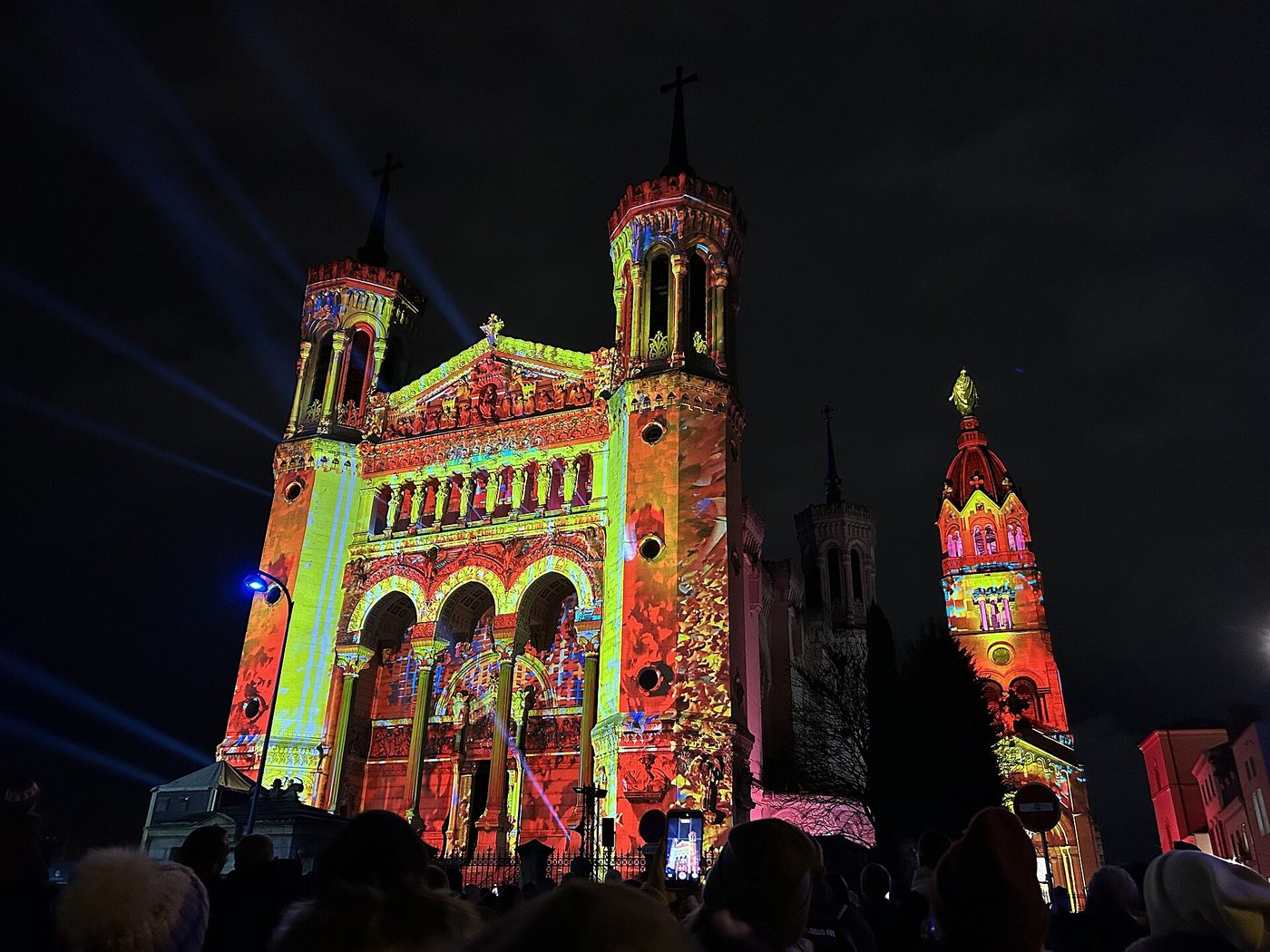
Lyon's Fête des Lumières runs for four evenings, not one. Where the works are, which night is calmer, how the centre closes to traffic and how to get out again.
The Lyon Festival of Lights, officially the Fête des Lumières, is not one night on 8 December, and planning it as one is how people end up in a crush. The festival runs 5–8 Dec 2026, and the works are lit on Sat, Mon and Tue 7–11 pm, Sun 6–10 pm. Entry is free, so the real choices are which evening to take, which two parts of the city to see and how to get out again afterwards.
Four evenings, not one
The official programme gives a Saturday to a Tuesday, and 8 December is only the historical anchor, the date every Lyonnais still associates with the festival. This year's programme has 27 works (27th edition), and the temptation is to try to see everything on one night. Four evenings exist so that you do not have to.
Hotel figures for 2025 give a measurable hint: Saturday was 93 per cent full and Sunday 62 per cent. That makes Sunday the evening to pick, and the festival itself helps, because it finishes an hour earlier then. Two zones are realistic in that time, not five, and the verdict below names them.
Where the works are: five zones
- Place des Terreaux: the heart of the festival, with a projection on the Hôtel de Ville and the Palais Saint-Pierre, and Le Carnaval des Animaux, a drawing set to Saint-Saëns that suits families. about one million people pass through here in four days.
- Vieux Lyon and Fourvière: S.E.P.T.E.M. on Saint-Jean cathedral tells the seven stages of alchemical transformation, while Vibraa and the Région des Lumières light the hill and the basilica above.
- Bellecour and the southern Presqu'île: Twist & Shine lets visitors build their own landscape from light sculptures, and Mission Lumignons sits on the same square, which the festival site calls the largest pedestrian square in Europe.
- The centre around République and Jacobins: lasers, interactive pieces and installations on Place Louis Pradel and Place Sathonay, including the laser dance Harp on Place de la République.
- Parc de la Tête d'Or: the family section, with Whispering Mountains and Sunflowers for Vincent van Gogh, and its own entrance and hours.
Parc de la Tête d'Or: its own entrance and hours
The park is a separate festival site, not an extension of the centre. Enter on boulevard des Belges at Porte Tête d'Or, across from rue Tête d'Or, and note the timetable: it opens 6 pm, last entry 10:15 pm (Sundays 5 pm and 9:15 pm). The park empties every afternoon from 3:30 to 6 pm (Sundays 2:30 to 5 pm) and refills in the evening, so there is no point arriving at lunchtime. Large luggage is banned, animals are not allowed, and in bad weather the park may close, with news posted on the festival's Instagram.
Metro A to Masséna is eight minutes' walk from the gate, and buses 38, C5 and C6 stop at Parc Tête d'Or Duquesne. When you leave, use the Porte de la Roseraie exit and metro A at Foch. The park, which opened in 1857, covers 117 hectares with a 16-hectare lake, a zoo and a botanical garden, so a second visit in daylight is easy if you stay on.
Getting there and getting out
The centre becomes pedestrian-only from 5 pm (Sundays from 4 pm), with about forty entrances roughly every 100 metres. Cars, motorbikes, scooters, bicycles and e-scooters are all banned, and garages inside the perimeter close their ramps while the closure lasts. Four footbridges are shut as well: Palais de Justice, Homme de la Roche, Saint-Vincent and Paul Couturier. Be inside the perimeter before it closes, because after that every route is on foot.
Metro, tram and some bus lines run extra services. The TCL network is free on 8 Dec from 4 pm, and an all-day Pass TCL en fête, valid for the whole festival, costs €3.70. If Vieux Lyon station is overloaded, the official advice is to use Bellecour and walk nine minutes over the Pont Bonaparte. To leave Terreaux, head for Cordeliers on metro A and skip Hôtel de Ville, which fills first.
Where it began
In 1852 the unveiling of a statue of the Virgin on Fourvière was moved from 8 September to 8 December after the Saône flooded. The skies cleared that evening, and the people of Lyon put lumignons, small candles in glass, in their windows on their own. The 8 September date goes back to a vow made by city councillors in 1643, during the plague, which is why the two dates are so often confused.
The festival as you see it now grew in stages: the "plan Lumière" of 1989, a real festival of light from 1999, and the name Fête des Lumières from 2000. Video mapping, the projection of images on to buildings, is the festival's emblem, but the programme also holds light sculptures, lasers and interactive pieces, which is why the festival has more variety than a facade show.
Tickets and tours, if you want them
Watching the festival costs nothing, since the city and its partners fund it. A ticket makes sense only if you want a guide, a boat or a pass.
- A guided evening walk with a tasting during the festival: a good option if you would rather follow a guide through the crowded streets than plan them yourself.
- A cruise on the Saône with Les Bateaux Lyonnais, boarding at Quai Rambaud and lasting around an hour. Ask the operator what it runs during the festival.
- The Lyon City Card for 1, 2, 3 or 4 days, covering transport, museums and one guided tour.
Where to sleep
A festival with this many visitors takes most of the central beds with it, so the room comes before the plan. The Presqu'île puts you closest to the lights, and the funicular to Fourvière is covered by the TCL ticket. Book first, then pick the Sunday.
Check the same room on both sites: price and cancellation terms can differ.


France, in brief
What now
If this sounds like your trip, start here.
Lyon
→France's capital of eating, with four hundred passages cut through its buildings
Lyon in 2 days
→Fourvière before the museum opens, the long traboule after lunch, the market hall before 2.30 and the Confluences until 6.30: two days by the hour.

Day trips from Lyon
→Four trips from sixteen minutes to two hours: Vienne by train, the Beaujolais by tour, Pérouges, Annecy only for a full day.

Where to stay in Lyon
→The Presqu'île for a first visit, Vieux Lyon for cobbles, and the Croix-Rousse asks for legs on the hill.

What Lyon costs
→The Roman theatres, the Tête d'Or and the Mur des Canuts charge nothing; the museums, transport and a bouchon do.
Lyon beyond Vieux Lyon: seven addresses, from the Mur des Canuts to a pebble garden
→A 1,200-square-metre wall, a revolutionaries' staircase, a garden a mason built from pebbles and the shed of the first film, each with an address and the day it opens.
What to eat in Lyon
→A city where breakfast is pork scratchings and andouillette with wine at nine in the morning, and the pralines are pink from colouring in the sugar.
The best time to visit Lyon
→May, June and September for the uphill walking, summer for long evenings, early December for the Festival of Lights.
Getting around Lyon
→By Rhônexpress tram from the airport, by metro and on foot in the centre, by funicular up to Fourvière.

France
→From Paris the fast TGV reaches Lyon, Bordeaux and Strasbourg in about two hours, so France is chosen by direction, not by city

The Paris Museum Pass in 2026, and the maths that changed
→The same Paris Museum Pass does a different job for a visitor from outside the EEA than for a resident of the EEA, and since January 2026 the break-even point has moved by a whole museum.

Lyon or Bordeaux for a long weekend, and how to pick one
→Lyon and Bordeaux both sit about two hours from Paris by TGV and both sell themselves as capitals of food and wine, yet one keeps everything inside the city and the other sends you out of it.

Strasbourg's Christmas market, and how old it really is
→How old the Strasbourg market really is, when it runs in 2026, where the crowds gather, what to eat from the deposit cup and why so many visitors sleep in Colmar.
Front row for the next trip
Leave your email and we'll let you know when a new destination or story goes up.