

Getting around Paris
Paris is crossed on one small card and two fares: the ordinary ticket covers the metro, the RER and the trains of the whole region, the two big airports need a separate one, and night buses take over when the metro stops.
- Card
- Navigo Easy €2
- Ticket
- Metro
- Airports
- A separate €14 ticket
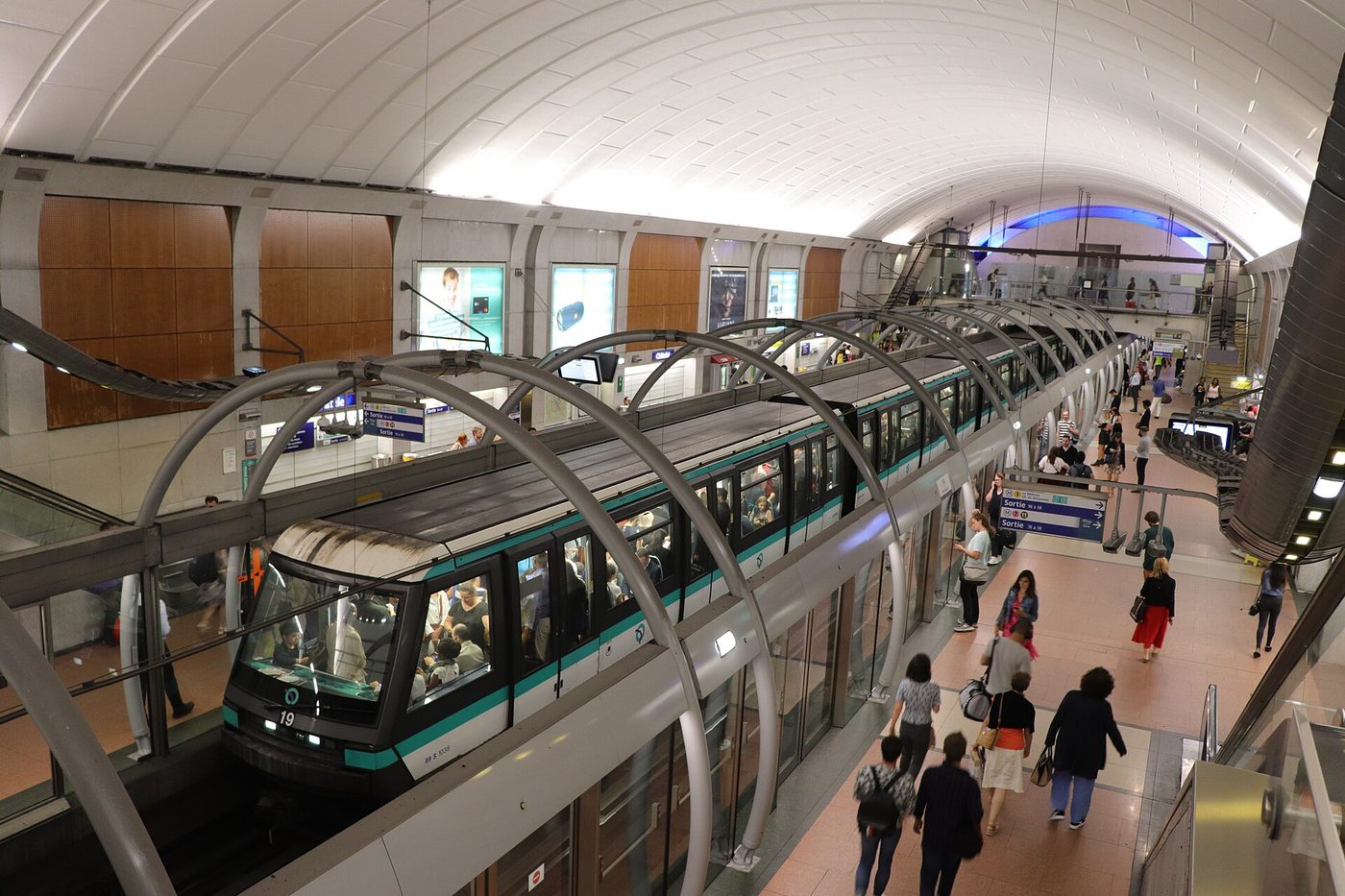
In Paris you pay for two things that look like one. An ordinary ticket of €2.55 carries you across the metro, the RER and the trains of the whole region, while a separate airport ticket of €14 is needed the moment either Charles de Gaulle or Orly is on your route. Paper tickets are gone, so the first job on arrival is a Navigo Easy card at €2 or a ticket on your phone. Everything after that is a matter of choosing the right line from a dense, old network whose stations sit so close together that walking is often the better choice.
From Charles de Gaulle: the RER B
The B line is the fast, direct railway from the airport into the central city. It calls at Gare du Nord, Châtelet–Les Halles, Saint-Michel–Notre-Dame, Luxembourg and Denfert-Rochereau, and the ride to Gare du Nord takes about 35 minutes. The station called Charles de Gaulle 1 serves Terminals 1 and 3, while Charles de Gaulle 2 serves Terminal 2, so check your terminal before you follow the main signs. A single ordinary metro ticket is not valid on this regional route, and you need the full €14 airport ticket.
Trains run every day from about five in the morning until late at night, every six to fifteen minutes depending on the hour, and a quick glance at the official Île-de-France Mobilités app on landing costs less than a long wait on a platform where no train comes.
Older guides still send you to the Roissybus, the direct coach from the Opéra, but it stopped running on 1 March 2026 after falling punctuality and passenger numbers. Its place on the road has been taken by the express bus 9517 from Saint-Denis–Pleyel, the northern end of metro line 14, which reaches the airport in around 30 minutes. Metro 14 plus that bus is therefore a cheaper way round when the RER B is shut.
RER B
- RER B
- about 35 min to Gare du Nord
- Ticket
- airport ticket €14
- Bus 9517
- about 30 min from Saint-Denis–Pleyel
Private transfer
- a driver meets you at arrivals
- booked ahead, late flights too
- costs more than public transport

Metro line 14
Orly has been on metro line 14 since June 2024. That puts the airport 23 minutes from Gare de Lyon and under 25 from Châtelet, on a driverless train that comes every 85 seconds at peak hours. Here too you need the separate €14 airport ticket. Because line 14 calls at both central stations, a hotel near either of these central stations means one direct train and no change.
Metro 14
- From Gare de Lyon
- 23 min
- Ticket
- airport ticket €14
Private transfer
- a driver meets you at arrivals
- booked ahead, late flights too
- costs more than public transport

One card, one ticket, one pass
Paper tickets have not been sold in Île-de-France since November 2025, and old cardboard ones stopped being accepted on buses and trams on 1 May 2026. Unused old ones can be used on the rail network only until the autumn. What replaced them is the small Navigo Easy card, €2 for the card itself, sold at stations and airports with no photo and no name. Only one person can use it at a time, but it can be handed on between trips.
You then load a ticket onto it. The metro, train and RER ticket costs €2.55 and the bus and tram ticket €2.05, a single flat price across the whole wider region since 2025, which is why the same ticket takes you to Versailles. If you would rather not carry a card at all, the app puts the same tickets on your phone, and Paris buses also accept a bank card at the validator.
A pass is the second decision. The weekly Navigo Semaine at €32.40 includes the airports, but the Navigo Jour at €12.30 covers all zones for a day without them, so it does not replace the airport ticket. The weekly pass runs only from Monday to Sunday and needs the photo-based Navigo Découverte card rather than the Easy. It pays off only if you arrive early in the week and stay to the end of it.

Metro and RER
The metro has 16 lines and 321 stations, on average 548 metres apart. In the old, dense centre two stations are therefore never far from each other, and a short walk often replaces a change of line. Lines 1, 4 and 14 run without drivers, and on the older trains of the other lines the doors do not open by themselves, so you lift the latch or press the button yourself.
The five RER lines cross the metro at big interchanges such as Châtelet–Les Halles, one of the largest metro stations in the world. The long corridors between its platforms can take ten minutes to walk, so leave time for a long change there.

On foot and by bus
With stations this close together, a good part of Paris is best done on foot, and the three-day plan keeps each day to one bank of the Seine for that reason. The bus is cheap at €2.05 and slow in heavy traffic, but it shows you the narrow side streets between two stations that the metro skips.
After dark
The first morning metro leaves early, around 5:30, and the last reaches its terminus at 1:15, or 2:15 on Friday and Saturday nights and before public holidays. If you board mid-line, the last train leaves 15 to 30 minutes earlier. The last RER runs between midnight and about 1:20, depending on the line.
Once they stop, the Noctilien takes over, a network of night buses running from about 0:30 to 5:30. It is built around five main hubs in Paris, Châtelet, Montparnasse, Gare de l'Est, Gare Saint-Lazare and Gare de Lyon, so the rule is to reach one of them and change there. If you fly at dawn, work backwards from the first RER B at about five and the first metro at about 5:30 rather than hoping a train will fit.


Where to next


Nomadinho scores out of 100, the same ones behind “Where to go”.
If you like Paris
Three places with the closest scores, from any country.


Before you go
Short answers to what people ask most before setting out.
Can I still buy a paper metro ticket in Paris?
No. Paper tickets have not been sold since November 2025; you load a ticket onto a Navigo Easy card, €2 for the card, or buy it on your phone.
How do I get from Charles de Gaulle to central Paris?
By RER B, about 35 minutes to Gare du Nord, with the €14 airport ticket. The Roissybus no longer runs; it was discontinued on 1 March 2026.
Does the Paris metro run all night?
No. The last metro reaches its terminus around 1:15, or around 2:15 on Fridays and Saturdays, and after that the Noctilien night buses run until about 5:30.
Ready for Paris?
Front row for the next trip
Leave your email and we'll let you know when a new destination or story goes up.