

Hurghada or Sharm el-Sheikh: where the difference really lies
- Published
- 11 June 2026
- Reading
- 5 min read
- Where
- The Red Sea, Egypt
- Prices checked
- 16. Sep 2026.
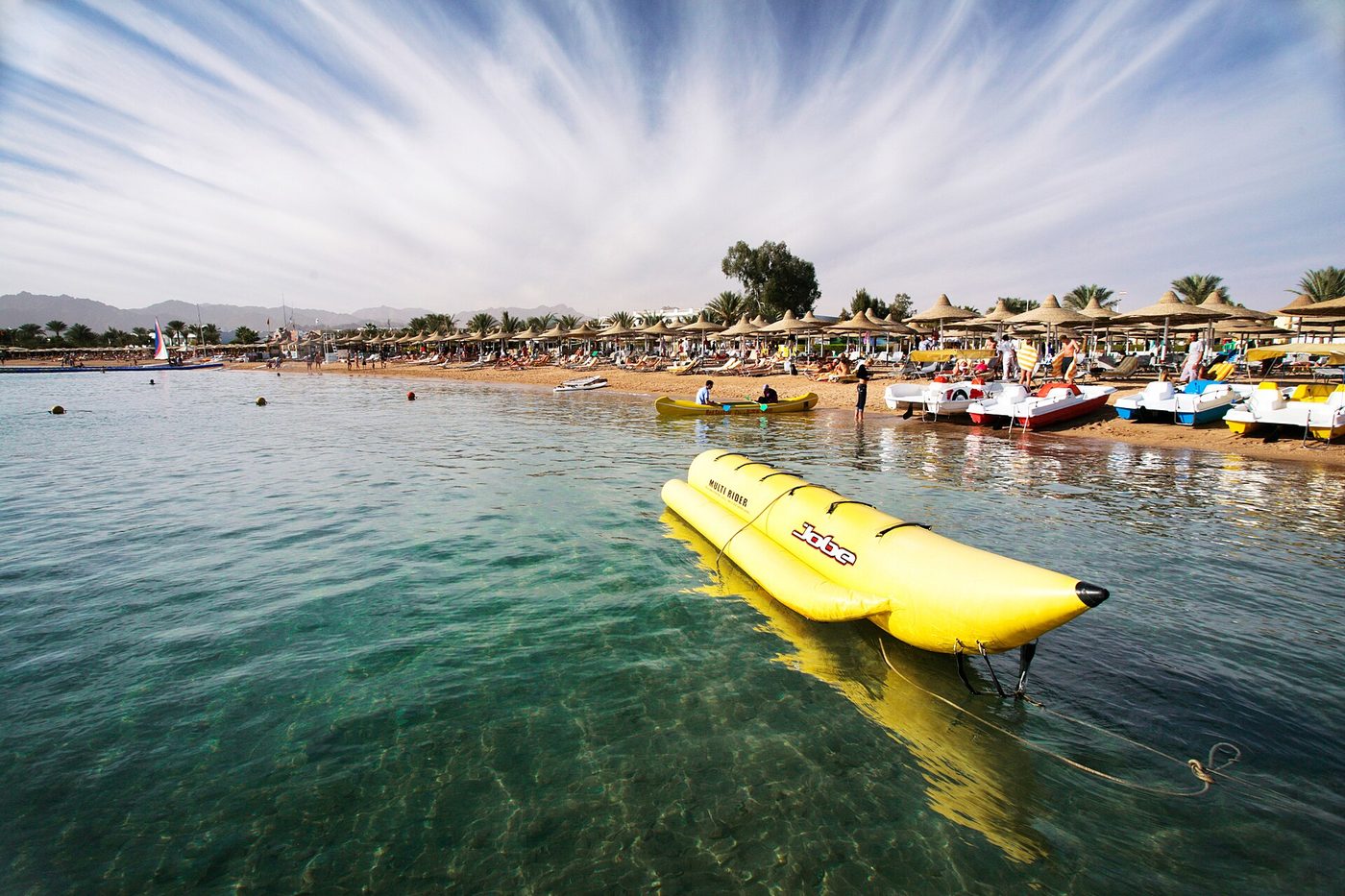
Two resorts on the same sea that look identical in a brochure. There are four differences, and all four show on the first day.
In a brochure they are the same: the Red Sea, all-inclusive, palm trees. In practice they differ in four things that decide what the week will be like: the flight, the reef, the wind and the paper at passport control.
Two airports that are not interchangeable
Each resort has its own airport, and the one a traveller lands at decides the week. The ferry between the two towns has not run since 2020, and by road the long route goes round the Gulf of Suez, more than twelve hours. So the first check is which of the two the home airport serves direct, and in which months. Hurghada has the denser year-round network, while Sharm leans on seasonal charters from tour operators. A connection turns a noon arrival into a midnight one.


Where you snorkel
Sharm has the steeper reef: the jetty ends where the bottom falls away. The snorkeller swims above a wall rather than shallows, and Ras Mohammed is half an hour away. Hurghada has a reef off the beach only in the south, at Sahl Hasheesh and Makadi, while in the centre and El Gouna the coral is reached by boat, half an hour to an hour. Anyone coming for the mask should choose Sharm or the south of Hurghada, and never the centre.
An organised visit with a guide.
Wind and season
Both resorts work all year, and even in February the sea is around twenty-two. The difference is the wind: in Hurghada the northerly blows most afternoons, so winter afternoons feel cooler than the thermometer says, while Sharm sits in the lee of the mountains and is calmer. Sharm is therefore the more pleasant choice for December and January, and Hurghada and Soma Bay are better for kitesurfing: the same wind, two different reasons.
The Sinai stamp
Anyone flying to Sharm and staying in Sinai needs no visa and gets a free Sinai stamp for fifteen days, covering Sharm, Dahab, Nuweiba, Taba and St Catherine's monastery. Hurghada and Cairo need the ordinary about €26 visa. The catch is that the Sinai stamp does not allow travel to Cairo or Luxor, and that is decided at passport control, not afterwards.

Day trips
From Hurghada, Luxor is done in a day: four to five hours by road, the Valley of the Kings and Karnak, back in the evening. From Sharm Luxor is out of reach. Mount Sinai at night and St Catherine's monastery in the morning make a trip that cannot be done from Hurghada even in two days. Cairo from either needs a full day and a full visa, so it is best skipped from both.
An organised visit with a guide.

Check the same room on both sites: price and cancellation terms can differ.
Egypt, in brief
What now
If this sounds like your trip, start here.
Hurghada
→The easiest Egypt — forty kilometres of hotels along the Red Sea, and Luxor four hours away if you want it

Day trips from Hurghada
→Giftun by boat, Luxor in fourteen hours, the desert with Bedouins, El Gouna for an afternoon and a Cairo not worth it: five trips from Hurghada ordered by what they genuinely give for a day.
Where to stay in Hurghada
→El Gouna, the centre with the Marina, Sahl Hasheesh or Makadi: four zones on forty kilometres of coast, where you choose between a town behind the hotel and a reef in front of it.

The best time to visit Hurghada
→Hurghada works all twelve months, but not the same way: in winter the sea is 22 and the afternoon wind…

Getting around Hurghada
→From the airport by taxi, app or hotel transfer, around the centre by microbus or app, around El Gouna by tuk-tuk, and to Luxor by coach or with a driver.

Egypt
→Two countries under one name: the Nile with its temples, which needs a plan, and the Red Sea, which needs only a charter — few people do both in one trip

Egypt in 2026: the base tickets have held in euros, the extras have not
→Headlines about tickets that have tripled are counting in pounds.

Giza without the hassle: the plateau after the new gate and the electric buses
→Getting around between the pyramids was always the real chore at Giza.

A Nile cruise or the train: what you actually get
→A cruise, a train ticket and a hired driver cover the same 242 km at very different prices and speeds.

Front row for the next trip
Leave your email and we'll let you know when a new destination or story goes up.