

The best time to visit Istanbul
September and May bring the most pleasant days, April brings tulips, July and August bring heat and the most visitors, and winter brings rain and a wind that stops the ferries.
- Best months
- April–May and September–October
- Wettest
- December, 99.2 mm
- Tulips
- April, usually peaking around mid-month
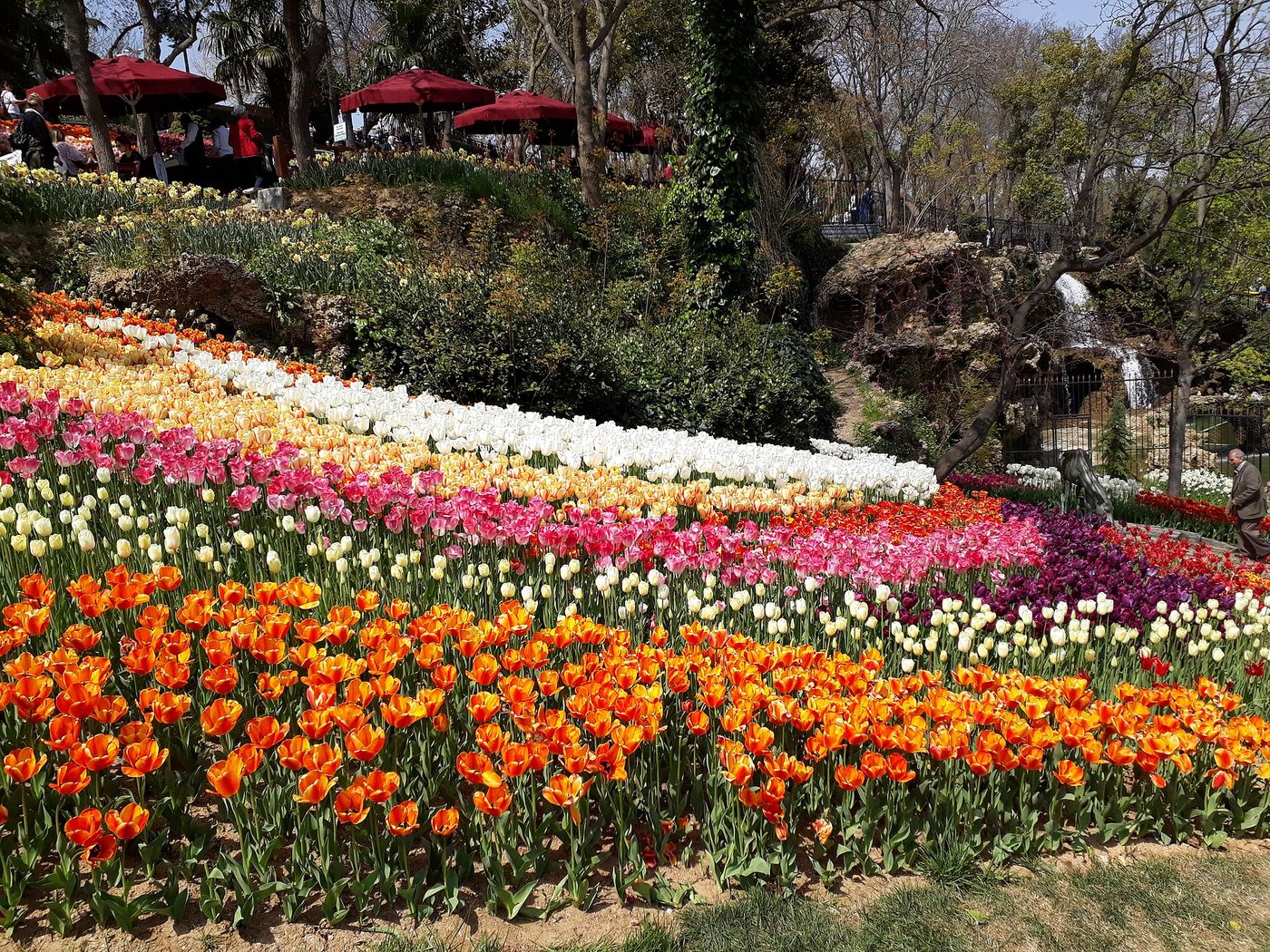
Istanbul is a walking city, and the walker pays when the month is wrong: wet cobbles in December, or stone baked by July heat at an average high of 29.7 °C. The month that dodges both is September, with a high of 25.9 °C and 39.7 mm of rain. The rest of the year trades one discomfort for another, and the sections below say which.
Through the year
Tulips and changeable weather
March is cold and wet, with a high of 12.4 °C and 62.3 mm of rain, yet it draws the fewest foreign visitors of the year, 1.23 million in 2025 by border entries. April lifts the high to 17.4 °C with 47.8 mm, and May reaches 22.3 °C with 32.9 mm, the driest of the three spring months. Pack an umbrella for March and expect to use it.
April belongs to the tulips. The festival runs through April, and in 2026 the city planted about 3.58 million tulips in historic parks: Emirgan Korusu, Gülhane Parkı, Sultanahmet Meydanı, Göztepe 60. Yıl Parkı and Hıdiv Kasrı. Peak bloom at Emirgan usually falls around mid-month, but it follows the winter, so treat that as a guide and not a promise. Holidays rearrange a visit too: Kurban Bayram moves every year. Mosques do not admit visitors at prayer time and the Grand Bazaar closes on Sundays, whatever the month.
Check the same room on both sites: price and cancellation terms can differ.

Heat and the biggest crowds
June averages a high of 27.1 °C, July and August 29.7 °C. July is also the driest month at 22.1 mm, which is the only mercy the season offers. July 2025 was the hottest July in Türkiye in 55 years, 1.9 °C above the 1991–2020 average of 25 °C, a national figure for the whole country. Summer brings the biggest crowds as well, with 1.88 million foreign visitors in July and 1.85 million in August.
Plan around the heat, and give mornings to the monuments and afternoons to the water. A boat to the Princes' Islands costs €2.44, and the timetable changes between summer and winter. The consolation of the season is the Istanbul Jazz Festival, held every year from late June into early July, with its opening night at the open-air Cemil Topuzlu theatre in Harbiye.

September, and October as the second-busiest month
September holds a high of 25.9 °C and 39.7 mm of rain, so it is the pick for a first visit. October drops to 20.6 °C and 66.3 mm, and November to 16.1 °C and 78.1 mm. Autumn slides into winter, which makes September the last month that takes long walks easily.
Autumn has a reputation for being quiet, and the numbers disagree. October is the second-busiest month for foreign visitors, with 1.86 million in 2025, behind only July. The Istanbul Biennial adds to it in odd years, from mid-September to mid-November, with free entry. So the advice is plain: September, with April, May and October in reserve.


Rain, snow and ferries that do not run
December is the wettest month at 99.2 mm, about 4.5 times the rain of July, and January follows with 88.8 mm. Highs stay between 9.6 and 11.8 °C and January nights fall to 4.2 °C. Snow does arrive, and the deepest cover on record was 41 cm on 9 March 1987. Keep the umbrella in your hand luggage.
The wind matters more than the rain, because the lodos, a south-westerly, stops the ferries. Boats were cancelled on 31 December 2025, again on 3 January 2026 under a governor's warning of 50 to 70 km/h winds, and on 19 January 2026 when wind and snow together grounded the lines. On such mornings see whether your boat runs and keep Marmaray, the rail tunnel under the Bosphorus, as the reserve.
The Bayrams move about 11 days earlier each year, so look up the dates of Ramadan and the holidays before you travel.


What each brings
Highs and rainfall: Turkish State Meteorological Service (MGM), long-run series 1950–2025; visitors: foreign entries into Istanbul in 2025.
Where to next
Getting around Istanbul
→One Istanbulkart works on the tram, the metro and the ferry, so Istanbul is crossed by chaining lines: from…

Safranbolu · 315 km
→An Ottoman town tourism skipped because it's too far from the sea

How well does Istanbul suit you?
→Six questions: a score for this place and others like it.
Nomadinho scores out of 100, the same ones behind “Where to go”.
If you like Istanbul
Three places with the closest scores, from any country.


Before you go
Short answers to what people ask most before setting out.
What is the best month to visit Istanbul?
September, with an average high of 25.9 °C and 39.7 mm of rain. April, May and October are good alternatives, though October is the second-busiest month for foreign visitors.
When do the tulips bloom in Istanbul?
In April. The festival runs through the month, and the peak usually falls around the middle, depending on how cold the winter was.
Do the ferries run in winter?
Mostly, yet departures are cancelled when the lodos wind blows, as on 31 December 2025 and on 3 and 19 January 2026. Marmaray keeps running under the Bosphorus.
Ready for Istanbul?
Front row for the next trip
Leave your email and we'll let you know when a new destination or story goes up.