

Málaga
For years just the airport for the Costa del Sol, now a city with more than thirty museums
- When to go
- September 24° · 4 rainy days
- Per day
- €€€price 3 of 5
- How many days
- 2–3days
- For you
- 6 questions →
- Nearest airport
- 9 km Málaga · 77 km Granada
- Right now

Picasso was born in Málaga in 1881 and left at ten, so the city waited out the twentieth century for its own name. The museum only opened in 2003, the others followed, the Moorish fortress was cleaned up and half the centre went car-free.
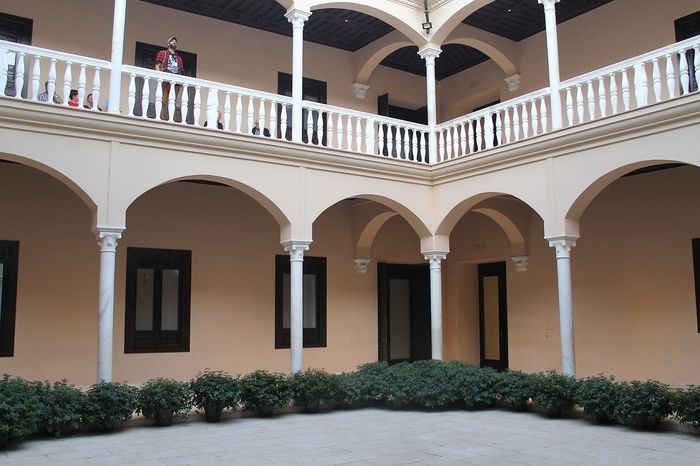
The Picasso Museum sits in the sixteenth-century Buenavista Palace, into which eighteen old houses of the Jewish quarter were folded. The core of the collection is a hundred and fifty-five works given by Christine and Bernard Ruiz-Picasso — paintings, sculpture, drawings, prints and ceramics. Below all of it, through a glass floor, lie a Phoenician wall, a Roman garum factory and part of a Nasrid palace. The basement is a museum in its own right and comes with the same ticket, and most visitors walk straight past it.

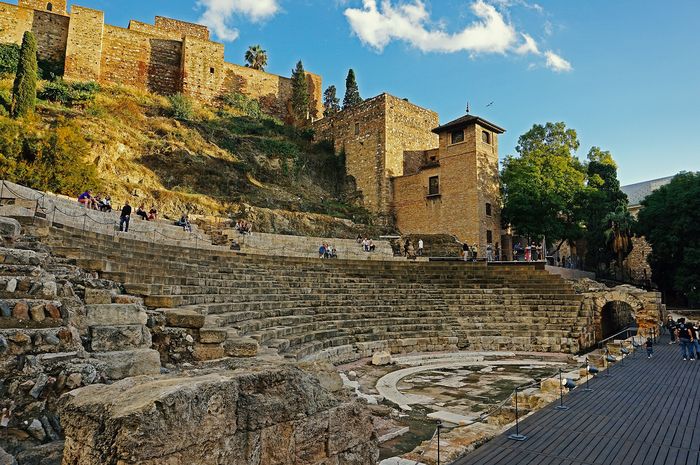
The Alcazaba and Gibralfaro castle are one system. The Alcazaba is a palace-fortress covering fifteen thousand square metres today, less than half its old footprint, raised over an earlier Phoenician-Punic fort; a walled corridor called the Coracha links it to the castle on the hilltop. A joint ticket for both is €10, one on its own €7. The Roman theatre sits at the foot of it, which puts Phoenicians, Rome, Moorish Spain and everything after 1487 on a single hill.
August is the one month to avoid, for two reasons at once: the Feria falls in the middle of it, and so does the peak of the heat. If you want museums and an empty Alcazaba, come in March, April or October — the winter here is mild and the city works normally through it.
Guides for Málaga
Shorter, practical pages for one concrete question each — how many days, how much money, where to sleep, where to escape the city.

Málaga in 2 days
→The castle by bus at nine, the Alcazaba downhill on the same ticket, the cathedral before 5.45 — and a Tuesday or a…

What to see in Málaga
The Picasso Museum and the birthplace
Open daily from ten — until six in winter, seven in spring and autumn, eight in July and August — with the last two hours free on Sundays, which is also when it is worst. The birthplace on Plaza de la Merced is a separate and much smaller museum, with the baptism record and family objects; half an hour, and it works after the big museum rather than before it.
The Alcazaba and Gibralfaro
The Alcazaba is walked in the shade, through courtyards and arches; the castle means twenty minutes up an open slope without a single tree. So do it early or towards sunset — or the other way round: bus 35 from the Paseo del Parque up to the castle, then downhill to the Alcazaba. From the castle walls you see the whole city, the bullring and the curve of the port — the best viewpoint in Málaga.
Soho and the murals
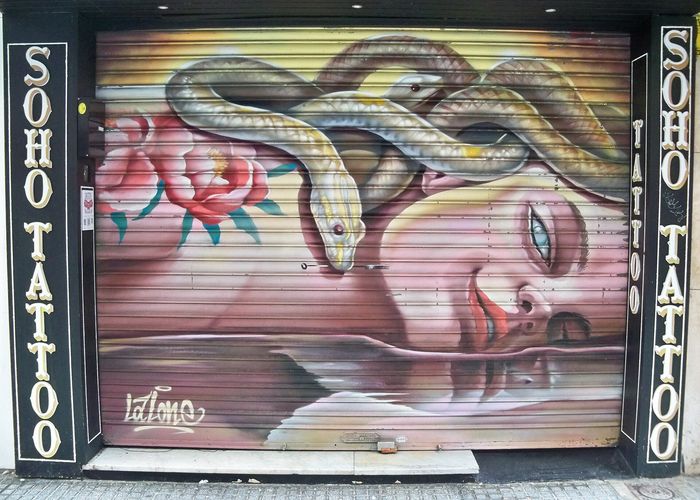
The quarter between the port and the Alameda, once run-down, now covered in murals several storeys high from the Málaga Arte Urbano Soho project. Walk it without a route — the work is on the fronts of ordinary apartment blocks, not in a gallery.
The beach and the espeto
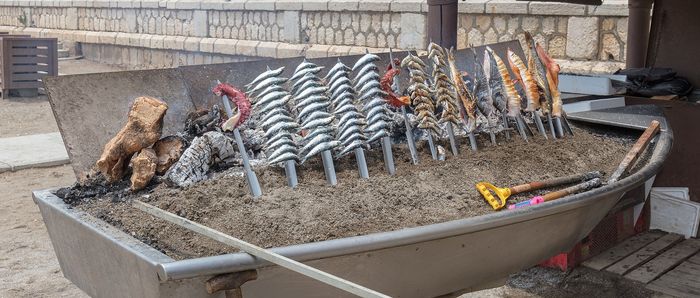
Sardines are threaded onto a half-metre cane and grilled for six minutes over olive wood in a boat filled with sand. It happens on the beach, in front of you, from midday. La Malagueta is in town; El Palo is further out and better for this.
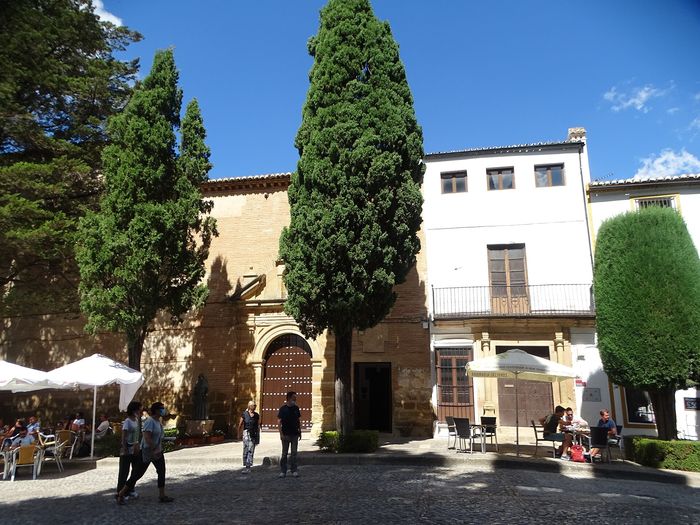
Ronda
An hour and a half by train through the hills. The town is split by a gorge over a hundred metres deep, crossed by the Puente Nuevo — built between 1751 and 1793. The bullring of 1784 is one of the oldest in Spain.
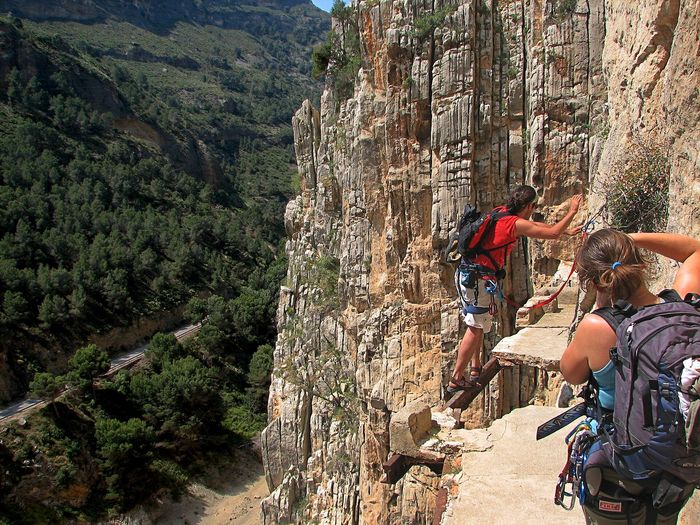
El Caminito del Rey
A walkway two kilometres nine hundred long and one metre wide, a hundred metres above the river, bolted to the cliff in 1901–1905 and rebuilt in 2015. The ticket is cheap — €10, or €18 with an official guide — but slots sell out weeks ahead, and children under eight are not admitted. It runs one way, and the visitor centre is some fifty kilometres from Málaga.


Two things you probably did not know
Antonio Banderas was born in Malaga and in 2019 opened a theatre in the building where he watched films as a child. He runs it himself, acts in its productions and keeps it open all year.
The Phoenicians founded Malaga around 770 BC, making it one of the oldest continuously inhabited cities in Europe. The Roman theatre below the fortress was found by chance in 1951 while digging foundations for a cultural centre.
Ready for Málaga?
Within reach from here
Places sorted by straight-line distance from Málaga — day trips or weekends.

Spain
→A country where dinner is at ten and the city wakes up as everywhere else turns the lights off

Portugal
→A country that spent centuries looking at the ocean instead of the Europe behind it

France
→From Paris the TGV reaches Lyon, Bordeaux and Strasbourg in about two hours — France is chosen by direction, not by city
All 277 places we write about sit on one page — narrow them down by continent, country, price or what you are travelling for.
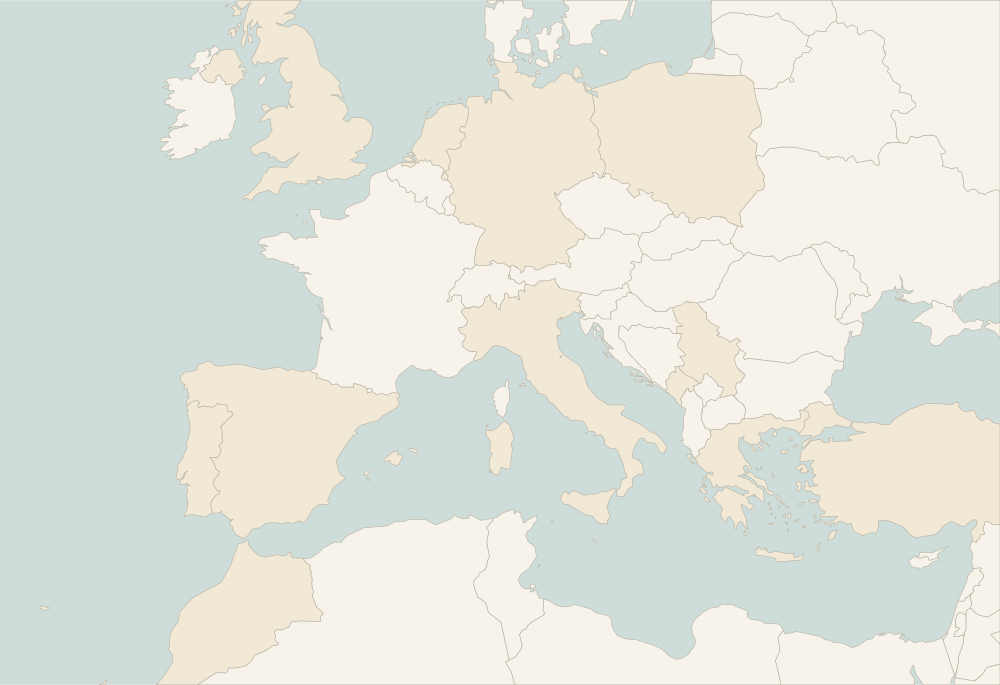
Within reach from here: Granada, Seville and Chefchaouen
See how much of that actually suits you — or pin Málaga if you have been.
Front row for the next trip
Leave your email and we'll let you know when a new destination or story goes up.