

Peggy Guggenheim Collection Venice: Ticket, Entry and the Rooms in Order
Modern art in a palace on the Grand Canal, with a queue that rarely matters
- Ticket
- €17
- Opening hours
- 10 am–6 pm, last entry 5 pm
- Takes
- An hour and a half to two hours
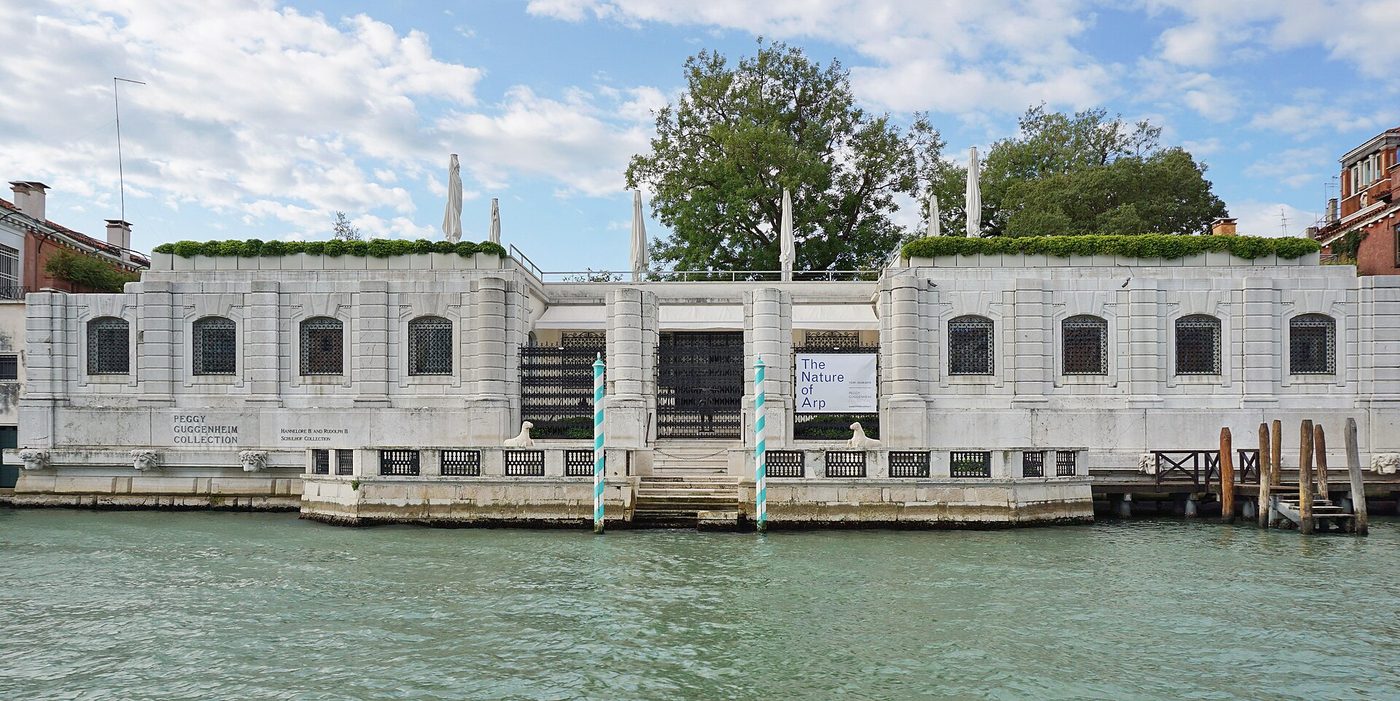
The Peggy Guggenheim Collection is small and personal, and a visit takes an hour and a half to two hours. The questions that matter are when to arrive and which rooms to linger in, because the queue rarely decides anything.
Which Peggy Guggenheim Collection ticket to buy
The standard adult ticket is €17. It covers the permanent collection and whichever temporary exhibition is on view. From 14 November 2026 to 29 March 2027 that exhibition is Fucina degli Angeli, about Peggy Guggenheim and twentieth-century glass, and the permanent display includes an installation called One Hundred Years of Cahiers d'Art. Students under 26 pay €9 with a student ID, and children under 10 go in free. The audio guide is separate and costs €7 at the door.
Resellers sell a timed ticket for the same entry, and what you buy is a guaranteed slot that cannot be changed for free. The official ticket gives no priority in the queue, and neither does the reseller version. For most visits the ticket office or the official site is the simpler choice.
The official ticket gives no priority in the queue, and the queue rarely runs past fifteen minutes. A reseller sells you a slot that stays put, and a faster check is no part of it.
Official ticket
- Audio guide
- not in the ticket
- Students
- under 26, with ID
- Children
- under 10 free
Through a partner
- options with a guide or audio guide
- usually costs more than the official ticket
When to come and how to get in
The busiest hours run from 11:00 to 14:00. Opening time or the late afternoon after 15:00 is calmer, and the queue seldom passes fifteen minutes, except around the openings of the Biennale, which runs from May to November. During those months a weekday morning is the quietest time, and the late afternoon stays easy as well, so the season hardly changes the plan for anyone who avoids the middle of the day. Opening hours: 10 am–6 pm, last entry 5 pm. Closed days: Tuesdays and 25 December.
So Tuesday is a day for San Marco and the Dorsoduro waits. The palace stands on the Grand Canal at Dorsoduro 701, and the vaporetto line 1 or 2 stops at Accademia, from where you walk. The palace itself is low and white, and it looks more like a house than a museum from the water.
The rooms in order: from the Cubists to Pollock and the garden
One way to walk it starts on the ground floor with Cubism and early abstraction, where Picasso's On the Beach from 1937 and Braque's Clarinet hang. Next come the Surrealists, with a room for Dalí, Magritte and Max Ernst. The Pollock room follows and sits at the centre of the collection, because Peggy paid him a monthly stipend and gave him his first solo exhibition.
Then step into the sculpture garden, which holds works by Giacometti and Henry Moore. Peggy's grave lies in the garden, and her dogs are buried nearby. On the terrace over the Grand Canal stands Marino Marini's bronze rider, the Angel of the City. A café overlooks the garden and a bookshop sells catalogues and monographs, so both suit the end of the visit: a coffee, then a quick look at the books before closing.

When you only have an hour
An hour is enough to see the ground floor and the garden, if you keep to the rooms that matter most. Spend the first half of it indoors with the Cubists, the Surrealists and Pollock, then use the second half outside, where the terrace and the garden give the visit a calmer ending. Anything beyond that, such as the temporary exhibition, needs the longer visit of up to two hours.
- Arrive at opening or after 15:00, when the building is quieter.
- Go straight to the Pollock room and the Surrealists.
- Spend the last fifteen minutes in the sculpture garden.
- Skip the audio guide if you know what you want to see.

Where to next

Ca' Rezzonico Venice: Ticket, Entry and the Rooms in Order
→Eighteenth-century Venice in a palace on the Grand Canal, from the ballroom to the pharmacy

Verona · 104 km
→An amphitheatre that still stages opera in summer, a courtyard tied to Shakespeare's tragedy and a fortress over the river, all inside a loop you can walk in a day, while a third day opens up Lake Garda.

How well does Venice suit you?
→Six questions: a score for this place and others like it.
Nomadinho scores out of 100, the same ones behind “Where to go”.
If you like Venice
Three places with the closest scores, from any country.


Before you go
Short answers to what people ask most before setting out.
Is the collection free, or is there a free-entry day?
There is no general free day. Children under 10 enter free, students under 26 pay €9, and the adult ticket is €17.
Is the audio guide included in the ticket price?
No. It is sold separately at the door for €7. The official site also offers a package that includes it, in five languages.
Is it worth buying through a reseller instead of at the ticket office?
Only if a fixed slot matters to you. The reseller sells a guaranteed time with no free changes, while the official ticket costs €17 and the queue seldom runs past fifteen minutes.
Guides that mention it

Museums closed on Monday and Tuesday in Europe, by city
→The Louvre shuts on Tuesday, Orsay and the Uffizi on Monday. Museums closed by city, what stays open instead, and how to plan a trip around the gaps.

Under-26 and student discounts at Europe’s big sights
→Which big sights in Europe give young people and students free or cheaper entry, and where the rule depends on EU or EEA residence: Louvre, Rome, London.
Ready for Venice?
Front row for the next trip
Leave your email and we'll let you know when a new destination or story goes up.