

The best time to visit Cairo
October to April for sightseeing, summer for empty pyramids and cheap rooms, Ramadan for different hours and quieter days.
- Best months
- October–April
- Summer
- Daytime highs above 35 °C
- Winter nights
- Around 10 °C
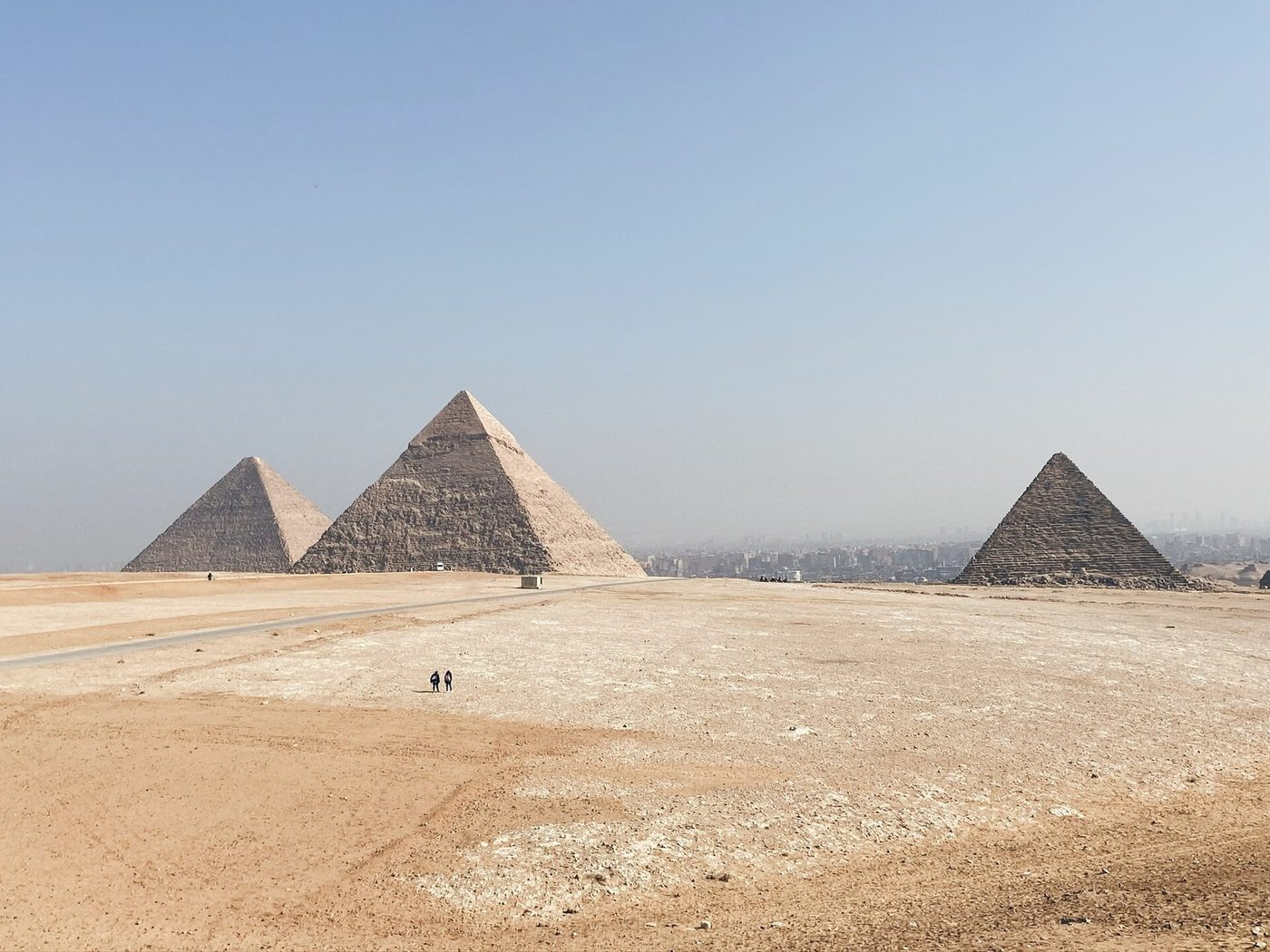
Pick your month by what you plan to walk, because the pyramids want a cool morning and the museums ignore the weather. Summer is allowed in Cairo, as long as the sightseeing is finished by noon. Everything below is about what each season trades: heat for quiet, crowds for price, clear air for short days.
Through the year
If one month has to do, make it April. Highs run 25 to 28 °C, with no autumn smog and no cold winter nights. The price is the khamsin, possible from March to May, and an Easter wave of European visitors in late March or early April.
Above 35 degrees and an empty plateau
From June to August the daily high sits above 35 °C, and in July and August it often reaches 40 °C. The Giza plateau is open from 8 a.m. to 4 p.m. every day, and the sun is up before 5 a.m., so the first hour or two after the gates open are the only ones with any shade. After 11 the plateau has none at all. The old line that Egypt is deserted in summer has a grain of truth: it is the low season for foreign visitors, queues are short and hotels are at their cheapest, and the heat is the bill.
Build the day in three pieces. Do the pyramids first, then go indoors around noon to the Egyptian Museum on Tahrir Square, or to any room with air conditioning. Leave the Citadel and Islamic Cairo for after 3 p.m. when the heat drops, and eat dinner outside. In summer a thermal inversion also holds pollution close to the ground, which is one more reason to keep the hot hours indoors.
Check the same room on both sites: price and cancellation terms can differ.

October and November, then the smog
October brings highs of 26 to 30 °C and November 22 to 26 °C, which makes both months comfortable for a full day on foot. Hotels start to rise in October, though it still counts as good value, and the first rain of the year is most likely from November onward. Rain stays rare in Cairo, so a light jacket is plenty.
The catch is the air. From September to November the so-called black cloud settles over the city, because cool, still air keeps pollution close to the ground, and the stricter control of straw burning runs until the end of November. The smog is at its worst in autumn, so a clear sky at noon is never guaranteed. November also has the Cairo Film Festival, based at the Cairo Opera House and held since 1976.
WWhere to stayWhich part of town to book in the month you choose.Where to stay in Cairo →Peak season and cold nights
December to February is the busiest stretch, and the Egyptian Museum and Giza are swamped between 10 a.m. and 2 p.m. Come early or late and you get the same sights with half the people. Hotels are dearest in December and January, so booking ahead matters more than in any other season.
Days are mild at 18 to 22 °C, but nights fall to around 10 °C, so bring a jacket for the evening. The sun rises at about 6.30 and sets before 5 p.m., and with the plateau closing at 4 p.m. the light is shorter than it looks on a map. Rain is rare, yet this is also when it is most likely, from November to March.

Khamsin, Easter and Sham el-Nessim
The khamsin can blow in between March and May, a dusty windy spell that lasts one to three days. Most sights stay open through it, apart from the rare severe episode. April suits the pyramids, at 25 to 28 °C, with no autumn smog and no cold winter nights, and May already heads toward 30 °C.
Sham el-Nessim, the Monday after Coptic Easter, is a holiday for every Egyptian, and Al-Azhar Park, the Nile corniche and Giza Zoo fill up with picnickers. The pyramids and the Egyptian Museum stay open, perhaps with shorter hours, and domestic travel peaks for about a week between Easter and Sham el-Nessim. The food of the day is fesikh, a fermented fish, and coloured eggs, and fesikh is one for visitors to approach with care.

Smaller crowds, shorter days
Ramadan arrives about eleven days earlier every year, so its date keeps shifting, and Dar al-Ifta sets it after the new moon is sighted. The Egyptian Museum then shuts at 4 p.m. instead of 5, and a foreign adult ticket is €9.20. The official page lists the Giza plateau at 8 a.m. to 4 p.m., with no separate Ramadan hours.
Museums usually close around 3 or 4 p.m., yet after dark the city comes alive, with cafes and shops open until 2 a.m. Some restaurants screen off their tables from those who are not fasting. Traffic is at its worst 30 to 45 minutes before sunset, when everyone heads for iftar, the meal that breaks the fast. Eid brings three days of public holiday. So the order of the day is sights in the morning and dinner after sunset.
Temperatures are daytime highs from travel guides and means from climate data; hotel prices move in the same direction year after year, but the amount varies.


Both sites fill in your nearest airport for you; change it in one click.
Where to next
Getting around Cairo
→Cairo has three metro lines and none of them reaches the airport, so the trip starts in a car and the metro takes over once you are in the city.

Alexandria · 180 km
→A city that was the capital of the world, of which remain a long Corniche, one fort where the lighthouse stood, and a library built again

How well does Cairo suit you?
→Six questions: a score for this place and others like it.
Nomadinho scores out of 100, the same ones behind “Where to go”.
If you like Cairo
Three places with the closest scores, from any country.


Before you go
Short answers to what people ask most before setting out.
What is the best month to visit Cairo?
October to April works as a range, and the right month inside it depends on the reason. April has no autumn smog and no cold winter nights, though a khamsin is possible from March to May. November is milder but carries the smog in the background.
Is Cairo too hot for the pyramids in summer?
Highs reach 40 °C in July and August, so the pyramids are a morning visit. The plateau opens at 8 a.m., and after 11 the shade is gone. Spend the middle of the day at the Egyptian Museum or in another air-conditioned place.
Is Ramadan a bad time to visit Cairo?
No. Museums close earlier, some restaurants screen off their tables and traffic jams before iftar, but nights are lively and the crowds are thinner. Plan the sights for the morning and dinner for after sunset.
Ready for Cairo?
Front row for the next trip
Leave your email and we'll let you know when a new destination or story goes up.